
Educational guidance only, not a veterinary diagnosis. New pain, sudden behavior changes, intense fear, or a bite risk call for professional assessment. Read the veterinary disclaimer.
Barking at other dogs on walks may reflect fear, excitement, frustration, or a blend of emotions. Barking alone cannot tell you which. A dog who wants to run over and play may look different from one trying to make an approaching dog leave, yet both need a handler who can create space rather than forcing a close greeting. Start where your dog notices another dog but can still think and eat a familiar reward.
This article is a walk-specific practice protocol, not a general explanation of every kind of barking. Our existing guide on selective dog-to-dog barking covers patterns and context; the reactive-dog safety overview addresses broader situations. Here the practical question is exactly what to do before, during, and after another dog enters view.
Choose Safety and Space Before Skills
Pick a route with wide paths, side streets, and clear exits. Fit a secure, comfortable harness and regular leash so you can guide your dog without choking, jerking, or dragging. Avoid on-leash nose-to-nose greetings while barking is an issue. Ask other handlers for room rather than testing whether dogs will “sort it out.” If there is a bite history or serious lunging, arrange specialist help before practicing near other dogs.
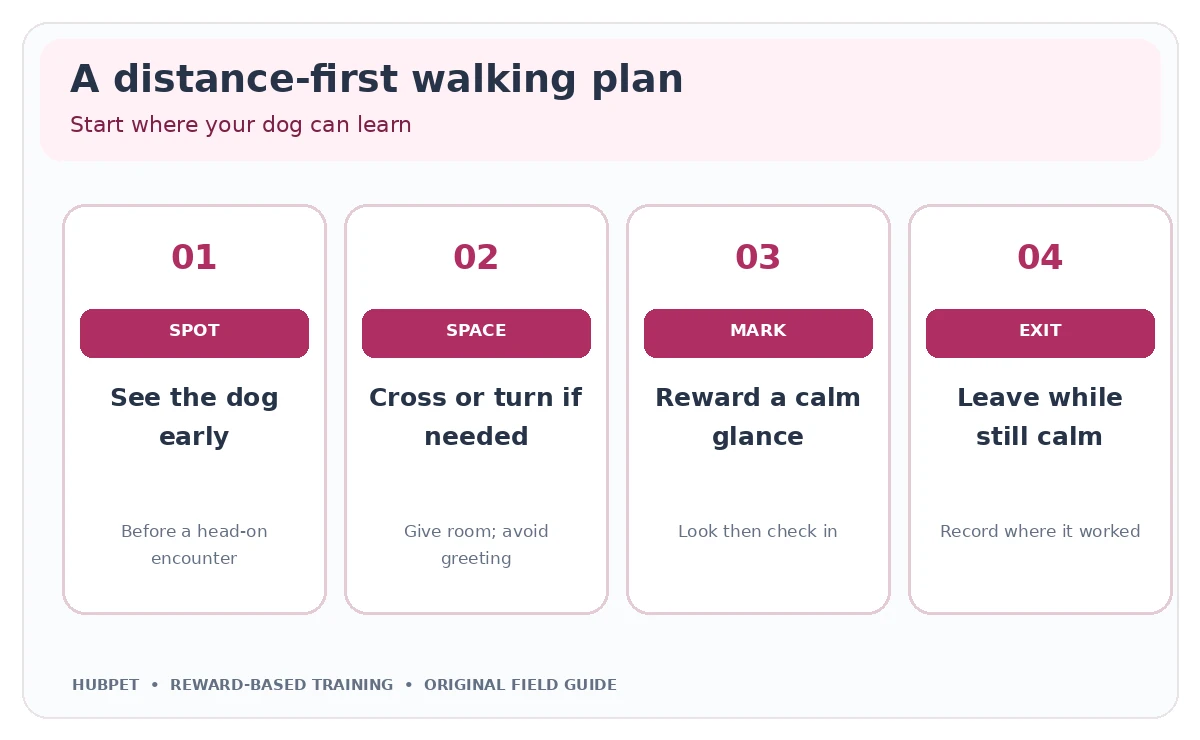
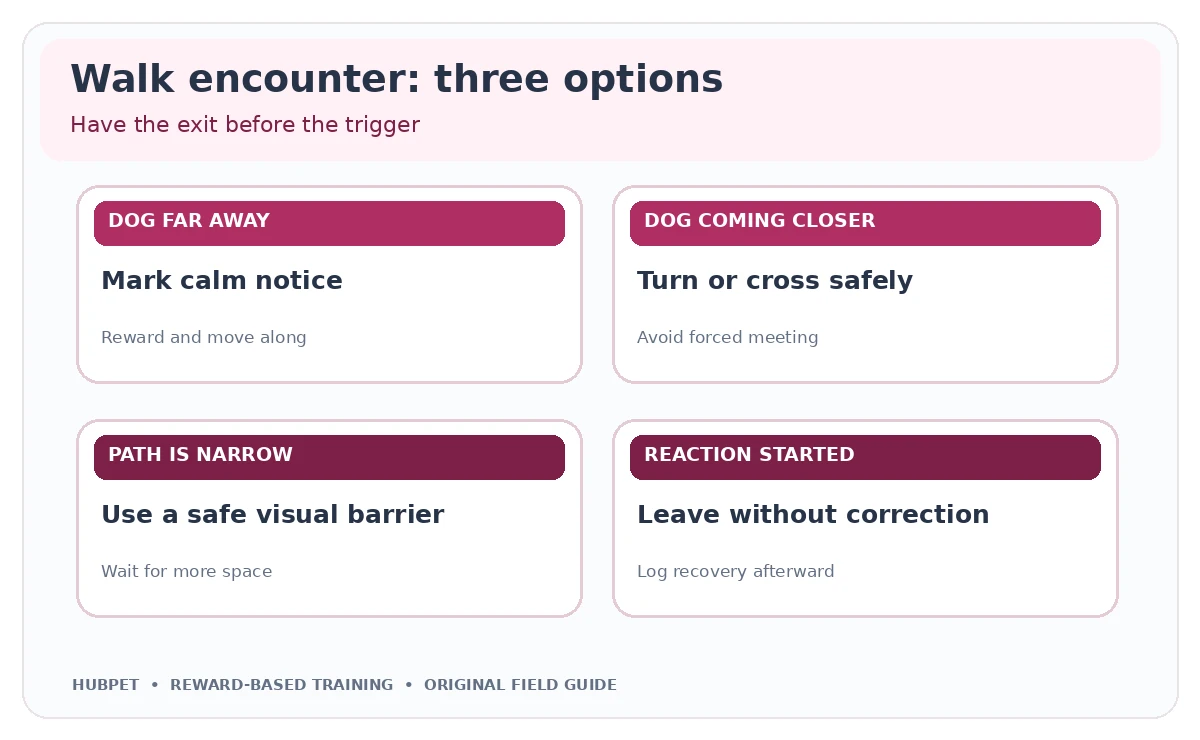
Your first job is management: notice dogs early, move across a street when safe, use a parked car as a visual screen, or calmly turn around. Do not stand still and wait for an unfamiliar dog to pass at arm’s length. A U-turn and a treat scatter in a clean, safe area can be rehearsed when no triggers are nearby, but food should not pull your dog toward an unsafe encounter.
Find the Distance Where Learning Is Possible
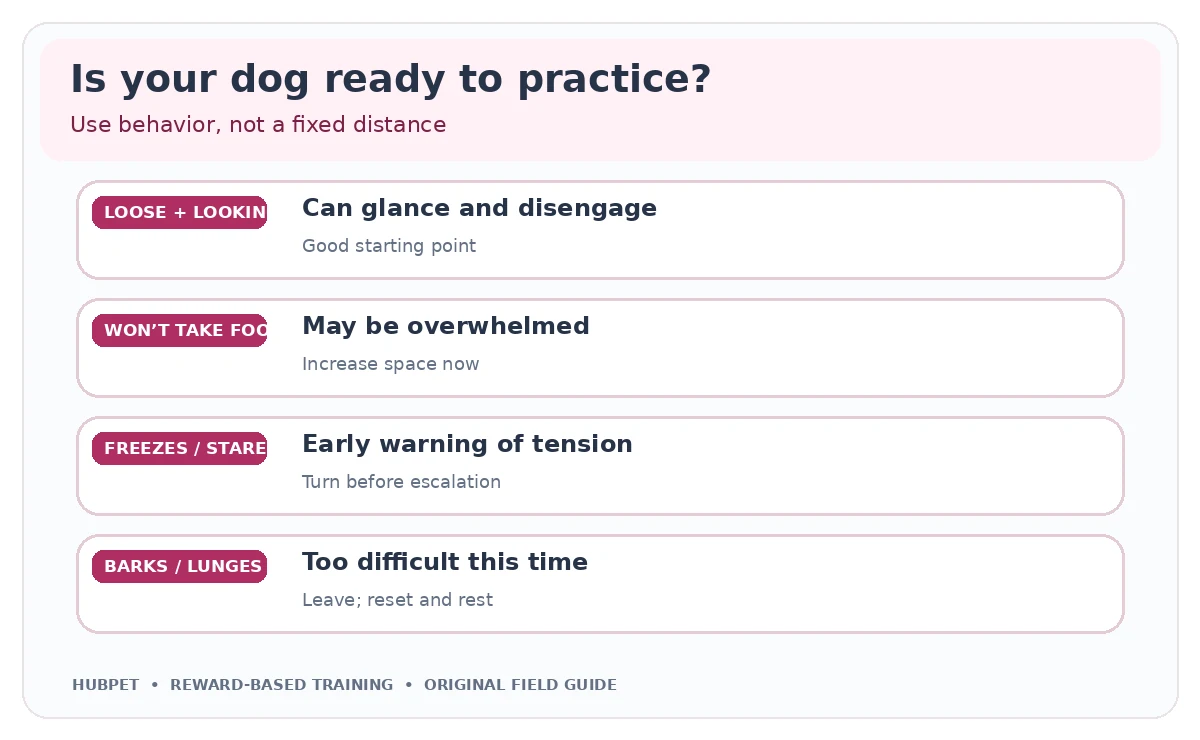
Begin far enough away that your dog can glance at the other dog and still respond to their name or take a familiar treat gently. This is a practical starting distance, not a fixed number of feet. If the dog freezes, stares without disengaging, lunges, or refuses food they normally like, you are likely too close or the scene is too intense. Increase distance promptly and keep moving.
Do not measure success by how close you can force the dogs together. If a dog can notice, turn back to you, and then sniff the ground, that is useful information. Practice on calm, predictable routes rather than near crowded dog parks. Dogs also differ in how they react to stationary dogs, fast runners, off-leash dogs, and narrow sidewalks, so log these conditions separately.
Teach Notice, Mark, Reward, and Move On
At a comfortable distance, let the dog see another dog for a moment. Mark the glance with a calm “yes,” then offer a reward back near your side. Move away or continue parallel at a distance while the leash stays loose. Practice a few successful repetitions; then end before arousal rises. This is not bribing a dog to endure a frightening close encounter.
Some dogs can learn to check in automatically when another dog appears. Others need an easier step, such as turning with you after the first look. If your dog cannot take a reward, do not insist on a sit or repeated cues. Distance is the reinforcer you can provide right away. Our distraction-training article gives another layer of foundation skills for easier settings.
Practice With Predictable Rehearsals
For early practice, arrange to watch a calm, well-managed dog at a long distance in an open area, ideally with a qualified reward-based trainer supervising. Work in short passes, not an uncontrolled meet-and-greet. Change one element at a time: a slightly nearer starting point or a little more motion, not both. Have an agreed escape route and stop if either dog looks uncomfortable.
Outside arranged sessions, every walk is an opportunity to avoid rehearsal of explosive barking. That may mean turning around more often than you planned. It is not a setback to prevent a reaction. When your dog can repeatedly look and disengage with loose posture, you can test one modest increase in difficulty, returning to easier distances if tension appears.
Know What to Do if a Reaction Starts
If your dog barks or lunges, avoid scolding, leash corrections, or forcing eye contact. Keep a secure hold, create physical space, and calmly leave the scene. If you cannot move, use a barrier such as a vehicle or hedge where safe and wait for space to open. Do not offer treats in a way that invites approaching the other dog. Keep your own body out of potential bite paths.
Once your dog recovers, take a real break instead of immediately restarting closer to the trigger. Write down how far away the other dog was, whether the path was narrow, and which warning signals came first. Look for signs of pain or an abrupt change in behavior; medical discomfort can lower tolerance, so a veterinary assessment may be appropriate.
Measure Progress Without a Rushed Result
For two weeks, track a few comparable walks: approximate trigger distance, number of easy check-ins, reactions, recovery time, and overall comfort. A useful improvement is being able to pass dogs with more space and less distress, not completing greetings. Some dogs will never enjoy close approaches to unfamiliar dogs; that boundary can be respected.
If your dog repeatedly lunges, tries to bite, panics, or cannot stay under threshold even at generous distances, pause self-directed exposure work. Ask a veterinarian and qualified behavior professional for an individual plan. AVSAB recommends reward-based methods and discourages punishment tools. Longer-term goals should protect both dogs and everyone on the path.
How We Research
We reviewed the linked veterinary and animal-behavior resources on October 26, 2026, separating published guidance from our practical at-home examples. See the HubPet editorial approach. We checked each recommended response against animal welfare, ordinary owner safety, and situations requiring veterinary or professional assessment. We created original teaching diagrams and observation tools; they are not diagnostic instruments or clinical trial data. Dogs differ in temperament, age, and history; the material is educational, not an individual assessment.
Sources
American Kennel Club: Understanding why dogs lunge and bark on leash. Reviewed October 26, 2026.
American Kennel Club: Use distance before progressing with leash-reactive dogs. Reviewed October 26, 2026.
American Veterinary Society of Animal Behavior: Humane dog training position statement and clarification. Reviewed October 26, 2026.
VCA Animal Hospitals: How to recognize canine stress and the value of context. Reviewed October 26, 2026.
No. Forced greetings can intensify fear or frustration and create risk. Practice noticing from a workable distance and let the dog disengage; greetings are not required for successful walks.
Move farther away or leave the situation. Refusing a familiar reward can indicate high arousal, fear, or a competing need. Training is unlikely to be productive while the dog is overwhelmed.
Not necessarily. Fear, excitement, and blocked access can look similar. Observe the whole body and situation, and seek qualified help if lunging, attempted biting, or extreme distress occurs.
Avoid leash jerks and other punishment. Securely manage distance, leave safely, and reward calm choices during easier rehearsals. Aversive corrections can increase distress or suppress important warning signals.
There is no universal distance. Start where your dog can notice the other dog without freezing, barking, or losing the ability to disengage. Increase space immediately if tension rises.