
This article offers general grooming and household safety information, not veterinary diagnosis or treatment. Stop when a pet is frightened or in pain; contact a veterinarian about bleeding, swelling, embedded or torn claws, or sudden changes in movement. Read our veterinary disclaimer.
How often to trim dog nails depends on growth, wear, activity, and the individual paws you are checking. A dog that walks often on rough sidewalks may wear some nails faster than a dog that mostly plays on grass or rugs. Dewclaws can be long even when the ground-contact nails seem fine. VCA describes a roughly monthly interval for many dogs but also explains that frequency varies. Instead of setting a universal appointment and forgetting about the paws, build a simple visual check and an adjustable record. This guide is for routine nail care; an injured or embedded nail needs professional assessment.
Use a calendar as a reminder, not a guarantee
Choose a recurring day to look at your dog’s paws, perhaps during a weekly grooming check. A scheduled reminder only tells you when to inspect, not whether every nail needs trimming. Compare the paws in their ordinary standing position, on a level nonslip floor. If nails are getting longer and making contact, plan appropriate maintenance. If the nails are comfortably clear and the dog is moving normally, record the condition and recheck later. This approach avoids cutting simply because a phone alarm sounded. Note whether the last session involved a clipper, grinder, or professional so you understand which routine your dog tolerated.
Watch for ground contact and repeated clicking
VCA and ASPCA list ground contact and clicking on hard floors as useful signs. Stand beside your dog and look at the toe from the side. Observe a few ordinary steps rather than making the dog pace back and forth for a test. A quiet walk on carpet does not rule out overgrowth. Conversely, clicking alone cannot diagnose pain or tell you where the quick ends. Use it as a prompt to inspect, not a reason for a deep cut. If the dog is limping, slips unusually, or shows a sudden change in gait, ask your veterinarian for guidance before assuming nail length is the only cause.

Account for pavement, grass, and indoor routines
Hard, abrasive walking surfaces may file some nail tips naturally, while grass and soft ground usually provide less wear. That does not mean you should force long walks on rough pavement to shorten nails. Protect the dog from hot ground, harsh salt, or joint strain. Indoor dogs may need closer observation as wear changes, particularly after a schedule change or during a period of reduced mobility. Record the usual mix of walks rather than trying to calculate a fixed trimming interval from miles. The front and back paws may wear differently, so inspect all of them. An active dog can still have long dewclaws.
Check dewclaws every time
Dewclaws sit higher than the main walking nails, so their ends may never contact the ground. They can curl or catch even when your dog has a healthy walking routine. Look at each dewclaw without pulling the leg into a painful angle. If one appears to grow into skin, if a toe swells, or if the dog cries when the area is approached, stop and contact a veterinarian. Include dewclaw status in the same simple log as the other nails. Never assume a dog’s rear paws have no dewclaws; anatomy varies. A quick visual check takes less effort than dealing with an overlooked snagged claw later.
Look for changes in age, activity, and comfort
A dog recovering from illness, walking less in winter, or entering senior years may need a different nail-care interval than before. Likewise, new pavement walks can change wear without changing growth. Avoid turning age alone into a rule: assess the real nails and movement. If your dog resists paw handling or suddenly avoids steps, ask the veterinary team whether your dog might have pain. Do not force repeated paw checks when your dog shows distress. Use gradual cooperative-care practice and a steady nonslip surface. The goal is a comfortable, realistic maintenance schedule, not perfect compliance with a generic chart.

Compare surface wear with actual nail length
A visual comparison helps more than a calendar-only rule. One scene can show a dog walking on a sidewalk with modest natural nail wear. Another can show a mostly indoor dog on a soft rug with visibly longer hooked nail tips. Neither scene proves that a particular dog needs a trim every set number of weeks. The important feature is the nail itself: whether it touches the ground, curls, snags, or changes from the last check. Include a separate dewclaw drawing because that nail may not wear down. Keep all illustrations descriptive rather than presenting a risky deep cut as the solution.
Create a personal interval with simple notes
Write down the inspection date, which paws looked long, any clicking heard, and which nails you actually trimmed. After a few checks, you may notice that some claws need maintenance more frequently than others. VCA cites roughly monthly trims for many dogs, but your observations and professional advice should determine the plan. Do not shorten the interval so much that every check becomes an unpleasant battle. If a tool causes distress, work on voluntary paw handling between necessary professional visits. A quick photo taken at the same standing angle can show gradual change without trying to measure the living quick by appearance alone.
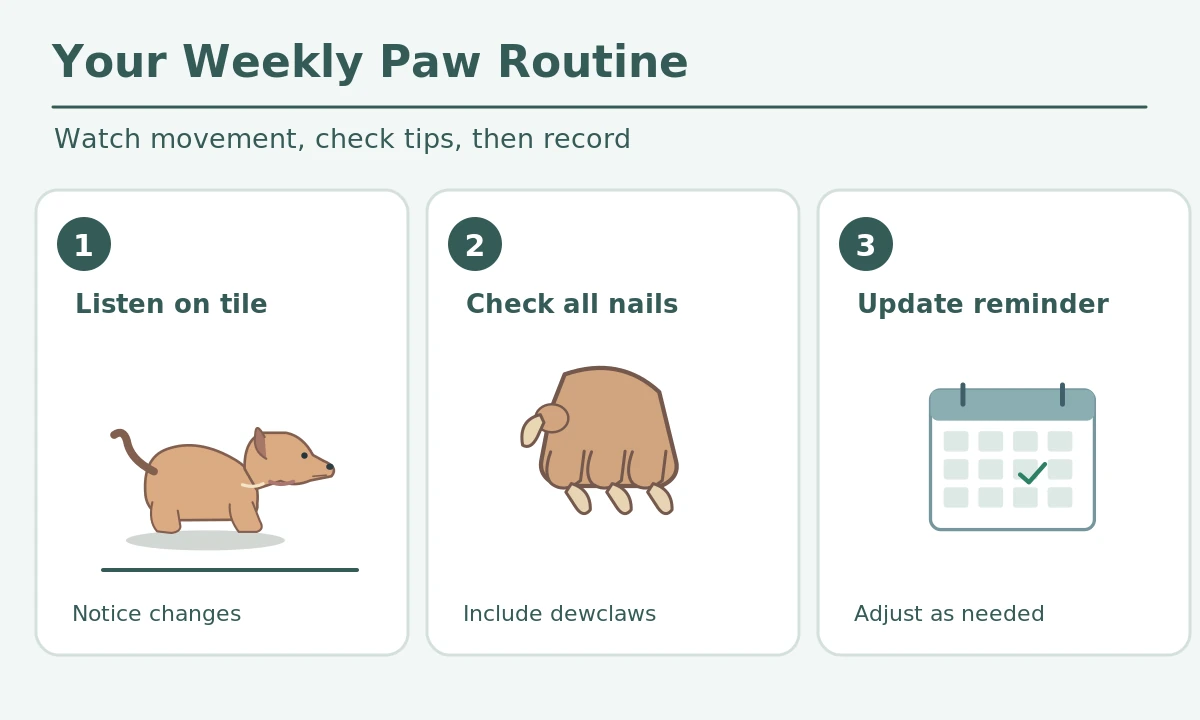
Follow a three-step weekly paw routine
First, watch your dog take a few ordinary steps on safe flooring and note repeated clicking or changes in movement. Second, inspect nail tips and dewclaws on a nonslip surface, allowing the dog to shift or leave when needed. Third, decide what is appropriate: document and recheck, perform only an ordinary conservative trim when you know the anatomy, or book a professional appointment for difficult or painful nails. Reward calm participation and keep the tool away if the dog is fearful. Contact a veterinarian for bleeding, a broken nail, pad penetration, swelling, or lameness. A flexible schedule works only when you respond to what you actually see.
How We Research
We compared original veterinary and animal-welfare information from VCA Animal Hospitals, ASPCA. We checked the difference between ordinary maintenance and signs requiring individual care, and focused on visible, repeatable checks rather than unverified product claims or fixed cut depths. The drawings are general explanations, not veterinary measurements or hands-on equipment tests. The instructions do not replace a veterinarian or experienced groomer showing the technique on your own pet. Learn more about our approach at About HubPet.
Sources
VCA Animal Hospitals, How to Trim a Dog’s Nails at Home. Read the original guidance.
ASPCA, Dog Grooming Tips. Read the original guidance.
VCA Animal Hospitals, Handling Exercises for Trimming Nails and Brushing Teeth. Read the original guidance.
Safety note: An embedded or torn nail, significant bleeding, a painful or swollen toe, or marked changes in walking warrants veterinary help. Do not restrain a distressed animal to finish grooming or guess where the quick ends. A professional can demonstrate safe positioning and individual next steps.
No. Roughly monthly is common guidance, but growth, surface wear, activity, and the condition of each nail change the interval.
Some walking nails may wear down on rough surfaces, but not always. Inspect the tips and dewclaws instead of relying on walks alone.
Repeated clicking is a cue to check length and ground contact. It does not show where the quick lies or justify a large cut.
Not necessarily. Age, movement, confidence with handling, and individual nail wear all affect the appropriate routine.
Practice brief, reward-based paw handling and stop when distress appears. Seek professional nail care if maintenance is needed before training progresses.