
A long, open-plan room boundary needs more than a gate with an impressive maximum width: panel geometry and anchor points determine whether the barrier stays stable. This practical guide separates a gate’s physical limits from the dog’s behavior. Check the installation instructions for your exact model before relying on a barrier.
First sketch the room you actually have
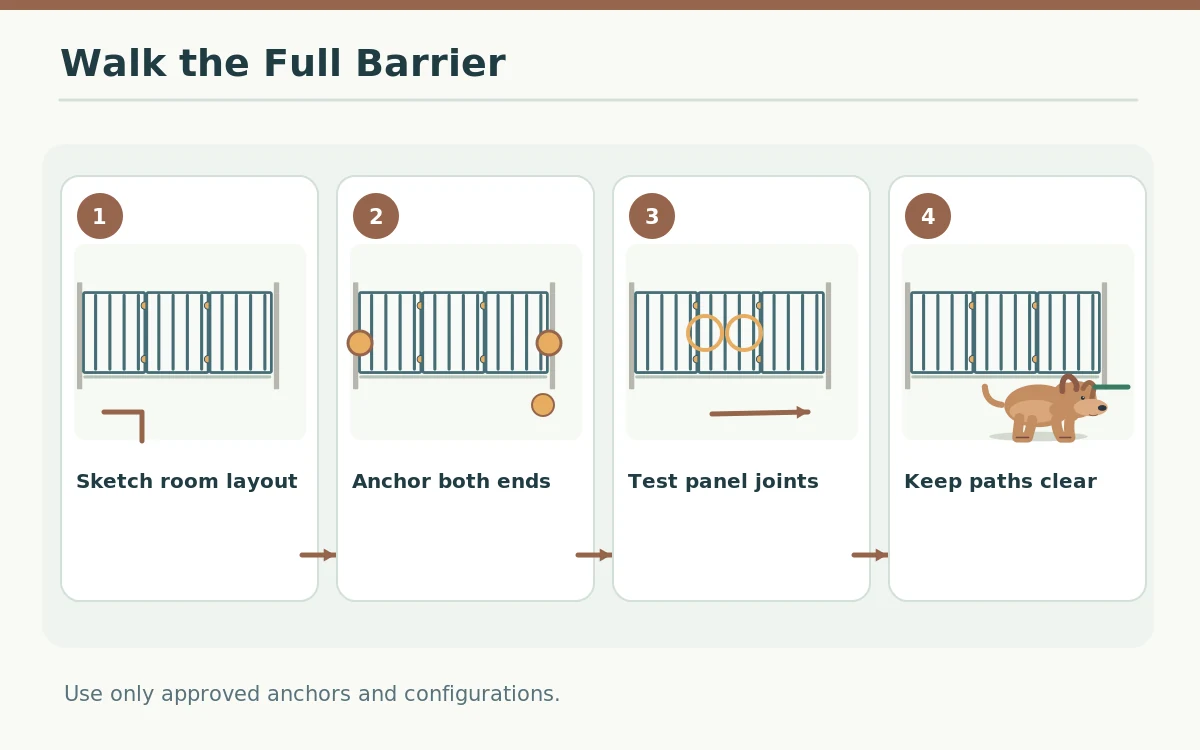
Measure the straight-line distance between usable anchor surfaces, but also mark door swings, vents, radiator edges, and furniture. An extra-wide gate may need several hinged panels to make a turn rather than a single unsupported straight run. Without approved anchors or supports, a long room divider may fold or tip when a dog leans on it. Draw the dog side and the human side before choosing a product. The useful dimension is the configuration the manufacturer supports, not simply the largest number printed on the box.
Decide between fixed and articulated panels
Some wide gates use solid extensions in one frame; others connect individual panels with hinges. Fixed extensions can suit a broad doorway when the mounting method matches the supports. Articulated panels allow L or U shapes around a room corner, but their joints introduce directions of possible movement. Inspect the hinge locks, angles permitted by the maker, and how the end brackets take load. A straight arrangement can wobble if it lacks side anchoring. Do not add universal panels from another brand unless the maker documents exact compatibility.
Check anchors before counting panels
Find solid attachment points at both ends; drywall alone may not hold fasteners that must enter framing or another suitable structural substrate. Use manufacturer-approved anchors and hardware suited to the actual wall. Where studs, columns, or banister posts do not line up, choose an engineered mounting kit or change the gate position. Avoid improvised cable ties, bookshelves, or adhesive-only hooks as primary anchors. A gate that seems stable when untouched may fail when a dog leans on a middle panel. Plan secure human access to the room before drilling.

Understand the trade-off of long spans
As a barrier gets longer, the center has more opportunity to sway if connections are loose or the panel layout is flat. An angled configuration with proper anchors may resist motion better than a long unsupported line, but only within the maker’s approved layouts. Check every connector while the barrier is standing. If the panels bow or creep when gently pressed, stop and revise the placement. For athletic dogs, a tall panel can still invite jumping if nearby furniture creates a launch point. No generic panel count guarantees containment for all animals.
Keep the walk-through path truly usable
For a daily household route, look for an integrated walk-through section with an easy-to-check latch. Place it where the person can stand safely on both sides rather than opening into a chair, a staircase, or a pet bed. People often leave an awkward gate unlatched. Evaluate threshold rails as potential trip hazards and consider access for people carrying laundry or assisting a senior dog. If visitors cannot understand the closure, attach a simple household reminder outside the gate. Never obstruct a required emergency exit or accessible escape route.

Set up two calm zones, not a social standoff
A gate between household dogs can prevent direct contact while they settle into a routine, but dogs can still bark, stare, guard toys, or snap through open bars. Arrange beds, food, and favorite chews away from the shared boundary. Supervise interactions and move the dogs back if they stiffen or repeatedly rush the panels. For introductions, brief sessions and more distance are often more useful than keeping animals face to face for hours. A barrier cannot replace behavioral assessment when conflict is serious.
Test the entire span, not just the latch
After installation, walk along both sides and examine each connection, foot, and anchor. Gently press the center, corners, and latch panel to find rocking, slipping, or unexpected folding. Check that a paw or muzzle cannot fit into a moving hinge gap. Repeat the test after relocating furniture, cleaning, or adjusting panel angles. Do not test strength by driving an excited dog into the gate. If the span moves in normal human checks, do not use it as a containment boundary until corrected.
Know when an open-plan divider is not enough
A determined jumper, chronic chewer, or fearful dog may need a closed door, a properly sized room, or individualized training instead of a long partition. Do not use an indoor wide gate outdoors unless the manufacturer explicitly rates it for weather and the intended location. Keep small children out of any setup that relies on pet-specific hardware for their protection. If the home has unusually shaped openings or risky drop-offs, consult the product manufacturer or a qualified installer. Safety begins with a stable structure and a reasonable expectation of how the dog behaves.
How We Research
We compared animal-welfare, pet-home and safety-gate guidance, then translated it into specific measurement, installation, and observation checks for extra-wide dog gates. We did not perform laboratory impact or restraint testing and do not certify any gate model. Manufacturer instructions control fit, installation, extensions, and indoor/outdoor rating. Pet-gate marketing tells you nothing about child-safety compliance. Sources reviewed October 28, 2026. See About HubPet for our editorial approach.
Sources
American Kennel Club, Dog Gates 101: Choosing the Right Dog Gate for Your Home. Read source. Accessed October 28, 2026.
American Kennel Club, Dog Gates for Every Dog and Any Home. Read source. Accessed October 28, 2026.
Consumer Reports, Safety Gates Buying Guide. Read source. Accessed October 28, 2026.
RSPCA Doncaster and Rotherham, How to Have a Successful Dog Introduction. Read source. Accessed October 28, 2026.
Safety note: This guide is general product-selection and pet-care information, not a claim that a gate can contain every animal or protect a child. Follow location-specific mounting instructions; stop using any gate that slips, breaks, or traps paws. Seek individualized help for significant canine distress or escape behavior. General pet health concerns are covered in our veterinary disclaimer.
Only if the manufacturer explicitly approves that combination. Improvised links can create weak or trapping points.
Only when the approved layout and anchors support a straight span without sway or tipping.
Use the mounting method specified for your wall and product, including structural anchors where required.
It may prevent contact, but animals can still react through a gate. Supervise and increase distance when tension appears.
Inspect both end mounts, each hinge and foot, the latch, and the middle of the span for movement.