
Enzyme cleaners for pet stains can help break down specific organic residues, but the words enzymatic and odor eliminator are not proof of performance. Formula, contamination depth, contact time, and the material underneath a stain all matter. A single spray on carpet can miss urine that already soaked into the padding. See the HubPet veterinary disclaimer for health and safety limits.
Use this guide to compare labels and match products to a known stain. It explains why blotting and rinsing come before treatment, when an enzyme product may be unsuitable, and how to evaluate an odor that returns. Keep pets away from all cleaning products while you work.
Start with the type and age of the stain
Fresh urine calls for removing liquid promptly. Feces and vomit require careful collection before any stain treatment. Old accidents can leave residues through carpet, upholstery foam, or porous wood. A general cleaning spray may move visible dirt without addressing a persistent odor.
Note whether the contamination is fresh, dry, repeated, or already treated with another chemical. These distinctions affect what a new product can reach. A surface can also appear yellow for reasons unrelated to pet waste. If you cannot identify the stain, avoid strong chemistry experiments.
Read the exact enzyme and surface claims
Some formulations name enzymes that act on certain soils; others use broad descriptions such as bio-enzymatic. Neither wording guarantees a particular result. Look for directions naming urine, feces, upholstery, washable textiles, or other intended surfaces, rather than inferring approval from packaging colors.
Check whether the manufacturer specifies carpets, natural fibers, sealed floors, or soft furnishings. Follow any restrictions concerning wool, silk, leather, suede, wood finish, or painted surfaces. The most useful label explains application, contact time, removal method, storage, and what you should avoid mixing with it.
Understand why contact time matters
Enzyme-based products need the conditions and time stated on the label. A mist that dries before reaching buried residue may not do much. By contrast, soaking a cushion until its core stays wet can create a moisture problem of its own.
Use the permitted quantity and keep the treated area undisturbed for the specified interval. Do not add extra solution to force better results. Before reuse, complete the manufacturer’s cleaning and drying steps. Never assume the word enzyme makes a product safe for direct contact with skin or paws.
Prepare the area without interfering with treatment
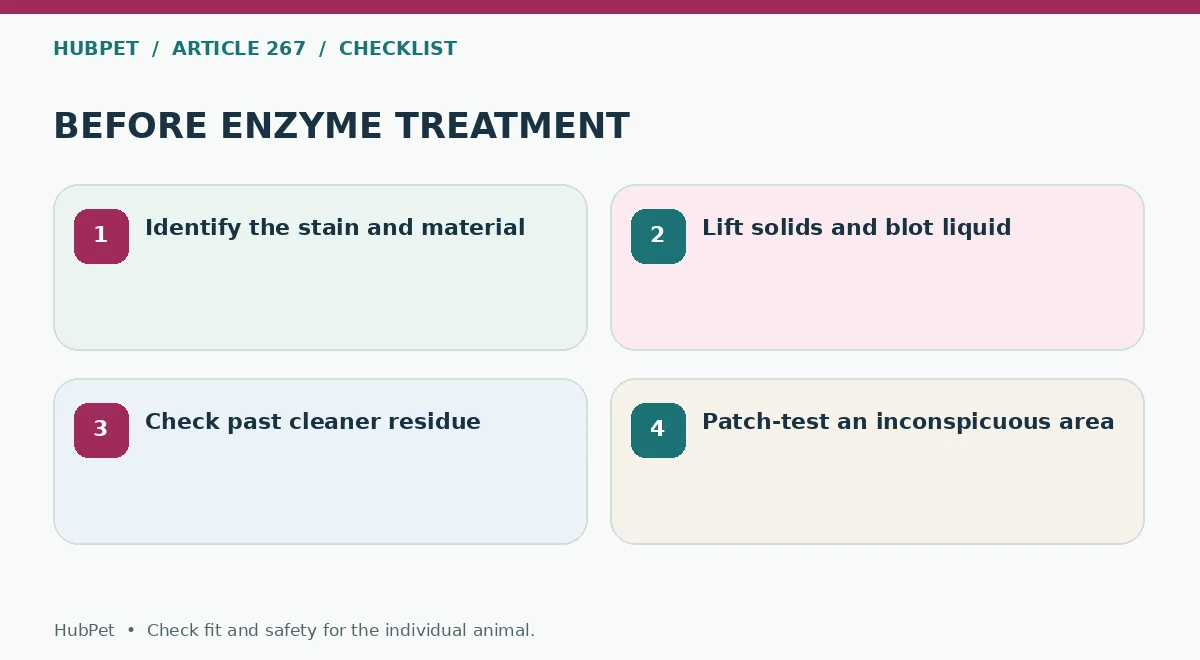
Pick up solids and blot excess liquid first. For fresh stains, Humane World recommends blotting rather than rubbing, followed by controlled cool-water cleaning when appropriate. Previous detergents can complicate a later odor treatment, so read directions about residue removal before adding another product.
Test in a concealed area and allow full drying. Watch for dye transfer, water rings, and changes in texture. Wear protection if the label requires it and keep animals outside the work zone. Good ventilation helps, but it never replaces correct dilution or reentry instructions.
Compare enzyme products with other chemistry
Oxidizing formulas and surfactant cleaners can address different stains. Consumer Reports has documented that non-enzyme formulas also perform well in specific stain tests. Therefore, enzyme chemistry alone is not a reliable score for cleaning performance across every material and mess.
Decide on the basis of stated soil type, fabric compatibility, removal steps, and independent testing when available. Oxidizers may lighten sensitive dyes or damage some surfaces. Enzyme products may require longer contact. Avoid combinations of chemical types unless the manufacturers explicitly instruct you to use them together.
Evaluate lingering odor without masking it
Fragrance can make an area smell pleasant before urine residue disappears. Choose an unscented or low-fragrance option if scents bother people or animals in your home. An odor that returns after drying suggests residual contamination, not necessarily a weak perfume.
Check the rug underside, furniture filling, and carpet pad when possible. For repeated deposits, one product may fail to reach the source. Consider professional help or material replacement. Cleaning the visible surface repeatedly cannot guarantee removal of contamination hidden deeper in the floor system.

Plan for dogs, cats, and household safety
Store all bottles where animals cannot reach them. Keep pets away during spraying, dwell time, rinsing, and drying. Follow the current label about protective equipment, ventilation, and reentry. Never let a pet lick treated upholstery or newly cleaned paws.
Avoid adding essential oils or improvised fragrances; concentrated oils can harm pets. Also, never blend stain products with household bleach or ammonia. If accidental exposure occurs, save the label and call a veterinarian or appropriate poison-control service. Do not rely on advertising words like natural to judge toxicity.
Match packaging to how you will use it
A trigger spray may work for small accessible patches. Larger bottles can be practical for repeat spot cleaning, but pouring without a measuring system risks overapplication. Foams and concentrates differ in coverage and removal instructions, so compare actual directions rather than bottle volume alone.
Review storage temperatures, shelf life, cap security, and whether the sprayer creates airborne mist. A pet household needs reliable containment. If a formula requires specialist equipment or complicated dwell conditions, a simpler compatible product may be easier to use correctly over time.
Know when stains call for more than cleaner
An animal returning to the same spot may smell residual deposits, but repeated indoor accidents can also reflect stress, training difficulties, or illness. A sudden elimination change deserves veterinary attention. Do not treat behavioral questions as a stain-cleaner defect.
With substantial soaked padding, a renter may need to involve the property owner. Record the area and cleaning attempt before applying more liquid. Professional extraction, drying assessment, or removal of affected material can sometimes provide a better resolution than repeated home treatments.

Use a realistic purchasing checklist
Verify the intended surface, named stain types, patch-test instructions, contact time, and full drying process. Check for a clear ingredient or safety-data pathway and find out whether you must rinse afterward. Match container size to a realistic frequency of use.
Ignore universal claims such as works on everything. An honest product acknowledges surfaces it cannot treat. Consider whether you can keep animals away long enough to complete the full process. Finally, address the reason for accidents while cleaning the residue, rather than expecting chemistry to change pet behavior.
How We Research
We checked this guide against the authoritative sources listed below on October 26, 2026. We reviewed practical differences, safety limits, and relevant home conditions rather than drawing conclusions from brand advertising. Specifications, warranty policies, and device capabilities change; check the manufacturer’s current manual. We did not purchase, laboratory-test, rank, or endorse individual products. Where a pet has pain, skin concerns, or fear, seek individual veterinary advice. See our approach at About HubPet.
Sources
Humane World for Animals: How to Remove Pet Stains and Odors. Accessed October 26, 2026.
Consumer Reports: Best Sprays for Tackling Pet Stains and Strong Odors. Accessed October 26, 2026.
AVMA: Household Hazards. Accessed October 26, 2026.
No. Stain removers use several chemical approaches. Compare the intended soil and surface instructions, not just whether enzymes appear on the package.
A surface application may never reach contaminated padding. Recurring odor after correct drying can mean deeper treatment or material replacement is needed.
Only when the specific label directs that contact period and permits it for the material. Excess moisture can harm carpets and upholstery.
No. Do not mix cleaning formulas unless the manufacturer explicitly instructs that combination. Unplanned chemical mixtures can create hazardous exposures.
Do not assume that. Keep cats and dogs away throughout application and the label-specified reentry period, including required rinsing and full drying.