
Pet safety note: Training advice cannot assess pain, illness, hearing, vision, or movement concerns. Ask your veterinarian about new or concerning changes and read our veterinary information disclaimer.
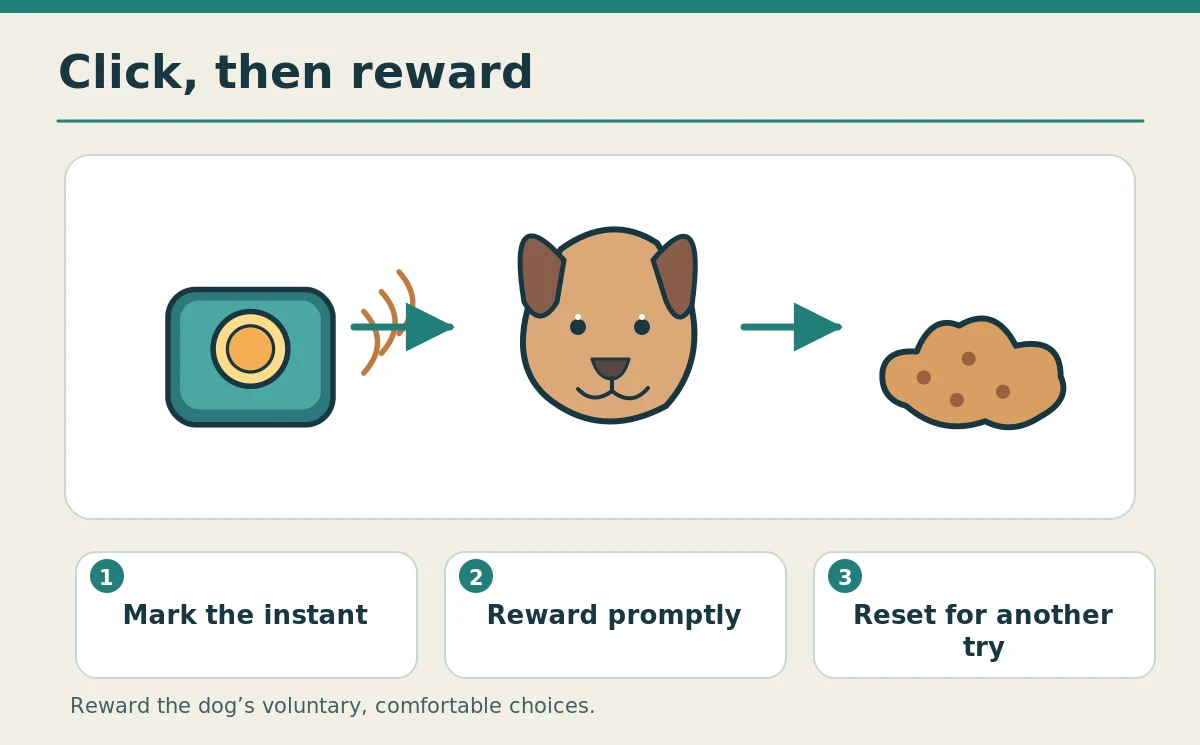
Clicker training for dogs is a method of identifying a wanted action the instant it happens and then delivering something the dog values. The short, repeatable sound makes a clear marker when your hand cannot put a reward at the exact spot in time. It is not a command, a way to interrupt barking, or a substitute for teaching a skill. A brief word such as ‘yes’ can serve the same role. Begin with one easy behavior and ask what single instant you want to reinforce before you ever press the clicker.
Select a comfortable marker and reward
Choose a clicker you can activate reliably with one hand, and test its sound away from your dog’s face. Some devices are loud in quiet rooms. If your dog startles, switch to a soft verbal marker rather than insisting on the noise. Prepare pea-sized, dog-appropriate food rewards or another small reinforcer your dog actually wants, and keep them reachable without constant rummaging. Consider treat calories as part of the daily food allowance. Everyone helping should agree that a click predicts a reward; inconsistency weakens the signal.
Build the sound–reward association first
In a low-distraction room, click once and promptly deliver a reward. Repeat short, comfortable pairings without demanding a sit or any other performance. Pause between repetitions so the marker is distinct, not a stream of background noise. The point is to teach that the sound forecasts good things, not to create a response to an invisible command. Watch your dog’s comfort: relaxed interest is useful feedback, while flinching or leaving means you should change the marker or setting. Finish before the dog becomes bored or overly excited.
Rehearse your timing without the dog
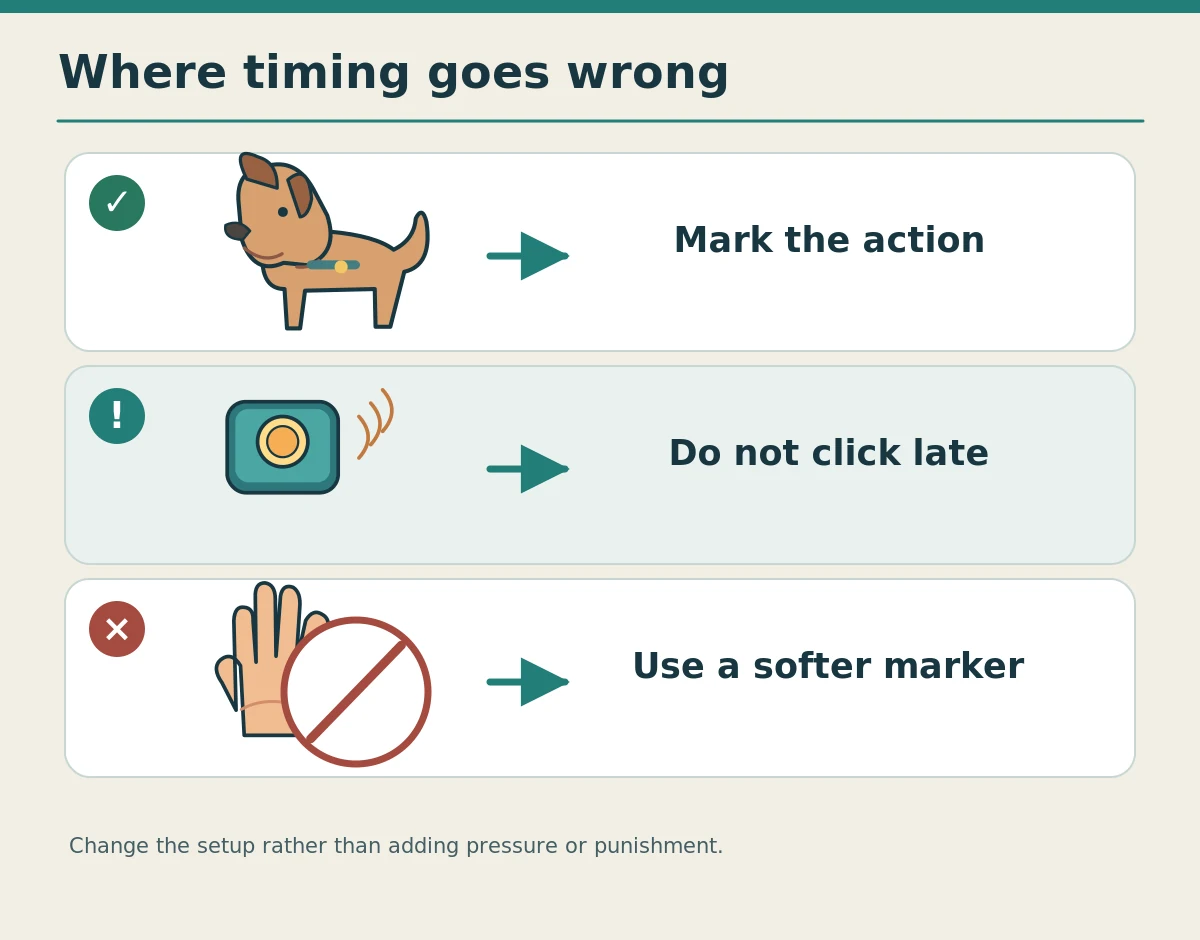
A common early error is clicking when you finally reach for the food, rather than when the wanted action occurs. Practice with a helper dropping a soft ball, and mark the instant the ball touches a safe surface. Or watch a slow-moving object and click on a predetermined moment. Then rehearse reaching for the reward only after clicking. This separates the two jobs: marking a precise behavior and paying afterward. You do not need split-second perfection, but practice helps avoid rewarding the motion that happened after the behavior you meant to capture.
Try a small, clearly observable behavior
Pick an action your dog already offers, such as glancing at your open hand, standing with four paws on the floor, or stepping toward a mat. Mark precisely when that action happens. Give the reward immediately afterward in a calm, convenient place. Avoid adding multiple verbal cues while the dog experiments. When your dog looks uncertain, mark a smaller approximation, such as turning the head toward the hand instead of requiring a full nose touch. Several easy successes teach more than repeated requests the dog cannot yet decode.
Keep delivery consistent after each click
Each click should predict a reward, even if you realize it was poorly timed. Withholding the reward after an accidental click makes the marker less trustworthy. You can make the next repetition easier and improve your timing instead. Deliver rewards in a way that sets up the next trial: for example, toss a treat gently away from the mat so your dog has an opportunity to approach again. Never click repeatedly as encouragement while the dog is struggling. One click communicates one completed moment; the food or play is the follow-through.
Separate capturing, luring, and shaping
Capturing means rewarding a behavior the dog offers without prompting. Luring uses a treat or guiding movement to introduce a position, but you should gradually hide the visible food so it does not become permanent bribery. Shaping rewards successive, achievable approximations toward a larger skill. All can work with a clicker, but changing strategies mid-session can confuse the learner. Plan a small criterion—perhaps looking toward a target—rather than chasing the finished trick. Raise difficulty only after the current step is easy in that environment.
Know what to change when learning stalls
When your dog walks away after a click, evaluate whether the reward matters, the room is too busy, or the sessions have become long. For jumping toward the treat pouch, reward a manageable calmer position and reset the food placement. A dog afraid of the sound needs a quieter marker, not repeated exposure to force adaptation. The American Veterinary Society of Animal Behavior recommends reward-based training and discourages aversive methods. Frustration is a signal to simplify, not to correct physically or become louder.
Add distractions one small piece at a time
Once the dog understands a behavior in the kitchen, try it in another quiet room before attempting a sidewalk. Keep the same easy criterion while changing location; add distance or duration later, not everything simultaneously. Mark what the dog genuinely does, not what you hope was about to happen. Outside, use a secure leash or enclosed space and a reward worth competing with mild distractions. An occasional failure is useful information that the previous step was easier. Lower the challenge and rebuild a reliable pattern.
Fade the clicker after the skill is fluent
A clicker is a teaching aid, not something you must carry forever. When a familiar behavior is reliably performed on cue in several ordinary settings, you can stop marking each instance and reinforce it with natural rewards, food, play, or praise that the dog enjoys. Use the clicker again when teaching a new detail or improving precision. Do not phase out rewards abruptly while also making the work harder. The objective is clear communication and a willing learner, not a dog that works only when a particular gadget appears.
Run a realistic five-minute practice plan
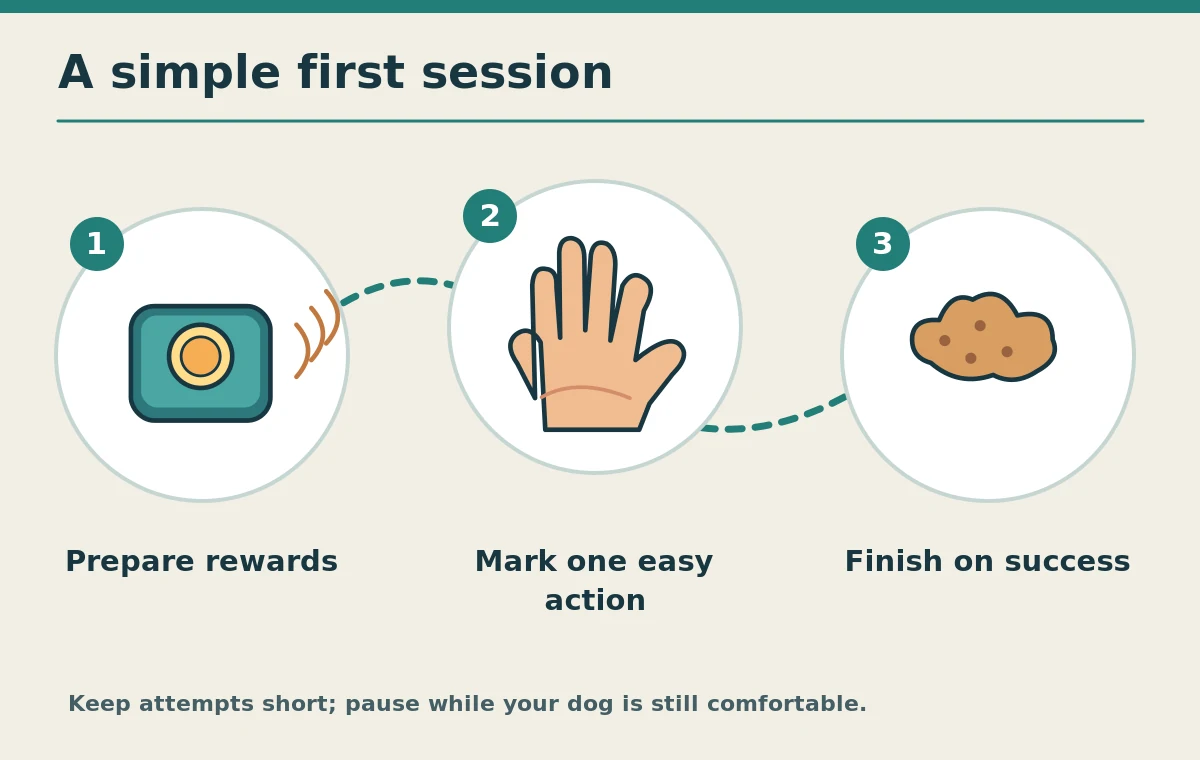
Keep a short record: name the behavior, record the easiest successful version, note your reward, and decide what single variable changes next. Start with two brief click-and-treat pairings, then mark a few naturally offered actions, pause for water or rest, and finish with an easy win. A five-minute session is only a framework; a puppy or easily aroused dog may need much shorter turns. Stop early when focus drops. Consistency across many tiny practices matters more than marathon drilling or clicking every movement the dog makes.
How We Research
We compared AVSAB guidance on humane, reward-based methods with AKC explanations of marker timing and reinforcer delivery. Our steps distinguish marker conditioning from asking for a cued behavior; we did not test or endorse any device, food brand, or learning-time guarantee. Learn more about our approach at About HubPet.
Sources
American Veterinary Society of Animal Behavior: Humane Dog Training Position Statement and 2025 clarification: Read source. Reviewed October 27, 2026.
American Kennel Club: Clicker Training Your Dog—Mark and Reward: Read source. Reviewed October 27, 2026.
American Kennel Club: Tips for Training Your Dog Using Rewards: Read source. Reviewed October 27, 2026.
No. A click is a precise marker that predicts a reward. Especially while teaching the association, follow each click with something the dog values rather than expecting the sound to be reinforcing by itself.
Yes. A short consistent word such as “yes” can act as a marker. It may be preferable when a clicker startles a sound-sensitive dog or when both hands are needed for safe handling.
Deliver the promised reward, then reset and improve your timing for the next repetition. Randomly withholding reinforcement after clicks makes the sound less dependable to your dog.
No. The clicker is not an interruption or punishment device. You can use it to mark a calmly offered alternative behavior as part of a broader reward-based plan adapted to why the barking happens.
After a specific behavior becomes reliable under ordinary conditions, you may fade the marker and keep meaningful reinforcement. Bring the marker back when teaching a new skill or refining an existing one.