
A dog feeding mat protects the surface around a meal, but a product marked waterproof or nonslip can still leak along a seam, curl at an edge, or trap food underneath. The best mat follows the actual spill pattern and lets the dog approach bowls normally. It cannot fix a medical feeding problem or an unsafe bowl; see our veterinary information disclaimer for individual health concerns.
Rather than choosing the thickest tray, start with a one-week observation of spills and foot traffic. FDA recommends cleaning food bowls after every use, and CDC explains that pet supplies require regular washing. The mat should support that routine instead of hiding mess under a textured surface.
Identify what actually lands on the floor
Different meals create different messes. Dry kibble may scatter several inches from the dish, while wet food can smear at the rim and water can pool on one side. Mark the messiest area with paper after a typical meal before estimating the useful footprint of a mat.
A mat designed for splash control may have a lip but no grip. A flat fabric pad may absorb moisture yet hold odors longer. Decide whether your main job is catching drops, stopping the bowl sliding, or simplifying wipe-down. One product does not automatically excel at all three.
Measure the whole feeding station
Set the filled bowls in their usual positions and measure the distance between them, the dog’s stepping space, and the nearby walking route. An undersized mat leaves one bowl hanging over the edge. An oversized sheet can create a trip point near a doorway.
Leave room to lift dishes without tipping them over the raised edge. If your dog walks around the dishes, make sure the surrounding floor remains stable. A mat that makes the station awkward is unlikely to help, regardless of the advertised dimensions.

Test grip on your actual flooring
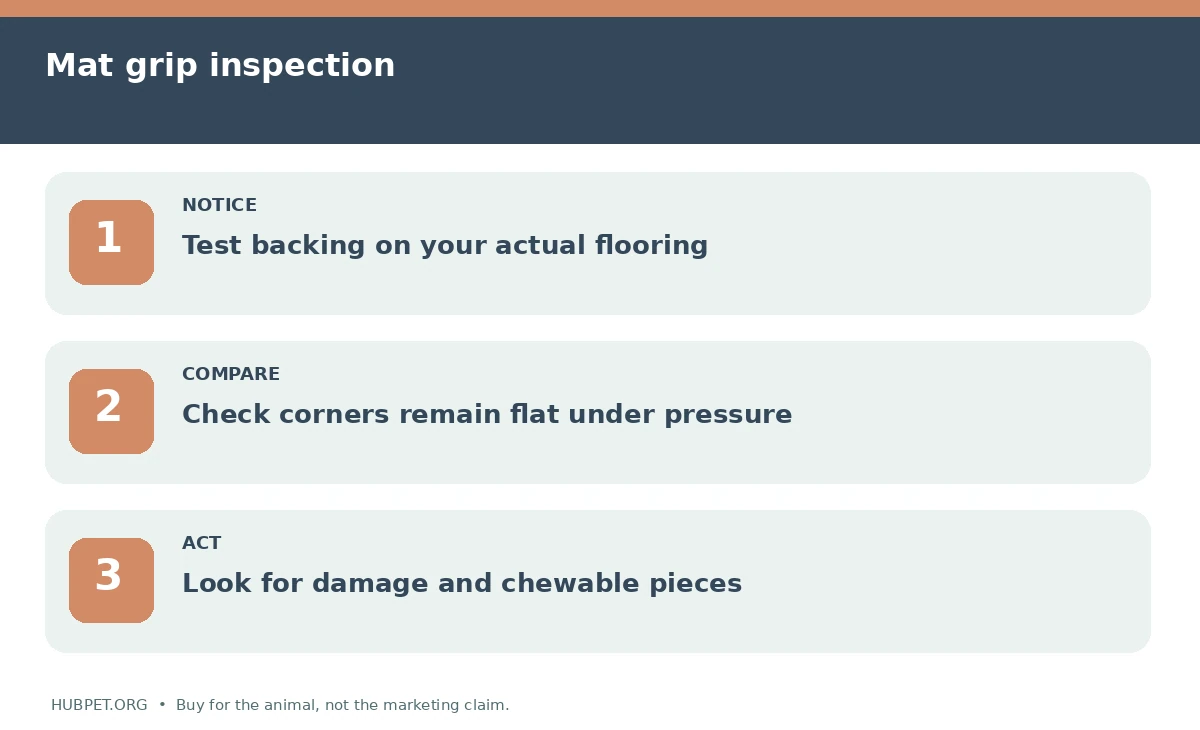
The same backing may hold on tile yet slip on smooth vinyl, wood, or a textured kitchen floor. Check the manufacturer’s flooring restrictions, especially for rubber-like pads on delicate finishes. Test an empty mat by applying gentle pressure in several directions; the edges should remain flat.
Do not glue down a feeding mat with unknown adhesives. Lift it periodically to check for moisture or discoloration underneath. If a heavy dog repeatedly drags the mat with the bowl, address bowl stability directly rather than relying on more aggressive texture.
Compare rim height and usable area
A low raised border can hold a small puddle, but very high walls may interfere with large bowls or stepping paws. Measure the flat interior space, not only the outside dimensions. Check whether liquid can pass through a seam, drain opening, or textured joint before accepting waterproof claims.
Scoop up any spill promptly. A deep tray may appear tidy while harboring stale food behind the bowls. For a dog with limited mobility, keep any border outside the walking route. Comfortable access comes before maximum containment.
Pick a surface you can truly scrub
Ribbed mats can catch crumbs but require extra brushing. Flexible silicone-style surfaces may rinse easily but can retain lint. Cloth mats may run through a washing machine, yet damp fabric needs thorough drying before reuse. Check care labels rather than assuming every surface tolerates high heat.
Inspect seams and embossed lettering after wet meals. These are common residue traps, especially near bowl feet. A washable flat mat can outperform a complicated tray in a busy household simply because its owner actually cleans it after meals.
Watch for chewing and curling hazards
Some dogs pull at loose corners after eating. A curled edge creates a trip hazard; bitten rubber or foam can become a swallowed foreign body. Discontinue use if the mat breaks apart or if the dog repeatedly tries to eat it. Do not count a feeding mat as a chew toy.
Check underside coatings, detached nonslip dots, and frayed stitched borders weekly. Put the mat away during cleaning or whenever a dog is unattended and inclined to chew household items. A simpler bare-floor setup is preferable to an attractive but hazardous accessory.
Clean bowls and mats as separate jobs
Lift every bowl before cleaning the mat. Wash food dishes after each use and clean the underlying surface when spills happen. CDC recommends soap and water as the foundation for cleaning and additional disinfection in specific higher-risk situations.
Follow each product’s cleaning label and keep pets away from wet disinfectants. Dry the mat, its underside, and the floor before resetting the dishes. Never rely on a fragrance spray to cover an unclean feeding area.
Test a new mat for seven ordinary meals
Keep the same bowls and food portions, then record how far food spreads, whether dishes slide, and how long cleanup takes. Photograph the same floor area after several typical meals. A well-fitting mat should make cleanup easier without changing where or how the dog feels comfortable eating.
If your dog hesitates at the mat or avoids the station, remove the accessory and restore the prior arrangement. If new mess accompanies drooling, swallowing trouble, or a sudden eating change, a veterinarian should evaluate the dog instead of another purchase.

Decide whether a mat is worth buying
Choose the simplest surface that lies flat, grips your floor, catches the observed mess, and tolerates complete washing. Look at replacement cost if the edges eventually fray or the backing loses grip. Store the mat flat where possible rather than folding it against the manufacturer’s directions.
A stable bowl and consistent cleaning routine may already solve most of the mess. Make the purchase only if it reduces effort while preserving safe access. Do not trade an easy-to-clean floor for a hidden layer of trapped moisture.
How We Research
HubPet reviewed published veterinary, animal-welfare, and public-health guidance relevant to dog feeding mat. We separated established safety and hygiene recommendations from product features that have not been independently measured. These are desk-researched criteria, not hands-on product tests or professional endorsements. Sources were checked October 26, 2026. See About HubPet and our editorial approach. This information does not replace individualized veterinary care.
Sources
U.S. Food and Drug Administration: Proper Storage of Pet Food and Treats. Accessed October 26, 2026.
U.S. Food and Drug Administration: Tips for Safe Handling of Pet Food and Treats. Accessed October 26, 2026.
Centers for Disease Control and Prevention: Cleaning and Disinfecting Pet Supplies (2026). Accessed October 26, 2026.
No. A mat catches only the food or water that lands within its usable area, and seams can leak.
Not necessarily. Compare floor grip, care labels, residue traps, and your actual spill pattern.
Only if it gives both bowls stable support without blocking your dog’s approach or creating a trip edge.
Clean it when meals or water spill, and inspect underneath regularly; wash feeding dishes after each use.
Remove it and choose an alternative that does not leave loose swallowable pieces.