
This article is general information, not veterinary advice. If your pet seems unwell, is in pain or may have eaten something harmful, contact your vet or an animal poison control line right away. Read our vet disclaimer. Long line training dog recall is a way to rehearse coming back in an open space while your dog remains connected to you. A fixed training line offers more exploring distance than a normal walking lead, but it is not a hands-off safety net and it is not appropriate everywhere. A dog can accelerate quickly into the end of a line, trip someone, or snag on a fence. Use a properly fitted back-clip body harness, a genuinely clear area and calm, reward-based practice. The skill you are building is responding to a cue; the line is a temporary management tool.
Short answer: start with only as much line as you can manage, even if you bought a longer one. Use two hands, gather slack into loose loops, reward every successful return and release your dog to sniff again. Do not connect a long line to a head halter or dog’s neck collar, wrap it around yourself, or attempt a sudden stop of a full-speed dog.
Pick the line length by space, not by ambition
A 10-foot line can help a beginner learn the feel of slack and recall timing in a relatively small clear area. Fifteen or twenty feet provides more distance once handling is reliable. Thirty or fifty feet can be awkward and risky in areas with people, poles or dogs crossing paths. Battersea notes that long lines are available over a wide range of lengths and should match both the dog and the handler. A heavy rope can drag on a tiny dog; a thin, fast-moving cord can burn hands. Choose a manageable flat line and an attachment compatible with the harness.
| Line length | Appropriate starting use | Safety question |
|---|---|---|
| 6 ft | Everyday leash walking, not long-distance recall | Can dog still practice a close return? |
| 10 ft | Early recall practice in quiet open ground | Can you collect slack without a tangle? |
| 15–20 ft | Gradual distance and distractions | Is the full area clear of people and obstacles? |
| 30 ft | Experienced open-field work | Can you prevent a fast end-of-line hit? |
| 50 ft | Specialized training in very large clear space | Would shorter line be safer today? |
Set up the dog and the handler for a loose line
Attach the clip to the back ring of a secure body harness. This reduces the risk of loading the neck if a dog unexpectedly reaches the limit. Run the line through your hands without knots, twists or damage. Hold it in two hands: one hand manages the dog-facing length and the other contains the remaining loose folds. Never wind it around wrist, fingers or waist. Manage distance gradually as the dog moves instead of opening the full length immediately. Keep a clear escape-free margin from roads and drop the difficulty if other people or animals enter the training area.
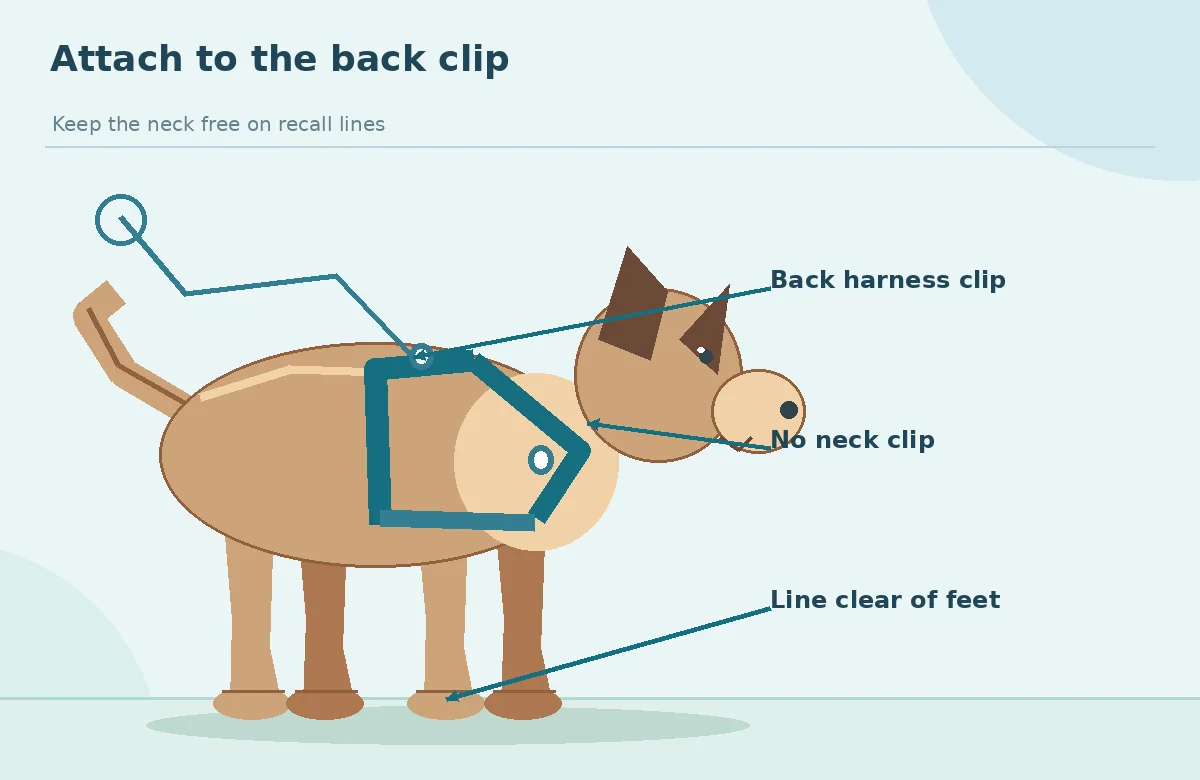
Start in a securely enclosed or otherwise appropriate spacious area where local leash rules allow your chosen length. Plan where the dog will run and where the line might catch; trees, benches, posts and people create hazards. Keep the line behind and to the side rather than under the dog’s feet. If the dog becomes tangled, calmly ask for a pause or scatter treats nearby to encourage stillness while you untangle rather than pulling. A helpful complementary foundation is HubPet’s come-when-called article.
Teach a recall the dog wants to repeat
- Begin close: say the recall cue once when the dog is already likely to respond; reward the return promptly.
- Let the dog sniff again after the reward so coming back does not always end exploration.
- Give a few feet of additional line only after several calm, easy successes.
- When attention is elsewhere, reduce distance or distractions rather than repeating the cue louder or reeling the dog in.
- End the session while the dog is succeeding; gather the line before returning to a crowded path.

Your first goal is not a dramatic fifty-foot recall. A dog who voluntarily turns from an ordinary scent at ten feet has practiced an important skill. If recall fails, do not punish or drag the dog toward you. Lower your difficulty: call from a shorter distance, use a more valuable food reward, or move to a calmer area. When the dog returns, reinforce and sometimes send the dog back to sniff so the cue remains a good deal. Positive reinforcement dog training explains why consequences and timing matter more than force.
Read the line and the situation before making a call
| Situation | Safer move | Do not |
|---|---|---|
| Line starts wrapping around a leg | Ask for pause and untangle without pulling | Pull tight while dog runs |
| Dog stares at a distant dog | Shorten working distance early; move away | Allow a full-speed lunge at end of line |
| Dog ignores first cue | Make cue easier; reward next success | Punish the eventual return |
| Pedestrians approach open field | Gather line and create room | Let a loose loop cross their path |

Long lines do not guarantee safety during wildlife chasing or at the edge of a road. If a dog is likely to bolt hard, increase distance from triggers and get qualified help rather than relying on gear strength alone. Never attach a training line to a head collar: a sudden stop may turn the dog’s head and strain the neck. Also check local rules; some public areas require a leash shorter than your chosen training line even when dogs must be leashed. Preserve everyone’s space and keep the dog under active supervision.
How to know when to progress
Track actual outcomes: did the dog respond to the first quiet cue, come all the way back, accept a brief collar or harness touch if needed, and then re-engage happily? Repeat across ordinary, low-distraction sessions before increasing distance. If a long line is constantly taut, the dog is not yet practising a reliable response at that distance. Shorten the exercise. A reliable recall in one grassy field does not transfer automatically to squirrels, bicycles or unfamiliar dogs. Some dogs should remain on a long line for life in risky environments; safe management is a legitimate success.
How We Research
We based the line-handling steps on Battersea’s long-line instructions and AKC recall safety advice, and the learning approach on AVSAB’s humane-training position. The length table is a practical decision aid, not a fixed progression requirement; use the shortest workable line and check your own site rules. No step here requires corrections, shock, choking pressure or chasing a fearful dog. For the general editing standards behind our content, read How We Research at HubPet. Shopping-category links in this article are navigation routes, not statements of sponsorship or partner approval.
Sources
Battersea: Using a Long-Line Lead; AKC: Is My Dog Ready to Be Off-Leash?; San Francisco SPCA: Collars and Leashes; AVSAB: Humane Dog Training Position. We use these references for practical fit, handling, and humane-training precautions; their advice does not substitute for an in-person fitting.
Start with a manageable distance, often around ten feet in clear space, and gather slack actively. Progress only when the dog and handler are comfortable.
For recall practice, a well-fitted back-clip body harness is preferred because an unexpected stop on a collar loads the neck.
No. Veterinary guidance warns against combining head halters with long lines because sudden neck rotation can cause injury.
Some experienced handlers use a trailing line in carefully selected open settings, but it can snag and is not a beginner technique or suitable around people and obstacles.
No. Reliable recall, a safe legal environment and the dog’s response to distractions must be assessed separately; many dogs are safest remaining attached.