
Motion-activated toys react when a cat approaches, usually by rolling, turning a wand, or moving a covered attachment. That can add variety while a person is nearby, yet automation is not a safety guarantee. A battery door, moving shaft, or exposed fabric tail may matter more than an advertised number of modes. The useful question is whether the cat can start, catch, and leave the game comfortably. For suspected battery ingestion or sudden physical symptoms, seek urgent veterinary advice. Read the veterinary disclaimer.
Identify what the sensor actually triggers
Read the product description for the sensor type and operating range. Some devices respond to motion near the shell, while others react to touch or begin cycling after a timer. Test the start behavior with your hand while the cat is in another room. A predictable delay makes the toy easier to manage. If it restarts repeatedly after the cat walks away, assess whether that will disturb resting pets. Do not assume that the word interactive means the toy follows the cat’s comfort cues.
Inspect the battery door and fasteners
Turn the device off and find the battery compartment. The door should close firmly and resist an ordinary paw or tooth pull. A captive screw may offer more security than a loose friction tab. Do not let a cat interact with exposed cells, damaged wiring, or an open charging port. If the latch is cracked or missing, remove the entire toy. Batteries can cause serious harm if swallowed, so treat a missing cell as an urgent problem rather than a toy repair task.
Review the accessible moving mechanism
Watch the attachment move without a cat present. Check for exposed gears, pinching gaps, hard propeller edges, and cords that wind around paws. A soft moving lure should not shed fibers or detach during normal use. Some mechanisms reverse direction automatically; verify that the toy does not trap a limb against furniture during a reversal. Test it on the intended floor surface, not only on a desk. Keep fingers away from moving shafts when evaluating noise or vibration.

Set the toy on a clear low-risk floor area
Choose a flat section of floor away from stairs, food bowls, cords, and doors. Clear loose strings and small household objects that could get dragged into the mechanism. A rolling toy needs extra space for turns and stops. If it bumps repeatedly into a pet carrier or furniture leg, adjust the play zone. Do not place an automated toy on an elevated perch where it can fall. A predictable space makes it easier to observe the cat’s response.
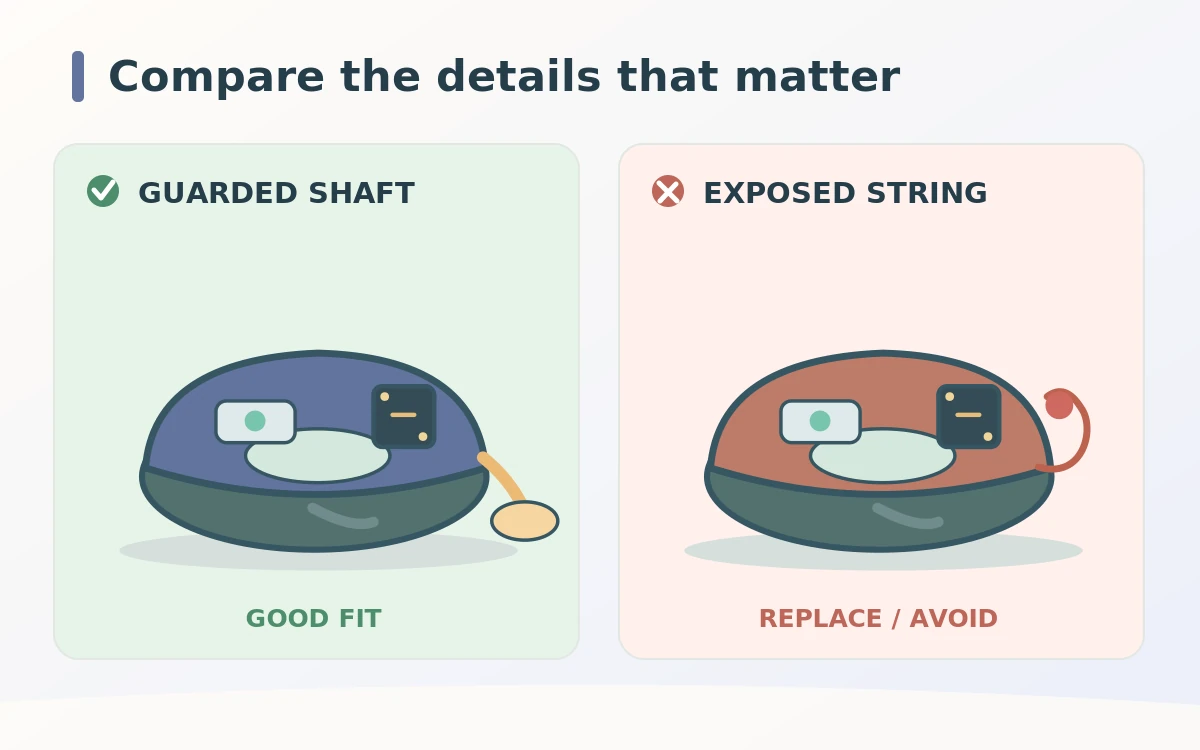
Compare protected moving parts with exposed cords
A guarded mechanism keeps the motor and shaft inside a shell while allowing the intended lure to move. An exposed string winding around a spindle creates more opportunities for tangling or ingestion. Look carefully at the actual design, not only at a marketing photo of a cat chasing it. A toy with an accessible ribbon may be appropriate only for direct hands-on supervision. For a cat that chews fabric or plastic, prefer a simpler nonmotorized game.
Check the auto-stop feature in real use
A stated auto-off time is useful only if the device actually stops reliably. Run a short test in front of you, including a pause in which no one touches the toy. Note whether it restarts from small movements, foot traffic, or vibrations. Test the physical power switch too. If the toy cannot stay off or begins moving unexpectedly, stop using it. Avoid leaving a running mechanism with a sleeping or fearful cat who cannot easily leave.
Introduce low intensity before high speed
Start with the slowest available movement while you are nearby. Give the cat room to approach, retreat, or watch from a distance. Reward curiosity with a calm voice or another familiar activity, not by pushing the toy toward the cat. Some cats enjoy a short chase; others may startle when the motor clicks on. Stop the game if your cat freezes, bolts, or repeatedly avoids the area. A calmer manual toy may be a better choice.
Give the cat a chance to finish a hunt
Chasing an object without ever touching it can create frustration for some cats. When possible, choose a game with a safe catchable element, and offer a separate supervised wand or soft toy at the end. Battersea recommends play that includes the stalk, chase, and catch sequence. Stop if the cat is panting, distressed, or unable to settle. Automatic movement should supplement your interaction rather than replace it. Short sessions often work better than endless cycles.
Plan for charging and storage
Use the charging equipment and safety instructions supplied for the device. Charge the toy in a pet-free place with the cord out of reach. Unplug and stow the cable before play. Do not continue using a swollen battery pack, damaged connector, or overheated case. When the session ends, switch the toy off and store detachable lures safely. Replace worn parts only with compatible pieces. Never improvise a power supply because the plug happens to fit.

Remove the toy before unattended periods
The safest default for moving battery-powered toys is direct supervision unless you have thoroughly evaluated the exact product and your cat’s behavior. Even a sturdy toy can collect hair or develop a loose attachment. Check for missing pieces every time you put it away. If you want an option during work hours, use simple passive enrichment with no accessible string, battery, or moving motor. A window view, secure perch, and appropriate stationary scratcher may offer a better match.
Compare real maintenance needs before purchase
Ask where lint accumulates, how the lure attaches, and whether a replacement battery door exists. Check that you can clean the outer shell without wetting electronics. Look for a clear power switch and an accessible shutoff procedure. Products that hide screws or offer no replacement parts can become difficult to maintain. Choose based on the safe mechanism and your cat’s response, not claims about artificial intelligence or nonstop amusement. Keep a manual play routine as a dependable backup.
How We Research
We used current feline welfare and veterinary guidance about play, hunting-style activity, chewing hazards, scratching, and safe materials. Next, we translated those principles into hands-on inspections of the specific toy or post: the seams, moving parts, size, stability, and cleaning access. We did not test or rank commercial models. The diagrams illustrate what owners can observe without claiming any item has a safety certification. This article is general educational information, not individual veterinary advice. Learn about our editorial approach.
Sources
Cornell Feline Health Center — Safe Toys and Gifts — Cornell Feline Health Center — Safe Toys and Gifts (consulted October 2026).
Ohio State University Indoor Pet Initiative — Toys — Ohio State University Indoor Pet Initiative — Toys (consulted October 2026).
Battersea Dogs & Cats Home — Playing with Your Cat — Battersea Dogs & Cats Home — Playing with Your Cat (consulted October 2026).
VCA Animal Hospitals — Cat Behavior and Training: Play and Play Toys — VCA Animal Hospitals — Cat Behavior and Training: Play and Play Toys (consulted October 2026).
Safety note: Take damaged toys, loose strings, sharp fragments, and accessible batteries away immediately. If a part might have been swallowed, contact a veterinarian promptly. Do not force a fearful cat to participate in play.
Do not assume that automatic shutoff makes a toy safe unattended. Moving lures, battery doors, and trapped hair still require supervision and checks.
Neither is automatically safe. Check the enclosure, charging cord, heat, and access to cells or battery packs in the exact design.
Remove the toy and contact a veterinarian promptly if ingestion is possible. Do not wait for symptoms or attempt home treatment.
Motor noise, speed, and unpredictable starts may be startling. Try a quieter manual activity and allow the cat to choose the distance.
Follow the product limits and watch the cat’s behavior. Offer brief voluntary sessions with rest instead of continuous stimulation.