
Cat self-play toys can give a curious cat something to bat, chase, or investigate between interactive games. But “independent play” does not mean every toy is safe to leave out when no one is watching. A rolling ball, a spring, an electronic mover, and a wand with string have different failure modes. A sensible setup starts with the cat’s habits and a close inspection of each object. Test new toys while present before deciding what may remain accessible, and remove anything the cat tries to dismantle or swallow.

Start with the cat’s actual play style
Watch what your cat does with a simple object while you are in the room. Some cats tap a ball gently and chase it across a rug. Others pick objects up, bite repeatedly, or wedge them under heavy furniture. The same toy can be an acceptable supervised game for one cat and a poor choice for another. Consider whether the cat climbs shelves to retrieve toys or pushes them toward stair edges. Prioritize a clear, low-clutter play zone with a nonslip surface. Pay special attention to kittens and determined chewers, whose behavior can change quickly.
Compare simple balls, tracks, and springs
A sturdy captive-ball track may keep a ball from rolling into an appliance gap, but the track must resist tipping and the ball must remain secured. A smooth, appropriately sized loose ball provides simple chase play, yet it may disappear under furniture or become damaged. Plastic springs can bounce in unpredictable ways and may develop cracked edges. None of these designs deserves an automatic “leave out” label. Inspect seams, openings, and how your cat bites or paws the object. Throw away chipped or broken items promptly. Choose size and strength for the individual animal, not the product photo.
Keep strings, ribbons, and fishing-rod toys stored
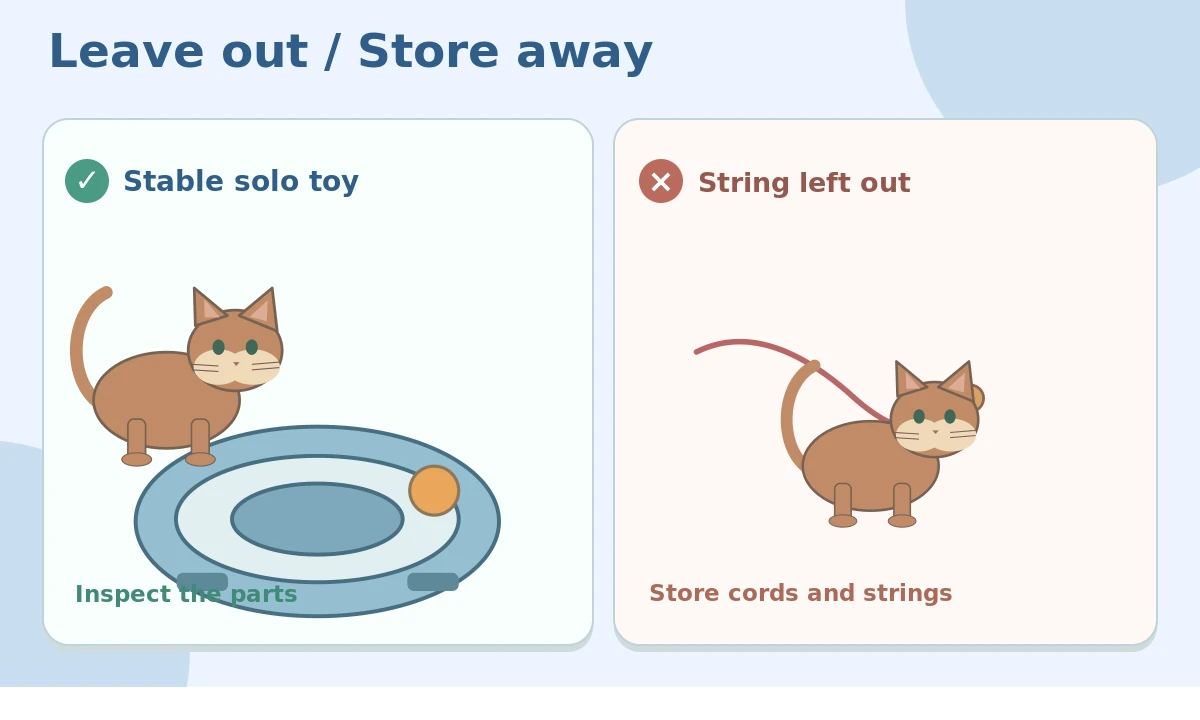
Long string can wrap around a cat’s body, limbs, or neck, and swallowed string may be a medical emergency. Feather teaser wands and elastic cords belong in a closed cabinet after supervised play. This remains true even when a package advertises an attachment as durable. An unattended cat may pull the wand down, chew through a knot, or become tangled while rolling. Do not hang a string toy from a door handle and leave for work. Cats Protection specifically advises storing string-like toys out of reach when leaving a cat alone. Provide a safer alternative instead.
Treat powered toys as supervised until proven otherwise
A motion-activated toy may stop automatically, but a timer cannot identify a cracked battery cover or a trapped paw. Inspect battery compartments, screw closures, charging cables, moving arms, and the manufacturer’s restrictions. Use the toy on the floor where it cannot fall from a high shelf. Observe whether the cat becomes overstimulated or frightened by sudden movement. Remove the power source before cleaning as directed. Never assume a motorized toy is safe for continuous unattended operation unless the maker specifically supports that mode and you have checked it against your cat’s behavior.
Create a room that makes chasing safer
Move loose charging cords, medicine, hair ties, craft supplies, and breakable objects away from the play zone. Check floor vents and gaps behind appliances where a ball can get trapped. Keep toy play away from balcony openings, stair tops, and doors that may swing. A small rug can stop a hard track from skating across smooth flooring. Do not place a toy beside the litter box or block a cat’s path to water and resting spots. Cats benefit from choosing when to play and when to leave. Avoid building an obstacle course that makes the cat jump into clutter.
Understand size and detachable-part hazards
A toy must be too large for your cat to swallow and solid enough to withstand their normal bite. Exact dimensions depend on the cat and product; marketing categories such as “kitten” do not guarantee fit. Check glued-on eyes, bells, small caps, foam pieces, magnets, and loose stitching. Run your fingers along any rough edge before the cat sees the toy. A worn fabric mouse may expose stuffing even when the outer fabric still looks charming. If a component comes off during inspection, do not glue it back and call the toy safe; retire or replace it.
Rotate toys without creating constant novelty
Leave only a small number of intact options in a familiar location and put others away. Swapping a ball for a sturdy track may refresh interest without filling the floor with hazards. Keep a favorite stable resting spot unchanged while you rotate the play objects. Some cats enjoy a new object immediately; others observe it for days. Respect that pace. If the cat ignores a toy, try a brief interactive session before assuming the cat is bored. Regular play with a person remains valuable even when safe self-play choices are available.
Watch for chewing, hiding, and overstimulation
An engaged cat may pause, crouch, bat, and then rest. Persistent chewing of plastic, attempts to swallow fibers, frantic pursuit that ends in collision, or long periods of hiding after a toy activates are reasons to change the setup. Do not chase the cat to retrieve a toy; calmly make the room safe and offer a trade where appropriate. If material may have been swallowed, contact a veterinarian promptly rather than trying to pull visible string from the mouth or rear. The safest self-play toy is not the most exciting one; it is the one your cat uses without distress or damage.
Make a quick inspection routine
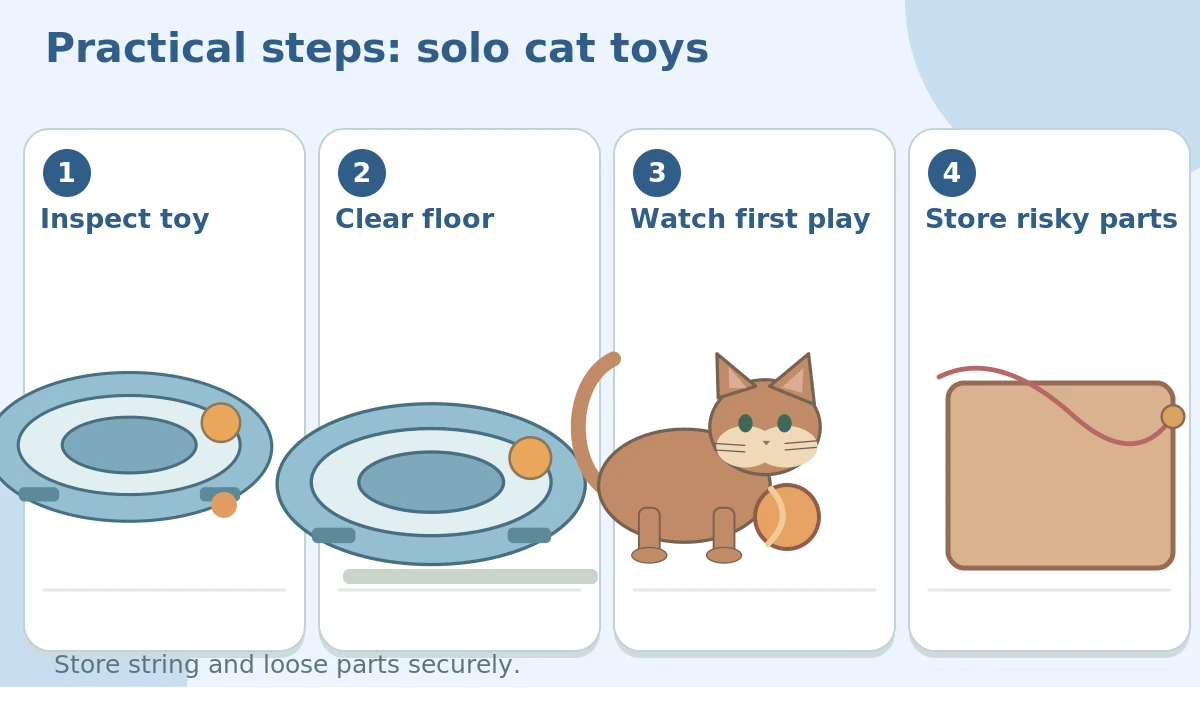
Before leaving a toy accessible, look for cracks, sharp edges, loose parts, exposed stuffing, corrosion, or battery damage. Place the item on a flat surface and check stability. After play, count the parts and look under nearby furniture for missing pieces. Wash washable toys with a pet-appropriate method and let them dry fully; avoid strong fragrances that may deter the cat. Keep a small storage bin for supervised-only toys so they do not accidentally stay on the floor. Review the setup whenever a new cat enters the household or your cat starts chewing more forcefully.
Know what solo play cannot replace
A safe ball or track cannot substitute for human interaction, climbing opportunities, scratchers, rest, and veterinary care. Some cats become less playful with age; others change behavior suddenly because of pain or illness. A dramatic loss of interest, unusual lethargy, or compulsive chewing merits veterinary advice. If your cat requires constant stimulation to avoid destructive behavior, look at predictable play sessions and the broader home environment before buying more gadgets. Independent toys are one enrichment layer, not a complete behavioral or medical solution.
How We Research
We reviewed practical play and environmental-enrichment guidance from established animal welfare organizations and veterinary teams. We prioritized direct supervision, safer materials, clear opportunities to stop, and cleaning. These drawings explain handling principles; they cannot establish product certification or suitability for every pet. See our editorial information and veterinary disclaimer. Ask a veterinarian about pain, swallowing hazards, dietary restrictions, or sudden behavior changes.
Sources
Cats Protection — Cats and Play — guidance on practical enrichment, play, welfare, or food safety.
Cats Protection — Going on Holiday Without Your Cat — guidance on practical enrichment, play, welfare, or food safety.
VCA — Behavior Management: Enrichment and Activity Toys — guidance on practical enrichment, play, welfare, or food safety.
No. Store toys with string, ribbon, elastic, or dangling attachments securely after supervised use.
No. Test ball retention, stability, component strength, and your cat’s chewing habits before leaving one accessible.
Do not assume that is safe. Read the manufacturer’s instructions and assess battery compartments, moving parts, and your cat’s response.
A small selection of inspected, familiar toys is easier to monitor and clean than a floor covered with loose items.
Contact your veterinarian promptly. Do not pull swallowed or protruding string, and keep any remaining product parts for identification.