
Many cats like to rest near a person who spends long hours at a desk. Yet the cozy space below a workstation can hold moving chair wheels, dangling wires, and sudden foot traffic. A small bed beside the desk can offer companionship without turning the chair’s travel zone into a hazard. The key is to plan a safe footprint and give the cat a quiet exit. This is a room-layout guide, not a claim that a specific bed will stop laptop visits or attention seeking. See our veterinary disclaimer for health-related concerns.
Draw the chair travel zone before placing a bed
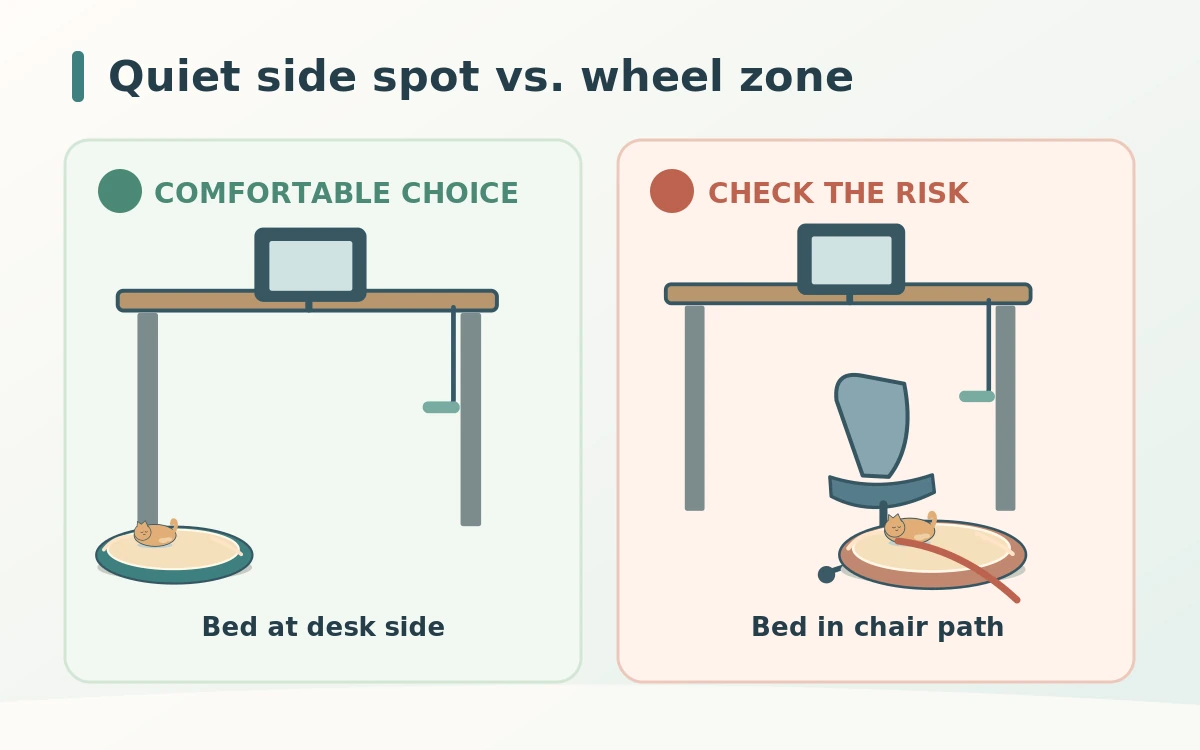
Roll the chair backward and sideways as far as you normally move it. Mark that footprint mentally or with removable floor tape while your cat is away. The bed should sit beyond the wheels and the space where your feet pivot. A corner directly behind a chair is easy to forget when you stand up. If the chair moves on a mat, keep the cat’s bed outside the mat’s edge. Safety matters more than squeezing a decorative cushion below the keyboard.
Choose a place the cat can see and leave
Cats often enjoy being near their people while still monitoring the room. Angle the bed so the cat can watch your desk without facing a blank wall. Avoid a dead end between a filing cabinet and a wall. Leave a clear path to a second resting spot, especially if another pet shares the office. The AAFP/ISFM guidelines emphasize access to several separated resting areas. One bed next to a human workstation should never become the only available refuge.
Keep cables behind a barrier, not under the cushion
Inspect the route from outlet to computer, monitor, lamp, and charger. Loose cords can become chewing or entanglement hazards. Run wiring through a secure cable channel that the cat cannot open easily, and keep power strips off the cat’s sleeping surface. Do not hide an overloaded adapter under the bed or blanket. Even a cat that has never chewed cables may investigate them while playing. Recheck the setup after each office rearrangement or equipment change.

Select a low-stable bed shape for the floor
A shallow padded bed or low-sided basket makes it easier for your cat to step off when you rise. Check that the bed does not slide when nudged with a hand. A raised donut rim may work for a cat that likes support, but it should not block visibility or exit. If the cat prefers an elevated position, place a suitable resting surface on a stable piece of furniture away from desk clutter. Never rely on a rolling chair as the cat’s perch.
Compare a quiet side zone with a cramped under-desk space
A side position leaves the chair and your legs a predictable travel path. Under a narrow desk, a cat may face moving feet, dropped objects, or cords. A broad built-in desk nook can be acceptable if every hazard is removed and the cat can walk out freely. Test the arrangement with the chair moving and the cabinet drawers open. If the bed shifts or gets trapped, relocate it before inviting the cat to use it.
Make the room comfortable without direct heating
Avoid placing the bed against a space heater, heating vent, or warm computer exhaust. A cat should be able to move to a cooler spot whenever it wishes. A window may offer daylight, but check sun exposure and secure the screen separately. Keep cups, desk plants, and small office supplies from falling into the bed. The resting surface needs a normal stable indoor environment, not a special heat source or a continuous stream of air from a fan.
Give work time and cat time separate cues
Some cats settle when they can stay nearby without constant petting. Reward calm voluntary resting with quiet attention when appropriate, but do not require the cat to remain in the bed. Offer a brief play session before a long work block and keep toys away from chair wheels afterward. If the cat climbs onto a keyboard, guide it toward an available safe alternative with positive reinforcement. Punishment and startling noises can make the workspace less predictable.
Use fabric that handles hair and spills
Choose a cover you can remove and wash after everyday use. Check for seams that trap hair, crumb accumulation, and exposed zippers. Avoid a shaggy surface that collects paper clips or small pieces of packaging. Wash according to the care label and return the bed only when dry. Keep a small vacuum tool nearby if you work with fabric furniture. An office bed often needs more frequent checks than a bedroom cushion because dropped objects are easy to miss.
Plan a second resting option for interruptions
Video meetings, guests, and vacuuming can make a home office noisy. Provide a quiet resting option in another accessible room. A familiar covered box or soft cushion can give the cat a place to leave without being shut out. Do not close a door on a cat that has no access to water or needed resources. A cat that leaves the office is making a choice; allow it. Cats Protection notes that cats commonly rotate sleep spots during the day.

Check the layout at the start of each workday
Before rolling the chair, look for the cat and confirm that the bed has not moved. Inspect cable channels, dangling straps, and objects perched above the sleeping area. Keep rolling drawers clear of tails and paws. If you move the workstation, remeasure the chair travel zone rather than assuming the old placement is safe. A simple glance takes little effort and prevents a common household conflict between a pet’s resting spot and human movement.
Use behavior to decide whether the location works
A cat that naps calmly and leaves freely may enjoy the arrangement. One that repeatedly startles, watches the chair wheels, or avoids the corner may prefer a different room. Move the bed slightly away from noise or provide a higher stable alternative with safe access. Do not treat a cat’s presence near a desk as evidence that it wants constant handling. A comfortable office setup protects both the cat’s resting choice and the human’s ability to move safely.
How We Research
We reviewed feline welfare guidance about secure resting places, access to separate resources, normal sleep choices, and material safety. We then evaluated the practical product details that owners can inspect: usable dimensions, stability, pathways, seams, and cleaning. The drawings show the intended checks rather than a promise that a product is approved or suitable for every cat. We do not treat marketing labels as evidence of comfort. Read more about our editorial approach.
Sources
AAFP/ISFM — Feline Environmental Needs Guidelines — AAFP/ISFM — Feline Environmental Needs Guidelines (reviewed October 2026).
Cats Protection — Preparing Your Home for a Cat — Cats Protection — Preparing Your Home for a Cat (reviewed October 2026).
Cats Protection — Bringing a Cat Home — Cats Protection — Bringing a Cat Home (reviewed October 2026).
AAHA — Enrichment: Supporting Your Pet’s Mental and Emotional Wellbeing — AAHA — Enrichment: Supporting Your Pet’s Mental and Emotional Wellbeing (reviewed October 2026).
Safety note: Remove bedding with exposed stuffing, wires, detached trim, or chewable strands. For sudden changes in hiding, movement, sleep, or appetite, contact a veterinarian. Never force a cat into a sleeping space.
Only if the space stays clear of chair wheels, feet, loose cords, and blocked exits during ordinary desk use. A side location often offers more predictable clearance.
Keep it outside the full travel area of wheels, swiveling legs, and your feet. Test with the chair moving in every direction you normally use.
A stable perch can work, but avoid narrow, cluttered or rolling surfaces. A low floor bed may be simpler when the cat needs easy access.
Offer a nearby optional resting spot and reward voluntary use. Add play breaks, and avoid scolding or forcing the cat into the bed.
No. Avoid hot exhaust and direct heater airflow. Leave the cat normal room-temperature choices and an easy exit.