
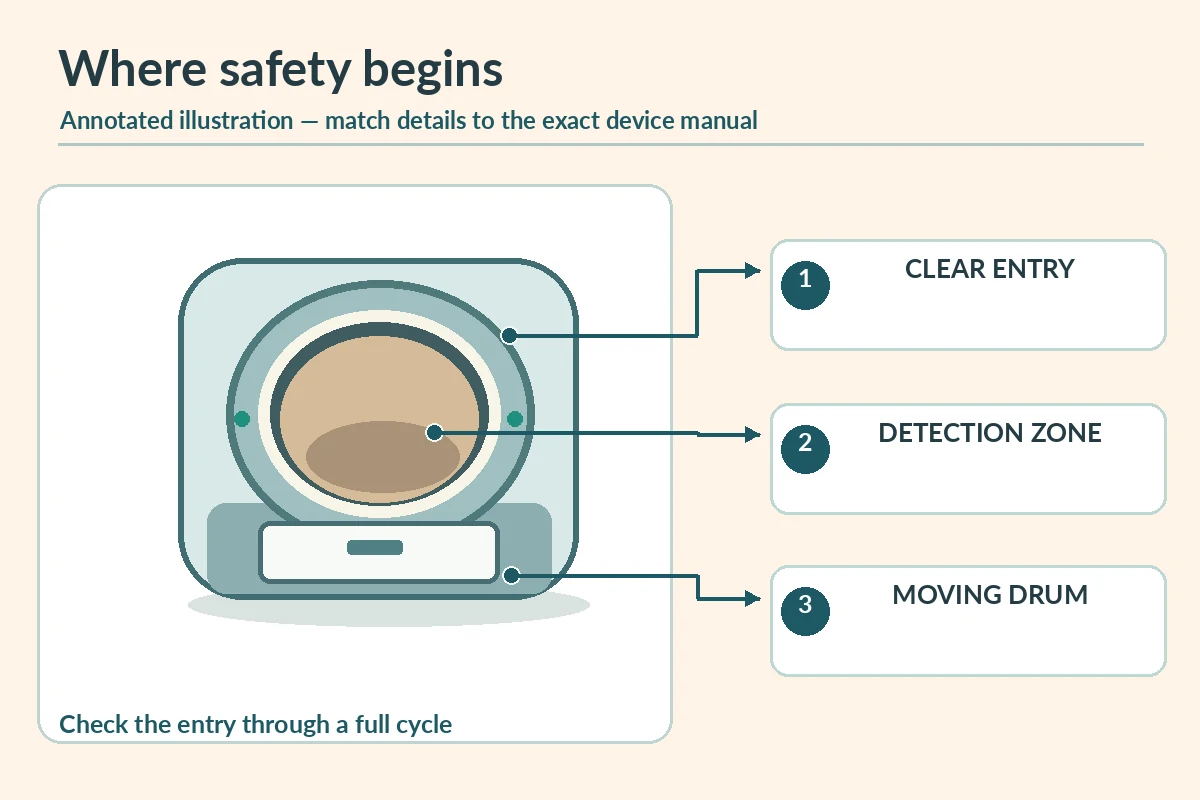
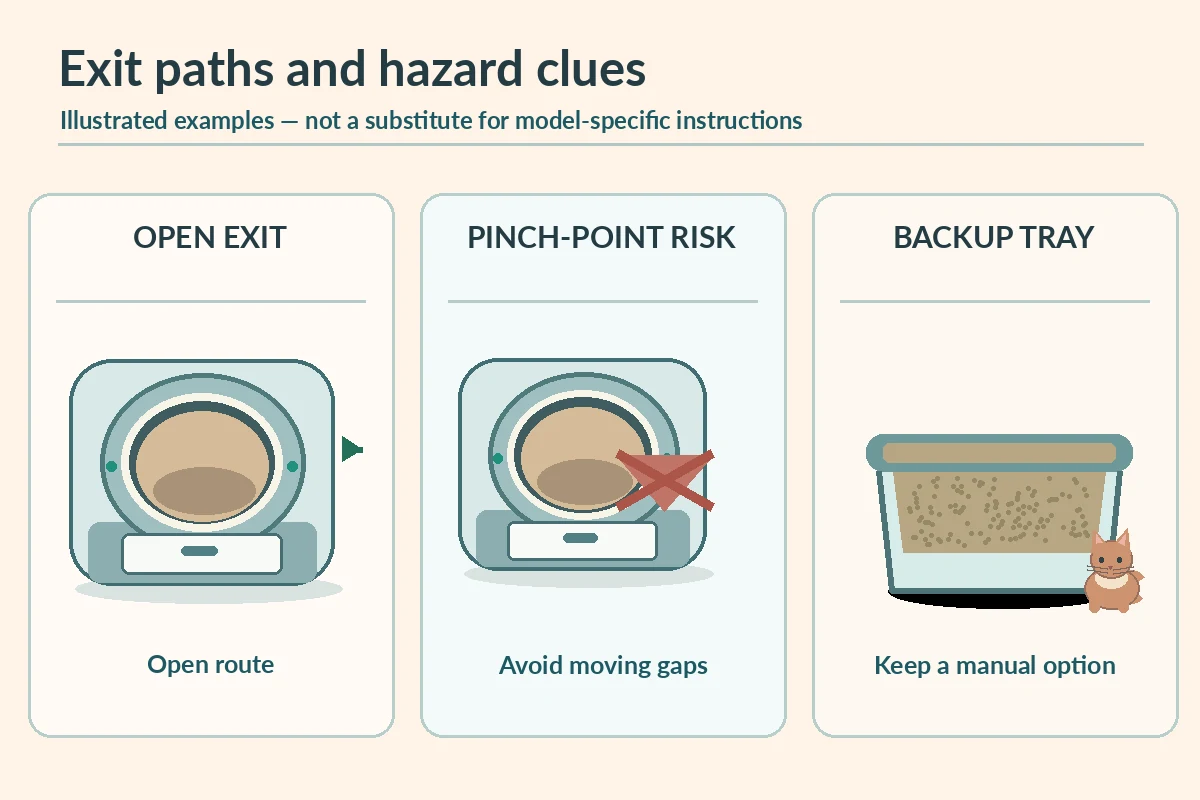
Safety depends on the physical opening and an effective stop system, not a product listing that merely mentions sensors. The doorway is the first safety feature to examine. A cat needs an unobstructed path in and out while the mechanism is at rest, starting, moving, and finishing. Look at a full demonstration with the actual opening visible; a still product photograph cannot show whether a fixed entrance becomes smaller during rotation. Reject a mechanism that could create a closing pinch point accessible to an animal. The US CPSC public incident database includes a consumer report about a problematic rotating design; that report is a submitted allegation, not a verified safety certification or a finding about all brands. Evaluate geometry rather than relying on reassuring marketing language.
Distinguish entry sensors from anti-pinch protection
A weight scale, infrared curtain, proximity beam, and motor resistance detection do different jobs. Entry detection may delay the cleaning cycle, but that does not prove the machine can respond if a cat approaches while a part is moving. Ask what stops motion, what reverses it, and whether the opening remains unobstructed. The seller should provide a current manual explaining detection thresholds and error behavior. If the operating logic is unclear or the company cannot explain safe interruption, treat the claim as unproven. Multiple sensors add value only if their placement and real interruption behavior address the exposed hazard.
Check how the machine behaves during interruptions
Simulate only the manufacturer-approved empty-machine test, without putting an animal or hand inside a moving mechanism. Verify that an error pauses operation and that a restart does not unexpectedly cycle while a cat investigates. Review instructions for power outages, Wi-Fi loss, blocked drawers, and motor stalls. Not every unit works in the same way after power returns. Place the appliance on the level floor specified by its instructions so weight-based detection can work as designed. Avoid extension cords or improvised electrical changes unless the manufacturer explicitly allows them.
Use the cat’s body size as an actual fit test
Measure the usable entry, standing area, and turning room rather than the outside diameter. The cat should be able to enter, turn naturally, dig, and leave without squeezing past a lip. Cats vary greatly in body shape and agility. Older animals and cats with mobility difficulties may prefer a low open pan, even if a robot technically fits them. The ISFM/AAFP cat-friendly environmental guidance supports easy-entry, appropriately sized boxes. A machine with a dramatic shell but narrow usable interior can be the wrong purchase for a large or cautious cat.
Introduce the device with automatic mode disabled
Keep the familiar clean tray available while the new unit sits powered off and quiet. Let the cat inspect it voluntarily, then observe whether the cat uses the litter bed and exits comfortably. Introduce movement only according to the maker’s instructions, when no cat is in or near the moving parts. Never hold the cat inside, carry it into an active machine, or force an unfamiliar entry. A frightened cat may avoid toileting, which can create a new household problem. Place the robot in a calm, accessible location rather than beside a loud laundry appliance.
Watch for the quiet signs of avoidance
A cat may approach the machine repeatedly but never go inside. Other clues include waiting in a doorway, jumping away after a cycle, scratching outside, or choosing an older tray every time. These are observations, not misbehavior. Keep alternative boxes in separate locations and record which cats use them. AAHA recommends accessible quiet litter resources, with more than one location in many homes. If a cat’s elimination pattern changes suddenly, discuss it with a veterinarian rather than assuming the machine needs an app adjustment. Straining or repeated attempts with little urine require urgent care.
Treat app alerts as secondary information
App notifications about visits, weight, cycle counts, or drawer fullness may help with a routine, but they are not a substitute for seeing the machine and cat. Weight estimates can be affected by positioning or multiple cats, and software may not identify individuals reliably. A frozen phone, disconnected network, or inaccurate alert cannot establish that a cat is safe. Inspect the entrance, litter surface, waste drawer, and power indicator during daily care. Prefer a device that can be operated and checked without an internet connection and that has understandable physical status indicators.
Verify service, parts, and documentation before paying
Download the exact model manual, not a generic marketplace brochure. Find manufacturer identity, support channels, a parts diagram, replacement sensors or seals, warranty terms, and return rules. Look for instructions showing when the device must be unplugged and which parts may be washed. Be wary of visually identical machines sold under changing names with no stable support information. Check current safety notices for the specific model; do not interpret the absence of a known recall as proof of safety. A product you cannot safely maintain is not a good fit.

Build a daily visual safety check
Before leaving an automatic box in service, verify that the entrance is clear, nothing is loose at a hinge or seam, the litter bed is usable, the drawer is properly seated, and the machine displays no unresolved error. Check the cat’s actual comfort, not just the machine’s cleaning count. Keep at least one accessible manual litter tray if an automated unit jams, loses power, or frightens a cat. The practical goal is consistent safe toileting. An automated machine should reduce scooping effort while preserving your ability to recognize changes in your pet’s habits.
How We Research
For this HubPet guide, we compared automatic litter box safety against published feline welfare guidance and model-specific operating instructions. We separated a machine’s documented capabilities from general assumptions and prioritized a cat’s voluntary use, normal exit access, and low-stress toileting. The original diagrams are illustrative, not photographs, certifications, independent hardware stress tests, or endorsements. This guide does not claim that a particular product is risk-free. Compare the current manual for the exact device and consult your veterinarian about individual toileting concerns. Read more about our editorial approach on About HubPet.
Sources
US Consumer Product Safety Commission, SaferProducts.gov Consumer Incident Report 20240910-7494E-2147336623: Read source. Reviewed October 27, 2026.
AAHA/AAFP, General Litter Box Considerations: Read source. Reviewed October 27, 2026.
Whisker, Litter-Robot Frequently Asked Questions (model-specific safety and litter): Read source. Reviewed October 27, 2026.
AAFP/ISFM, Guidelines for Diagnosing and Solving House-Soiling Behavior in Cats: Read source. Reviewed October 27, 2026.
Safety note: If your cat strains, repeatedly attempts to urinate with little or no urine, shows pain, or suddenly stops normal toileting, seek prompt veterinary care. This is general education, not veterinary diagnosis. See our veterinary disclaimer.
No. Sensor type, position, fault behavior, and doorway geometry all matter. Verify instructions and interruption features for the exact model.
Not necessarily. The risk depends on moving-part design, pinch points, interruption systems, and how the opening changes during operation.
Do not put your hand or a pet into moving parts. Use only the empty-unit, manufacturer-approved safety test and follow the manual.
Yes, keeping an accessible familiar box during transition and as backup is prudent when automation fails or the cat declines to use it.
Disable automatic operation, restore access to a familiar quiet litter box, and reintroduce the unit slowly without forcing contact.