
This article is general information, not veterinary advice. If your pet seems unwell, is in pain or may have eaten something harmful, contact your vet or an animal poison control line right away. Read our vet disclaimer.
Why dogs react to other dogs behind fences has several possible explanations, and the barrier itself can matter. The Merck Veterinary Manual behavior guide, updated April 2026 describes frustration when a dog cannot complete a motivated behavior because of a physical or psychological obstacle. A fence can create exactly that setup.
However, fence reactions are not always frustration. The VCA guide to aggression toward unfamiliar dogs notes that barrier situations can involve frustration, territorial patterns, fear, and learned reinforcement. Therefore, do not remove the fence to “test” whether the dog is friendly.
Why Dogs React to Other Dogs Behind Fences: Short Answer
Why dogs react to other dogs behind fences depends on what the dog expects and feels in that moment. The dog may want to approach, want more distance, defend a familiar area, or repeat a barking pattern that has worked before. The selective barking guide explains why the same dog can react to one dog and ignore another.
First, stop repeated fence rushing while you build a new pattern. The redirection guide starts with management, then rewards a safer alternative. For outdoor triggers, the distraction-training guide adds distance and gradual difficulty.
| Possible factor | What you may see | Safer first step |
|---|---|---|
| Frustration | Pulling or rushing toward the barrier | Increase distance and reward disengagement |
| Fear | Barking while trying to retreat or stay far away | Create more space |
| Territory | Strong reaction near home boundaries | Block rehearsal and manage access |
| Learning | Reaction repeats as dogs pass and leave | Change the routine before the trigger arrives |
| High arousal | Slow recovery after the dog passes | End the session and lower difficulty |

Why Dogs React to Other Dogs Behind Fences Can Become a Habit
In practice, why dogs react to other dogs behind fences can become clearer when you track what happens before and after each reaction. Every repetition gives the dog another chance to rehearse rushing, barking, staring, or pacing. If the other dog then disappears, the sequence may become even more established. The delivery-driver reactivity guide shows a similar pattern when a trigger reliably approaches and then leaves.
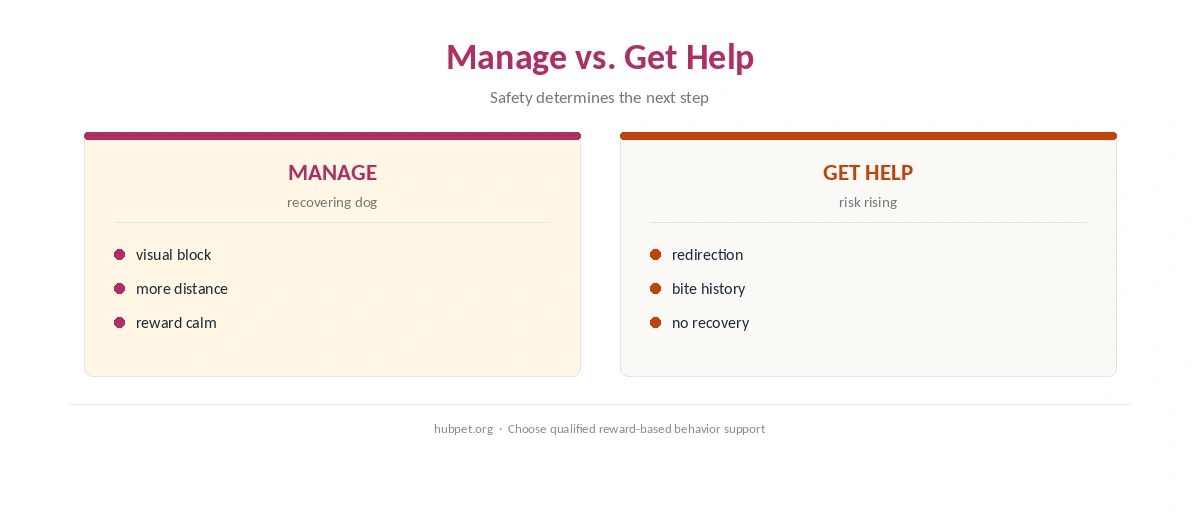
Change the environment before asking for calm behavior. Use opaque screening, a different yard zone, supervised outdoor time, or more distance when another dog passes. Then teach a simple response in an easier setting. The doorbell training guide uses the same management-plus-station logic for another boundary trigger.
A mat or station can give the dog a practiced destination away from the fence. Build that skill first with the settle-on-a-mat guide. In addition, use the positive reinforcement guide to reward looking back, moving away, or settling.
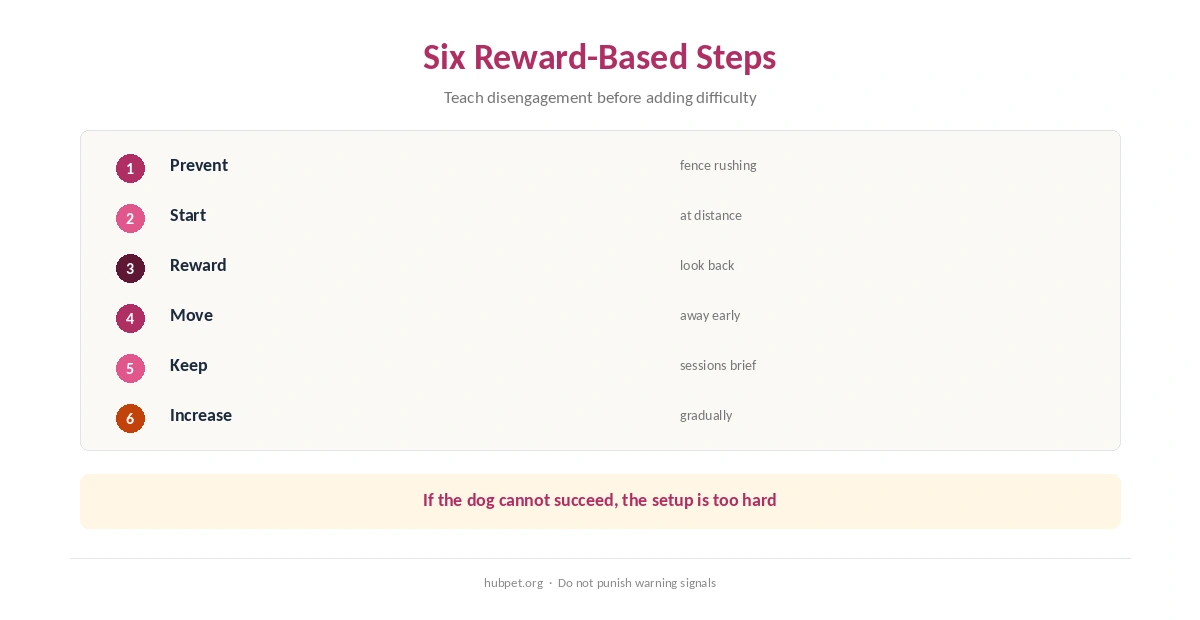
- Prevent unsupervised fence running while training is underway.
- Start far enough from the trigger that the dog can still take food or respond.
- Reward noticing the other dog and then turning back toward you.
- Move away before barking or lunging escalates whenever possible.
- Keep sessions brief and stop after successful repetitions.
- Increase difficulty gradually instead of waiting for a full reaction.
If the dog struggles even at a large distance, lower the challenge. The fear-confidence guide emphasizes choice and distance for worried dogs. The basic training guide can also help establish simple cues in quiet settings before you use them near the fence.
What Not to Do with Fence Reactivity
Do not punish the dog for warning signals or drag the dog toward the fence. The scolding myth guide explains why interruption without a taught replacement can add conflict. Also, do not assume the dog is trying to dominate the other dog.
If food, toys, people, or yard locations are part of the trigger, review the resource-guarding guide rather than grabbing items during a high-arousal moment. If you need a disengagement skill, the leave-it guide gives a reward-based foundation away from the fence.
When to Call Your Vet or a Behavior Professional
Contact your veterinarian if the reaction appears suddenly, if the dog reacts during ordinary movement or touch, or if another physical change appears at the same time. Medical issues can affect behavior, and an online article cannot identify the cause.
Get qualified reward-based behavior help if the dog redirects toward people or other pets, has a bite history, cannot recover after triggers, or cannot stay below reaction threshold even with substantial distance. Use barriers and supervision while a plan is developed.
How We Research
HubPet reviewed these sources on October 11, 2026: the Merck Veterinary Manual behavior guide, updated April 2026, the Merck definition of frustration, and the VCA unfamiliar-dog aggression guide. Read more about our research process.
No. A fence reaction can involve frustration, fear, territorial behavior, learning history, or more than one factor.
No. Removing a safety barrier to test a highly aroused dog can be dangerous.
Yes. Visual screening can reduce repeated rehearsal while you teach an alternative response.
Reward manageable behaviors such as looking back at you, moving away, settling, or calmly noticing the trigger.
Seek reward-based professional help for redirection, bite risk, severe reactions, or a dog that cannot recover even with more distance.
The Bottom Line: Why Dogs React to Other Dogs Behind Fences
Why dogs react to other dogs behind fences cannot be reduced to one motive. Frustration, fear, territory, learning, and arousal can overlap. Prevent rehearsal, add distance, reward disengagement, and get qualified help when the reaction creates a safety risk.