
This article provides general dog-care and reward-based training information, not veterinary diagnosis or individualized behavioral treatment. For sudden behavior changes, panic, attempts to escape, or risk of injury, contact a veterinarian or qualified reward-based behavior professional. Never punish a dog for distress or for accidents discovered later. Read the veterinary disclaimer.
A puppy’s first experience of being without you should feel ordinary and brief, not like a test of endurance. Before arranging an actual errand, practice tiny separations while you are still at home. Notice how the puppy rests, explores, takes treats, and responds to your return. Plan toilet breaks, sleep, and supervision before increasing distance. The goal is a puppy who gradually learns that caregivers come and go, while trusted people still meet every physical and social need.
Prepare a rest area before touching the door
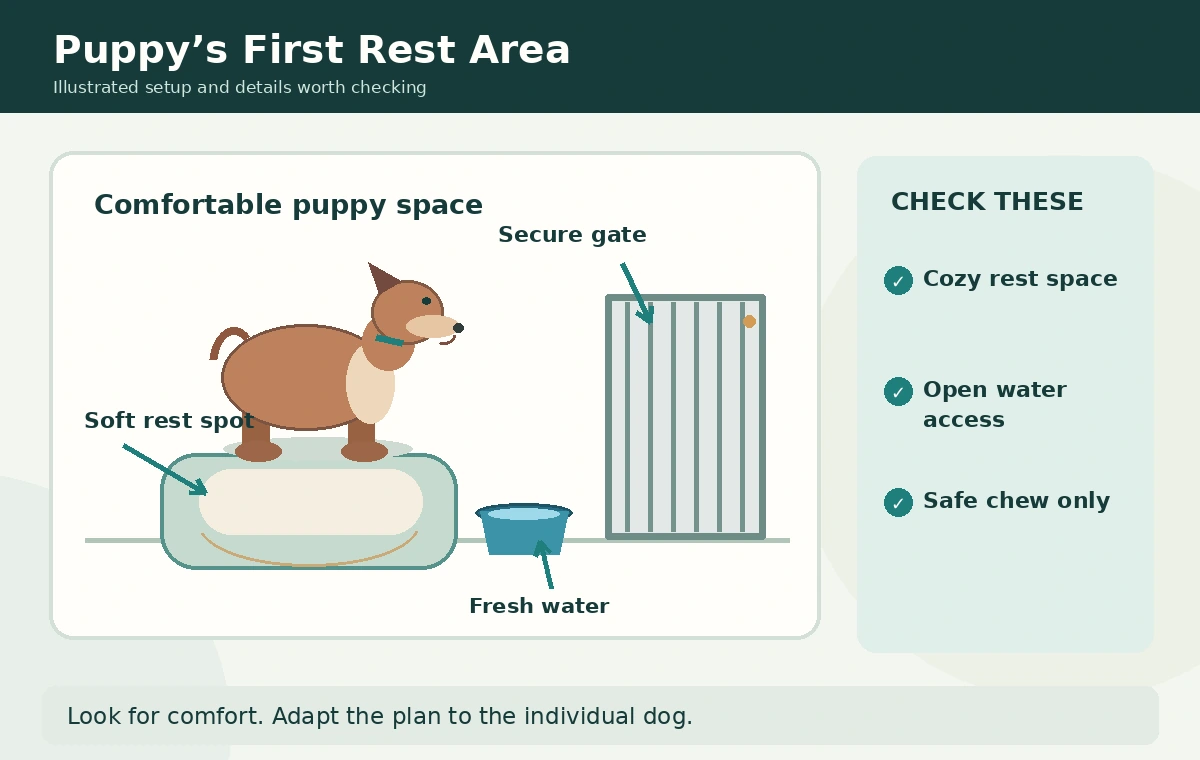
Choose a familiar space with secure flooring, a comfortable bed, fresh water, and a suitable resting temperature. Remove cords, cleaning supplies, small swallowable objects, and anything the puppy might shred. A gated area may offer freedom to shift positions, provided its bars and latch cannot trap a paw or head. Do not assume a crate is a safe unsupervised option when the puppy is distressed or chewing the enclosure. Practice resting here while a person remains nearby. A safe room matters more than buying extra gadgets.
Match your first session to the puppy’s needs
Schedule training after a successful potty trip and a little gentle activity, rather than when the puppy is desperate to go outside. Puppies need frequent bathroom opportunities, meals, rest, and company; age alone cannot establish a universal safe absence length. Begin by taking only a step or two away and coming right back. Your first successful repetition might last a second. That counts as progress. If work or travel requires a longer absence, arrange a reliable adult caregiver instead of treating a puppy’s crying as something to endure.
Practice with a visible doorway first
Let the puppy settle with a familiar mat or an appropriate supervised food activity. Walk a short distance, pause, and return without fanfare. If the puppy remains comfortable, repeat several times before briefly moving behind a doorway or properly fitted pet gate. Avoid forcing a stationary position; your puppy can choose to lie down or investigate safely. Look for a soft body, normal breathing, and interest in the environment. If the puppy stops eating, rushes toward you, or begins panicking, shorten the separation and work at an easier point.
Build duration only while the puppy is comfortable
Progress by varying easy repetitions rather than adding more time every attempt. One repetition could be a step away, another a moment in the hall, and a third simply sitting quietly nearby. The puppy’s response—not a stopwatch target—sets the pace. Check for barking, persistent scratching at exits, frantic pacing, drooling, or repeated attempts to escape. These signs are a reason to stop and reassess, not to extend the session. Keep training separate from unavoidable absences, and organize help when real-world schedules exceed the puppy’s coping ability.
Choose safe enrichment, not a risky distraction
A familiar, size-appropriate chew or food toy can make brief practice pleasant, but only if the puppy has already used it safely while supervised. Check for loose parts, damaged seams, sharp edges, or a tendency to swallow pieces. Avoid leaving strings, fabric strips, or untested chews in a confined area. Food may need to come from the puppy’s normal meal allowance. Enrichment is not a substitute for rest, water, toileting, or human attention. A puppy that abandons a favorite food toy when you leave may be communicating worry.

Return gently without rewarding a panic cycle
Open the door calmly, check that the puppy is safe, and offer ordinary companionship. You do not need to ignore your puppy for an arbitrary period or wait through escalating fear. If you accidentally leave for too long and the puppy becomes distressed, provide support and make the next practice much shorter. A low-key return should not feel like withdrawing comfort. Focus on predictable, easy repetitions before expanding distance. Your aim is confidence built through many harmless experiences, not obedience under pressure.
Keep a simple observation record
Write down where the puppy rested, what happened just before the separation, what you did, and the first signs of discomfort. A short recording from a fixed camera can help you see whether the puppy actually relaxes after you step away. Point the camera only at the pet area and respect household privacy. Do not make conclusions from barking alone; temperature, noise, toileting, and other triggers may explain changes. Review patterns over several days and ask a veterinarian for help if distress escalates or the puppy repeatedly injures itself at barriers.
Arrange real departures around support
Before a genuine appointment, check whether a family member, trusted neighbor, or suitable pet sitter can supervise and provide a potty break. Give written instructions about feeding, safe toys, medications if prescribed, and emergency contacts. Avoid using a car as an unattended waiting space because temperatures can become dangerous quickly. At home, close unsafe rooms and confirm that doors and gates work. A first absence should be a planned, manageable event. Never promise that an untested puppy will sleep the whole time simply because the environment looks comfortable.

Know when a training plan needs expert help
If the puppy panics within seconds, urinates despite recent toileting, damages exits, refuses normally desirable treats, or struggles to recover after you return, stop extending absences. Speak with a veterinarian who can consider medical issues and guide a referral to a qualified reward-based behavior professional. Do not punish accidents, barking, or chewing after the fact. Separation-related distress is a welfare concern, not stubbornness. The best next step may be changing care arrangements while the puppy learns at an achievable pace.
How We Research
We compared animal welfare and veterinary behavior guidance, focusing on real signs of comfort, gradual exposure, reasonable supervision, and the reasons to seek an individual assessment. The advice favors positive reinforcement and caregiver support over punishment, forced isolation, or fixed duration claims. Exact coping limits vary by dog; product suggestions are not endorsements or medical treatments. Learn more about HubPet and our editorial approach.
Sources
Dogs Trust — Helping your dog spend time alone.
RSPCA — Teaching a dog to stay home alone.
RSPCA — Puppy care and early alone-time practice.
ASPCA — Separation anxiety and departure cues.
No. Sustained distress is a signal that the session is too hard. Return supportively and shorten the next practice.
There is no universal starting duration. Begin with seconds or even a step away, based on the puppy’s comfort.
No. A safe gated space or puppy-proofed room may work if your puppy can rest there comfortably.
Only if the toy is appropriate and has proven safe in supervised use; food cannot solve severe distress.
Get veterinary guidance for persistent panic, injuries at exits, repeated accidents, or sudden behavior changes.