
Rolling crate wheels are a maintenance convenience, not a transport or restraint system. Before buying casters, identify the specific frame the manufacturer specifies for their use, inspect each mount and brake, and make sure the crate sits on a level floor. This guide covers observation and manufacturer-supported setup rather than claims of strength or crash protection. Keep the dog out of the crate while anyone moves it. A stationary crate may be a better choice when a wheeled base adds instability or an awkward step. For health-related limits, review the HubPet veterinary disclaimer.

When wheels solve a real problem
Casters can help move a heavy crate for cleaning or rearranging a room. They do not make the crate an appropriate transport vehicle for a dog. First decide why you need to move the crate and whether the maker approves wheel mounting. A removable caster kit, a factory-mounted locking set, and a separate rolling platform have different stability concerns. Treat product photos as clues, not evidence of fit. An unapproved wheel can raise the crate, change its balance, or loosen under repeated movement.
Verify the mount before buying wheels
Read the exact crate manual for the approved caster type, thread, plate or socket, and number of attachment points. Check all mounting holes and corners for cracks or bent metal. Never drill through a structural frame or substitute hardware merely because a thread looks similar. A caster that seems to fit while empty may shift under the crate’s actual weight. If you cannot verify compatibility from the manufacturer, choose a stationary setup or an approved complete base instead of experimenting with wheels.
Check brake levers and swivel motion
Many rolling crates use a pedal to stop wheel rotation; some designs also restrict the swivel. The two functions are not identical. On a level, empty crate, activate every provided brake and gently test for rolling and turning according to the manual. The levers should be easy for an adult to reach but not placed where a dog’s paws can touch them. Inspect for grit trapped in wheel forks. Do not claim a model cannot move at all without a hands-on check.
Choose a flat surface and consider floor seams
A lockable caster still performs poorly on a slope, thick rug edge, stair landing, or floor with a raised transition strip. Choose a firm, level area clear of cords and doors. Confirm the crate remains stable when a person operates the latch from the front. A raised base may alter how a short-legged dog steps into the crate. Use an approved ramp or change the location only if the manufacturer supports that arrangement. Do not leave a rolling crate near stairs or an open doorway.
Compare fixed feet with a properly braked set
Stationary feet offer fewer moving parts and may be preferable where the crate never needs relocation. Braked wheels can help with cleaning access but require routine checks. A crate shown with wheels rolling freely while a dog is inside is not an acceptable daily-use scenario. Watch the wheel-to-frame connection, not only the tire. If the frame rocks on four casters or a brake slips, stop use until you correct the problem. Extra friction under one wheel is not a substitute for proper brakes.

Move the crate without a dog inside
If the crate must change location, first move the dog to a safe area and close or secure both doors. Remove loose bowls and unsecured objects. Release the brakes on the approved wheels, guide the crate slowly across a clear level floor, then reapply all brakes at the destination. Avoid dragging it over stairs, thresholds, or outdoor gravel. A person should not ride or push the crate with a dog inside. Recheck the door fit after moving because twisting during transport can affect alignment.
Look beneath the crate after cleaning
After wiping the tray or floor, dry the caster assemblies and the area beneath the frame. Hair, dust, and grit can block swivels or keep brakes from engaging fully. Check for rust, cracks, bent brackets, or loose fasteners. If a wheel wobbles or turns unevenly, consult the instructions rather than adding improvised washers. Keep cleaning products away from dogs until surfaces are dry and safe for contact. This inspection matters especially when you roll the crate often.
Reassess the raised entry and the dog’s stride
Even a small increase in floor height can matter to a puppy, an older dog, or a dog with mobility limitations. Observe voluntary entry and exit on a nonslip surface. If the dog jumps awkwardly, hesitates, or catches a paw on the lower edge, use a different arrangement. The crate must still provide adequate interior height and a secure, resting area. Do not use movement devices to compensate for a poor room layout or to move a recovering dog without veterinary direction.
Set limits for everyday use
Crates with brakes are not crash-tested vehicle restraints merely because they can roll. Do not use them as wheeled kennels in transit. Check the specific product guidance for moving, loading, and locking. For dogs who panic in confinement, wheels will not resolve the problem; Cornell and ASPCA recommend reconsidering the setup and seeking help for severe distress. Choose the simplest safe equipment that serves the actual task, and have a stationary alternative if the wheel assembly fails.
Before you decide: a repeatable safety checklist
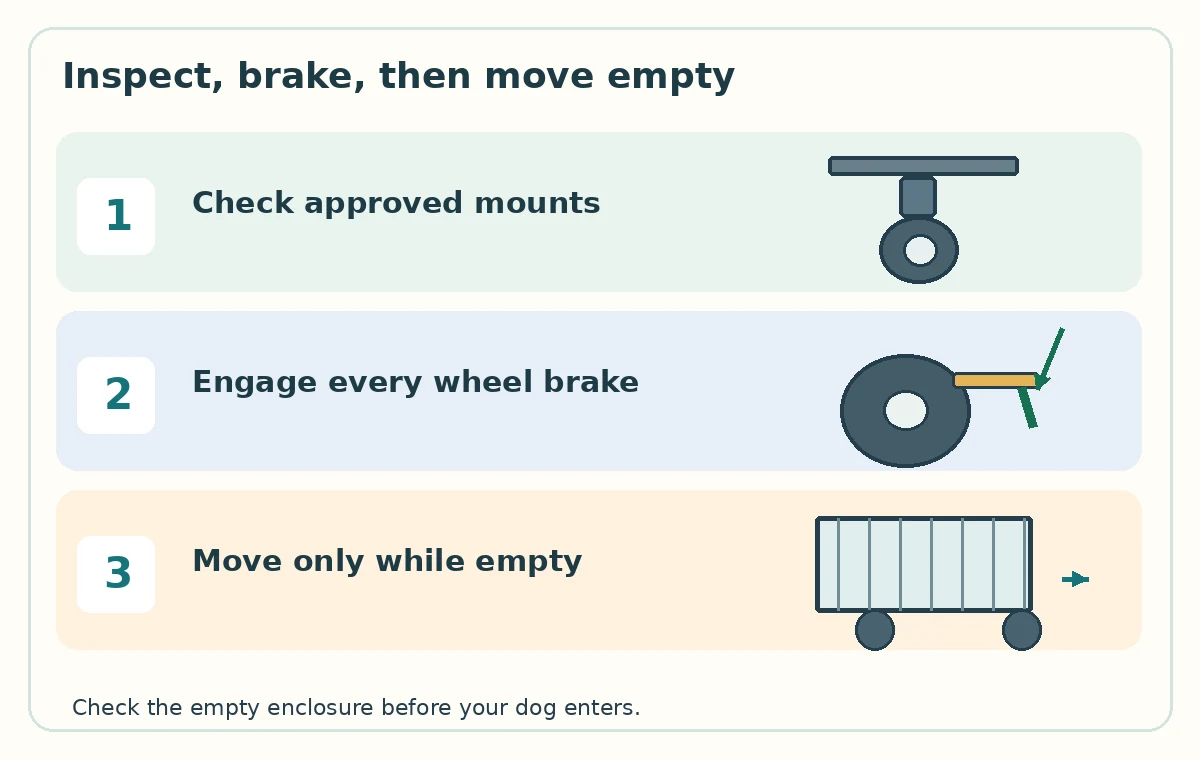
Check factory compatibility, all four mounts, brakes on every required wheel, the floor slope, and entrance height. Reposition the crate only while it is empty. Reapply the brakes and confirm the frame does not rock before admitting the dog. If the wheel assembly is loose, use a safe stationary alternative until correct parts are available. Do not rely on caster brakes in vehicles or near stairs.
How We Research
HubPet reviewed veterinary and welfare guidance from Cornell University, Dogs Trust, Battersea, and ASPCA. For equipment mechanisms, we also consulted manufacturer instructions. A product manual explains one design. It does not establish identical hardware or capacity across brands. We did not conduct load tests, crash tests, or comparative product trials. Use these steps as conservative at-home inspection points rather than safety certifications. Ask a veterinarian or qualified professional about severe distress, swallowed material, or changes in mobility. See our editorial approach.
Sources
Cornell University College of Veterinary Medicine — Dog Crates: When to Use Them and How to Pick One. Used to check the scope and limits of confinement, the equipment design, or the manufacturer-specific setup instructions.
PawHut Heavy Duty Dog Crate — Assembly and Caster Instructions. Used to check the scope and limits of confinement, the equipment design, or the manufacturer-specific setup instructions.
ASPCA — Separation Anxiety and Crate Confinement. Used to check the scope and limits of confinement, the equipment design, or the manufacturer-specific setup instructions.
No. Use only compatible mounting hardware specified by the crate maker; a similar-looking thread does not establish structural safety.
Follow the manufacturer’s design. When the design includes locking wheels, engage each required brake and test stability before use.
Avoid that practice. Move the dog to a separate safe area before repositioning a crate across the floor.
No. Rolling wheels are not evidence of crash protection. Use a properly secured travel arrangement suited to your vehicle.
Stop using the mobile base until the wheel, fasteners, and intended mounting points pass inspection and you correct the fault.