
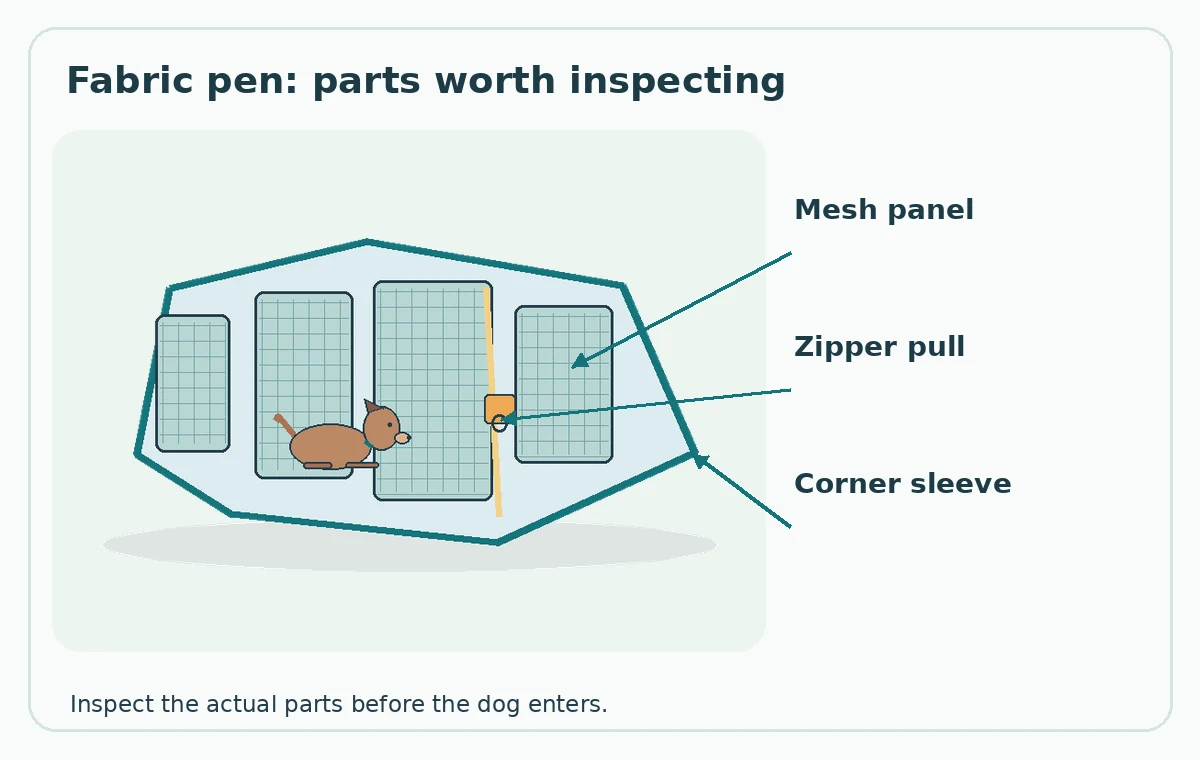
A portable fabric dog playpen looks lightweight and friendly, but its safety depends on the mesh, zipper tracks, seam strength, floor, and the dog’s habits. Some designs are useful for brief supervised sessions; others are inappropriate for dogs that chew, climb, or push through walls. The illustrations show recognizable parts to examine and differences to watch for. Follow the exact product restrictions and introduce the space gradually with rewards. Fabric barriers do not provide verified crash protection or prevent all escapes. For health-related limits, review the HubPet veterinary disclaimer.
What a fabric pen can and cannot do
A collapsible fabric enclosure is convenient for short supervised rest or a quiet familiar setup in a suitable indoor space. It is not automatically chew-proof, escape-proof, or approved for car restraint. Mesh windows may improve visibility, but cloth walls can collapse when a dog leans, jumps, or climbs them. Review the manufacturer’s weight, behavior, and use limitations. A puppy who is actively biting seams may be better managed behind a stable exercise pen or in a carefully pet-proofed room.
Trace the wall seams and corner supports
Run your eyes along the vertical supports, stitched fabric sleeve, and join at the floor. Gaps near corner poles or thin seams can become starting points for tearing. Press lightly against the empty playpen wall to see whether it returns to shape without a support folding. A seam that pulls open under normal handling is unacceptable. Look for accessible loose threads and strips that a dog might swallow. Never assume a thick-looking panel is stronger than a properly assembled metal pen.
Inspect mesh holes and visibility
A mesh panel should permit air exchange without allowing the dog to bite a dangling section or force a nose through damaged fabric. Look at the inner surface for protruding stitching, punctures, and sharp zipper ends. A dense cover over several panels changes airflow and visibility. Avoid heat, direct sun, or enclosed corners where air becomes stagnant. A fabric pen is a management space, not heat protection. Keep drinking water accessible during supervised use.
Check zipper tracks and pulls
Open and close each door slowly with the pen empty. The teeth should mesh smoothly, and the fabric should not enter the track. Inspect whether a looped zipper pull hangs within easy reach of a curious puppy. If a dog can push its head through a partly open door, the closure is not secure. Use the product exactly as designed; do not tie dangling pulls with an improvised cord. Replace a torn zipper assembly rather than trusting an unpredictable closure.
Compare a low-stress resting pen with an escape attempt
A comfortable dog may settle on bedding, watch the room, and choose to lie down. An unsettled dog may paw at the roof, climb the mesh, bite the entry seam, or repeatedly push a wall outward. Those are signs to intervene, not an invitation to buy a taller cover and leave the dog alone. ASPCA warns that confinement may increase distress in some dogs. Introduce the pen gradually and choose a different management plan when the dog cannot remain calm.

Choose a floor and door layout that work together
Place the pen flat on a stable nonslip surface and keep it clear of heaters, cables, and easy-to-grab furniture. Ensure the floor liner does not bunch under the door or lift at a corner. A removable floor is convenient only when the attachment remains secure during movement. Practice opening the door wide enough for the dog to leave without catching a leg. Do not drag an occupied fabric pen across a room or use the pen as a carrier.
Introduce it in brief, positive sessions
Set the open pen where people can observe the dog. Add a familiar comfortable rest surface and reward voluntary exploration. Once the dog chooses to enter, practice very short closure periods with you nearby, reopening before anxiety builds. Dogs Trust recommends patient introduction rather than forced confinement. If a dog starts panicking, switch back to easier training or a different safe room. A pen is not a substitute for breaks, attention, outdoor access, or needed medical care.
Fold, wash, and inspect before reassembly
Follow the manufacturer’s folding sequence so spring supports do not whip toward a person or pet. Remove the dog before handling the frame. When cleaning, use a product-appropriate method and fully dry the mesh, floor, and hidden seams. Folded damp fabric can develop odors and wear. Reopen the pen and verify that every corner sits securely before use. Check the floor remains securely attached and that no tie or strap dangles into reach after storage.
Know when a rigid alternative is safer
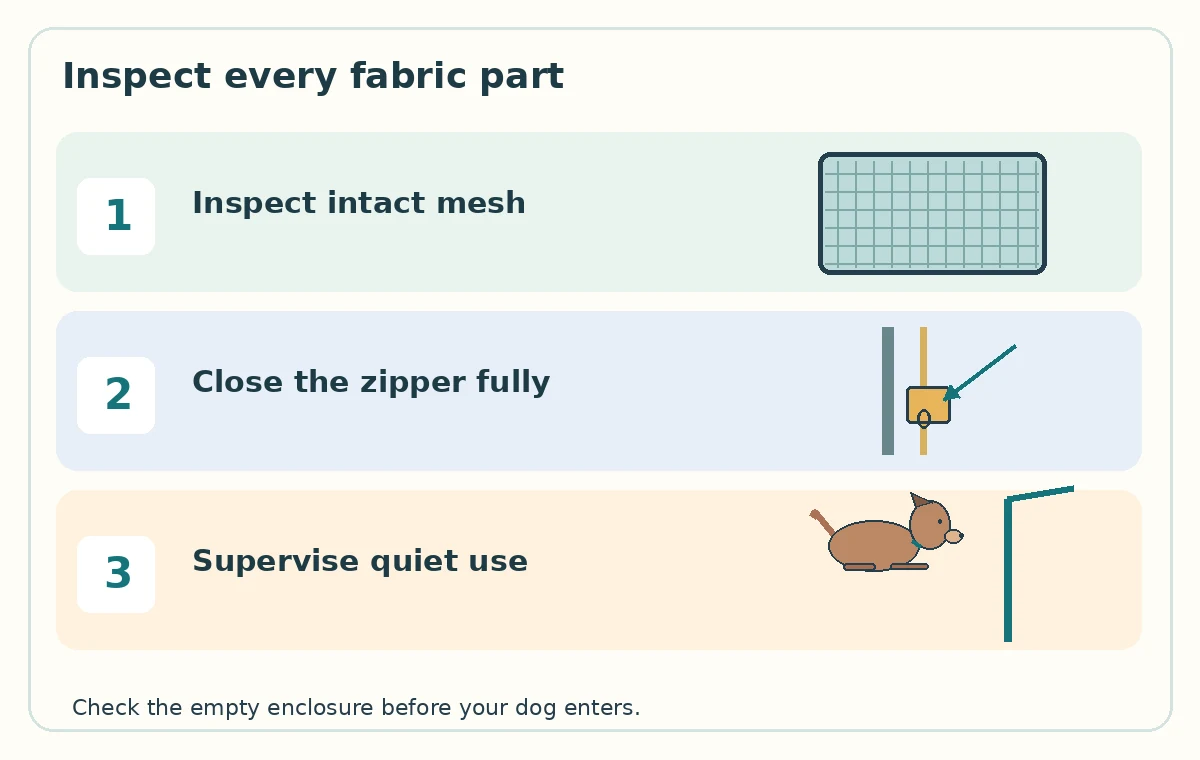
For dogs that chew through fabric, climb walls, or push hard enough to tip the pen, switch to an appropriate rigid barrier or a fully dog-proofed room. Match the setup to the dog’s actual behavior, not age or breed alone. Never use a fabric pen in a vehicle as though it were a crash-protective crate. If a pet shows severe separation distress or repeated escape attempts, seek individualized support from a veterinarian or qualified trainer rather than relying on stronger zippers.
Before you decide: a repeatable safety checklist
Check each seam, mesh panel, zipper, pull tab, floor attachment, and corner support in good light. Set the pen on a nonslip floor away from cords and heat. Watch the dog during a gentle first session. If chewing, climbing, wall collapse, or obvious distress appears, stop using the fabric pen. Store it dry and inspect again after folding. A zipper closure does not certify unsupervised containment.
How We Research
HubPet reviewed veterinary and welfare guidance from Cornell University, Dogs Trust, Battersea, and ASPCA. For equipment mechanisms, we also consulted manufacturer instructions. A product manual explains one design. It does not establish identical hardware or capacity across brands. We did not conduct load tests, crash tests, or comparative product trials. Use these steps as conservative at-home inspection points rather than safety certifications. Ask a veterinarian or qualified professional about severe distress, swallowed material, or changes in mobility. See our editorial approach.
Sources
Jespet — Portable Soft-Sided Exercise Playpen: Product Construction. Used to check the scope and limits of confinement, the equipment design, or the manufacturer-specific setup instructions.
Dogs Trust — Playpen and Crate Training a Puppy. Used to check the scope and limits of confinement, the equipment design, or the manufacturer-specific setup instructions.
ASPCA — Separation Anxiety and Crate Confinement. Used to check the scope and limits of confinement, the equipment design, or the manufacturer-specific setup instructions.
Do not assume overnight unsupervised use is suitable. Follow the model’s limits and consider the dog’s chewing, escape, and distress behavior.
Look for holes, loose stitches, accessible pulls, and areas where a nose or paw could become trapped or snagged.
No. A roof does not make a fabric frame escape-proof or structurally safe for a dog that jumps or climbs.
Only when the label explicitly permits it. Clean seams and zippers, dry fully, and reassemble according to instructions.
No. Remove the dog before moving or folding the enclosure. Use an appropriate carrier for transport.