
A cat introduction mesh gate is useful only when it reliably prevents contact while both cats stay able to retreat. A typical baby gate may have gaps a kitten can squeeze through, and a tall-looking barrier may still allow climbing. Visual contact should follow a period of comfortable separation and scent work, not replace it. This guide explains how to inspect mesh, edges, gaps, and mounting, then plan a short session in which the resident cat and newcomer can see one another with routes away from the doorway. For health and safety concerns, see our veterinary disclaimer.
Use visual contact only after scent work
Two cats do not need to look at one another immediately after adoption. Begin with a separate sanctuary room and allow both to settle, eat, and sleep reliably. Offer scent cloths and room exchanges while keeping them apart. Cats Protection describes moving to controlled visual interaction after earlier stages go calmly. If either cat still fixates on a cloth or guards the closed door, a gate will not resolve that tension. Wait and rebuild calm routines before revealing the other cat. The barrier is a management tool, not a substitute for the animals’ readiness.
Inspect the actual mesh openings
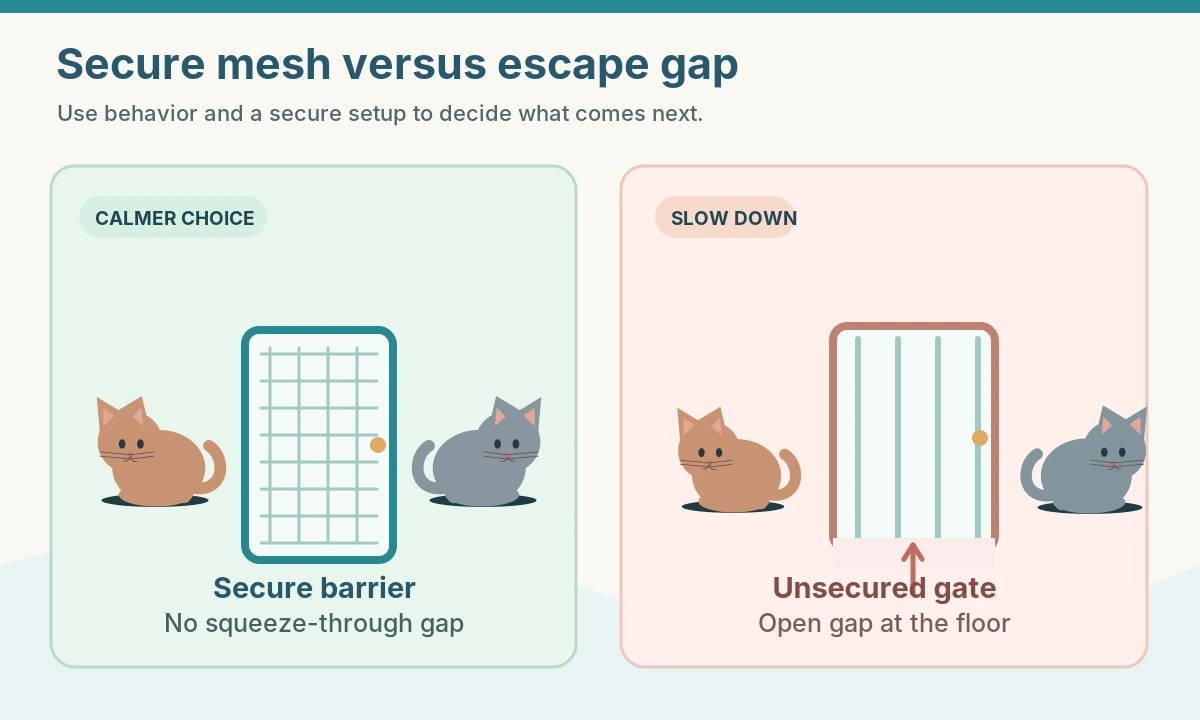
Check every corner, seam, and opening at the floor, not just the main center panel. A small kitten may fit through a gap that looks harmless to an adult human. Push gently on the empty barrier to see whether it sags or separates from its frame. Follow the manufacturer’s size and use instructions; never guess at a safe gap by comparing it with a cat’s head. Loose ties, torn fabric, exposed wires, and frayed straps can catch paws or tempt chewing. Replace a damaged gate rather than adding improvised string or hardware.
Choose the doorway and anchor points
Place the gate in a stable opening with secure hardware and enough clear floor on both sides for the cats to approach or retreat. A gate that relies on pressure can slip in an unsuitable opening; a mounted system may need specified structural backing. Use the instructions for the exact product and avoid modifications that create sharp edges. Keep electrical cables, shelves, and movable furniture away from the gate if they could become climbing aids. Before each session, test the empty barrier, then close the adjoining doors to prevent an unplanned escape into the wrong part of the home.

Control how much the cats can see
An opaque cover or door can reduce visual intensity while a cat learns that the other is nearby. Gradually reveal a small section only when both animals remain calm. Do not hold a towel over a cat or block every route away from the gate. Position food or rewards at a comfortable distance, not directly against the mesh. A cat looking briefly and then turning back to a normal activity is often more useful than a long frozen stare. End the view if body posture stiffens, either cat rushes forward, or the barrier becomes the focus of repeated pawing.
Plan a route away from the barrier
Visual sessions work poorly in a dead-end hall where one cat can pin the other against a corner. Provide clear retreat paths into separate rooms and keep door swings from obstructing them. Both sides need accessible resting and hiding locations that do not require passing directly in front of the gate. A raised perch can help a confident cat choose distance, but it should not be the only escape or require a difficult jump. Keep litter boxes and food away from the pinch point so no animal must face the other to meet basic needs.
Understand the difference between glass and mesh
A closed glass door prevents physical contact and often blocks direct scent transfer, while mesh allows more odors and airflow through. That extra information can be useful later, but it can also intensify responses when cats have not prepared for that intensity. Some cats may become frustrated by a visible barrier. Use each design according to the home’s layout and the cats’ behavior rather than assuming mesh is always gentler. Clean glass so the animals can see without sudden distortion. With mesh, inspect both sides for small gaps, stretched sections, and access to latches.
Supervise every early viewing
Have an adult present who can calmly end a session by blocking the sight line or closing an adjacent door. Never leave a kitten alone next to a questionable gate, even briefly. Do not tease the cats into reaching through openings, and keep hands away from the mesh if either cat lunges. If one cat begins stalking the barrier or repeatedly jumps at it, end the exercise rather than testing the gate’s strength. In homes with several cats, avoid gathering the entire group at once. Introduce individuals gradually so pressure remains manageable.
Read warning signs on both sides
Watch for flattened ears, fixed pupils, tense crouching, tail lashing, growling, and intense staring, but remember that any one signal depends on context. A cat that turns away, takes a treat without rushing, or resumes a normal activity may be more comfortable. Compare both animals, not just the confident newcomer. A quiet resident cat may feel overwhelmed while the other appears playful. If either stops eating afterward, hides excessively, or changes litter-box habits, step back to a closed-door routine and seek advice if these changes persist.
Make the first shared room easy to exit
A calm barrier session does not grant permission to leave the gate open indefinitely. For a brief supervised face-to-face meeting, select a room with multiple routes away from each other and no prized resource in a narrow passage. Let cats move voluntarily without carrying them toward each other. Keep a large visual screen, such as a piece of cardboard, available to interrupt an escalating stare from a safe distance. Never intervene in a fight with bare hands. Separate the cats into familiar rooms and consult a qualified professional if aggressive incidents repeat.

Retire unsafe barrier setups
Stop using a gate if it shifts under gentle pressure, the mesh develops tears, a latch fails, or a kitten discovers a climb or squeeze route. Pets can change size and behavior quickly, so a setup that worked yesterday may no longer be secure. Make a simple pre-session routine: inspect openings, check supports, clear hazards, verify both cats have retreats, and decide how the session will end. Do not use a barrier as a substitute for closing a room securely when no one is supervising. A safe introduction relies on control over the environment, not on the gate alone.
How We Research
We compared animal welfare and humane-society guidance on sanctuary rooms, scent exchange, barriers, resource distribution, and cat body language. These stages offer practical ideas, not a fixed timetable. For individual concerns, speak with a veterinarian or qualified feline behavior professional. We did not test or certify any training barrier, product, or treatment. We reviewed the source guidance in October 2026. Individual cats may need a slower approach. Learn more about our methods on the About HubPet page.
Sources
Cats Protection — Introducing Cats & Kittens (reviewed October 2026).
Seattle Humane — Cat to Cat Introductions (reviewed October 2026).
Blue Cross — Introducing Cats (reviewed October 2026).
Safety note: If either cat suffers an injury, becomes ill, stops eating, or shows persistent distress or aggression, contact a veterinarian. Do not separate fighting cats with bare hands, use physical punishment, or force contact.
Not necessarily. Kittens can squeeze through gaps or climb many gates. Use a secure barrier designed and checked for your actual doorway and pet.
Only if both cats are completely comfortable there. Begin rewards farther back so no cat must approach a stressful sight line.
A securely closed glass barrier can prevent contact and limit scent exchange. Choose the stage and barrier based on the cats’ responses.
Do not leave early introduction sessions unsupervised. Use closed, secure separate rooms when you cannot monitor the setup.
End visual sessions, restore distance, and return to calmer scent and room routines. Repeated aggression or guarding deserves professional guidance.