
This article gives general home setup and pet-product advice, not medical diagnosis or treatment. If your cat is straining, unable to urinate, in pain, or suddenly avoiding the litter box, seek prompt veterinary care. See our veterinary disclaimer.
A senior cat may be fully capable of using the litter box yet hesitate at a tall wall or a long walk to a distant room. The useful upgrade is often a simpler entry, a generous turning area, and a more accessible location—not an elaborate automatic system. Cats Protection and Cornell both recommend low-sided trays for older cats and cats with mobility limitations. This article is about box design and home setup, not diagnosing arthritis or urinary illness. Any new elimination trouble, pain, straining, or frequent attempts to urinate deserves veterinary attention promptly.
Observe the existing route before replacing a tray
Watch your cat move toward and into the current box without interrupting. Does it pause before lifting a hind leg, climb sideways over a tall wall, or stand at the edge because turning feels cramped? Is the box hidden behind a door that sometimes closes? Note whether a slippery mat shifts under the front feet. These observations can reveal a specific equipment obstacle without proving a medical diagnosis. For cats that have always preferred a covered box, changing both the enclosure and the litter texture at once may make the setup less familiar. Write down the likely barrier and change the least number of features needed to remove it. A veterinarian should assess a cat that suddenly avoids the box.
Measure the threshold rather than the outside wall
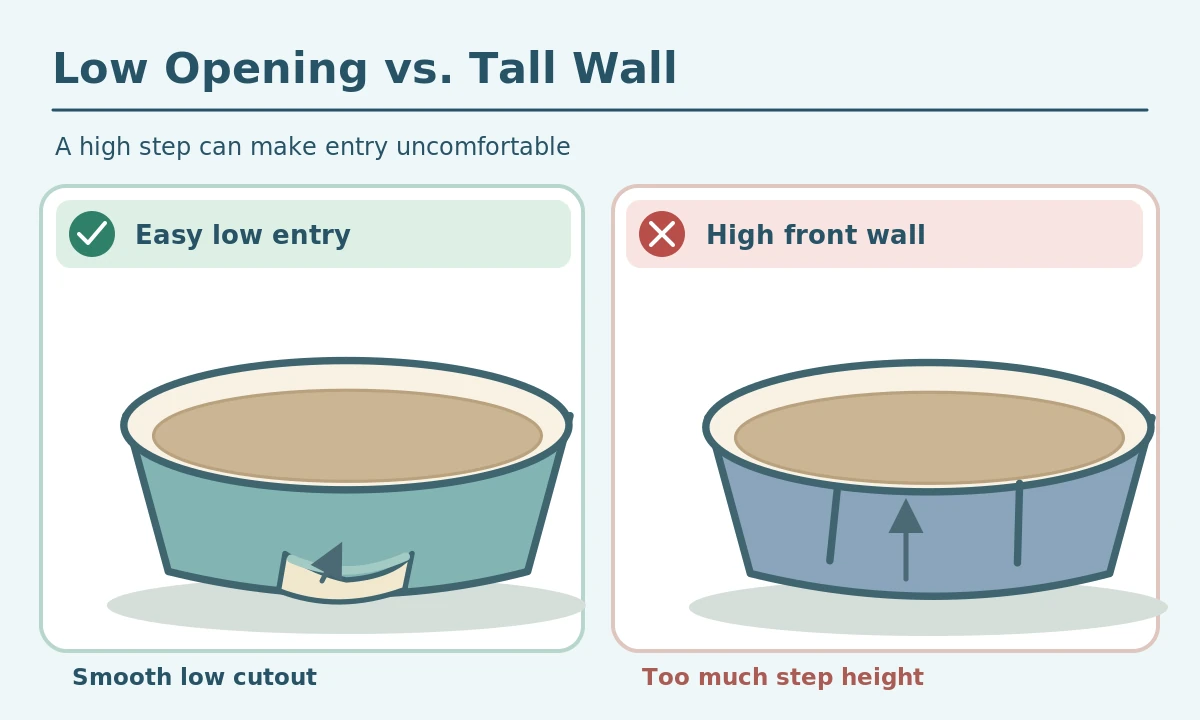
A senior-friendly tray can have high back and side walls to catch scatter while providing one wide, low front opening. Measure the vertical step from the floor to the actual lowest usable rim. Check that the cutout edge feels smooth and free of sharp plastic seams. A tiny V-shaped notch may still require the cat to lift its feet higher than expected. The entrance must be wide enough to avoid rubbing the cat’s hips or shoulders. If you need a truly shallow open pan, ensure it remains stable and does not permit litter to spill into a walking path. Do not create a jagged homemade cutout with exposed rough plastic edges.

Allow full turning and normal digging inside
The advertised length often includes the outer lip. Judge the usable interior and watch whether the cat can rotate without its body pushing against a wall. Cornell advises larger trays for larger cats, and feline welfare guidance often uses roughly one and a half times the cat’s nose-to-tail-base length as a useful starting point. It is a starting point, not a promise of fit. A low-entry box that is too short can cause a cat to position its rear over the wall or abandon the tray. Choose a level floor location with enough free space in front for a comfortable approach and exit. Do not solve a turning problem by raising a box onto a platform.
Keep the threshold dry, flat, and secure
The front edge should not flex downward when weight transfers onto it. Press the empty tray gently at the entrance, then test on the actual floor. A slick bathroom tile may require a stable mat that does not bunch or curl. Avoid placing the box on a wobbly step stool or slippery tray stand. If you consider a ramp, choose one that is wide, gradual, slip-resistant, and provide room for the cat to turn at the top. In many homes a floor-level shallow entry is simpler and safer. Inspect the rim after cleaning because cracks or rough scratches may be harder for a cat to tolerate. Replace a broken box rather than covering sharp edges with tape.
Compare high walls with low entrances
The fully low-sided pan reduces the step on every side but may scatter litter if a cat digs enthusiastically. A pan with tall sides and one low front opening can offer a compromise. Closed boxes can restrict visibility, retain odor, and create a single cramped escape route. Battersea advises against covered trays when possible, while Cats Protection notes that preferences vary by cat. Offer a choice if there is uncertainty, using familiar unscented litter in both trays. A lid is not essential for dignity or privacy; a quiet location with an unobstructed way out can provide more comfort than a closed top. Watch the cat’s actual use rather than relying on a product label.
Place a box on each floor where the cat spends time
Stairs can turn an otherwise appropriate toilet into an inaccessible resource. Cornell advises keeping boxes on the same level as a cat that has trouble climbing. Cats Protection suggests multiple accessible locations in multi-level homes. Put a box near the cat’s favored resting area but still away from food, water, and heavy traffic. A doorway that closes unpredictably can make a nearby box effectively unavailable. Consider a night-light outside the box path, as Cats Protection recommends for some older cats; keep cables safely routed. Where there are several cats, separate the boxes so one animal cannot block every route. Make access continuous rather than requiring a person to open a door.
Use a familiar litter and maintain clean footing
If your cat prefers a particular unscented litter, preserve it while evaluating the box. Some older cats may be sensitive to hard pellets under their paws; the International Cat Care home-modification guide notes that softer substrates can be preferable for cats with pain or mobility problems. Avoid forcing a new litter and a new tray at the same time. Scoop regularly so the cat does not have to step around wet clumps. Wash the box with mild soap as instructed and dry it before refilling. Check that the mat and the box underside remain dry; damp floors can become slippery. Keep the opening clear of stored supplies and trash bins.

Know when an easier box is not enough
If the cat suddenly cries in the box, strains to urinate, visits repeatedly without producing urine, or shows marked discomfort, contact a veterinarian urgently. Trouble producing urine can be an emergency. Increased accidents, constipation, or changes in drinking also warrant professional assessment. A new low-entry box may reduce a physical obstacle but cannot treat disease. Keep a brief record of trips and whether the cat can enter and leave without hesitation. Offer multiple suitable trays while any veterinary investigation is underway, without withholding access or punishing accidents. The best product decision leaves the cat with a predictable, safe route and enough room to use its toilet naturally.
How We Research
We reviewed original welfare and veterinary information from Cornell Feline Health Center, Cats Protection, International Cat Care. We compared its guidance on litter box dimensions, location, cat access, and hygiene to the practical limitations of the layouts described here. Our figures illustrate common tray and room designs rather than a specific commercial product, and we do not claim independent laboratory tests or veterinary diagnosis. Readers should verify manufacturer instructions for individual materials and home fixtures. For more information about our approach, see About HubPet.
Sources
Cornell Feline Health Center, House Soiling. Read the original guidance.
Cats Protection, Cats & Toileting. Read the original guidance.
International Cat Care, Home Modifications. Read the original guidance.
Safety note: Keep litter waste away from children and dogs, wash hands after handling dirty litter, and follow the litter manufacturer’s disposal directions. Ask a veterinarian about a sudden change in your cat’s elimination, painful or frequent attempts to urinate, or other concerning signs. Do not use a new box or barrier as a substitute for clinical advice.
Choose the lowest smooth step your cat can cross comfortably; judge actual floor-to-rim height rather than the product’s name.
Not automatically. A cover can reduce visibility or make a cramped doorway; offer a roomy open alternative if the cat hesitates.
A box on every frequently used level helps cats that find stairs difficult and reduces the chance that a door blocks access.
Avoid jagged or weakened edges. A purpose-built smooth low-entry tray is generally simpler and safer.
Arrange veterinary assessment promptly. A change in toileting can reflect pain, urinary disease or other conditions beyond box design.