
A dog poop bag dispenser seems simple until a roll jams, the cap falls off, or the holder swings against your dog during a walk. The best choice is not necessarily the biggest or most decorated case. It is the one you can reload with cold hands, attach securely to your own leash, and use without pulling the whole roll onto the sidewalk. This guide uses a practical fit-first checklist rather than brand rankings. You will learn how to examine a holder before buying, test the feeding slot, place it away from moving leash hardware, and carry a backup bag without creating loose plastic litter.
Measure the roll before choosing the shell
Check the diameter of a full roll, the length of its cardboard or paper core, and the width of the folded bags. Standard-looking rolls vary between brands, so a holder that fits one replacement roll may bind on another. Leave space for the roll to turn freely instead of relying on force to close a small case. Look for a lid that closes completely without squeezing the bag edges. If you switch bag brands, test a fresh roll, not one that you have partly used. A refill slot should remain accessible without disassembling the leash attachment.
Look at the feed opening, not only the exterior
A generous opening can allow several bags to spill out; a narrow one may tear the next bag as it catches the perforation. The useful design has a smooth edge and enough room to pull one bag at a time. Feel for burrs, rough seams, and sharp molded corners. Pull several bags through while the unit hangs vertically, which better imitates a walk than testing it flat on a kitchen table. Inspect how the final bag leaves the roll and whether you can start the next roll without awkward threading. Aim for controlled separation with minimal tugging.

Choose a leash attachment that stays put
Carabiner-style clips are convenient to move between leashes but can rattle, twist, or open when they catch another object. A strap loop may stay quieter, provided the stitching and fastener hold up to regular use. Neither attachment should carry the dog or serve as a safety-rated leash connector. Put the dispenser on a handle loop or a dedicated accessory point, not on the load-bearing clip that attaches to the collar or harness. Check that your wrist and thumb can reach the bag without reaching across the dog or the leash line.
Test one-handed access before a real walk
Fill the case, clip it where you plan to use it, and try pulling one bag while holding the leash in your other hand. Repeat with a jacket on and with damp fingers. A stiff lid, cap that unscrews unintentionally, or dangling holder can turn a routine pickup into a balancing act. Avoid using your teeth to open bags, and do not let the dog mouth the holder or loose rolls. If the first bag will not feed smoothly, rethread it or change the holder before the walk instead of fighting with the mechanism beside traffic.
Compare rigid cases and soft pouches
A rigid plastic barrel usually protects a roll from crushing but may create extra noise and a hard swinging object. A fabric pouch can be quieter and more flexible, yet wet fabric takes time to dry and loose stitching can trap grime. Silicone shells often squeeze onto a roll without a threaded cap, but the closure and feed opening still deserve inspection. Think about your real route: a short urban trip may prioritize speed, while long muddy walks may favor washable surfaces and secure closure. There is no universal winner; reliability after repeated loading matters most.

Keep spare bags and used bags separate
A built-in pocket may hold a few emergency bags, but do not treat a waste-bag holder as a hygienic place to store used waste. Place sealed waste into an approved trash container as soon as practical. Keep the clean refill roll away from the pickup area, and wash your hands with soap and water after handling feces, even when a bag prevents direct contact. If a park bin is unavailable, use a dedicated, closed carry solution until you reach an appropriate trash container. Never leave filled bags on a trail as a plan to collect them later.
Spot the weak points in a low-cost holder
Examine the cap thread, hinge, clip spring, and seam where a loop joins the body. A case that survives a few drops is useful, but a missing cap or broken attachment can scatter bags. Avoid exposed sharp screws and brittle pieces your dog might chew. If the holder uses magnets, ensure the enclosure keeps them away from pets; loose magnets pose a risk when swallowed. Clean soil from the feeding slot and let the case dry before adding another roll. Replace the holder when it no longer closes consistently rather than trying to secure it with loose wire.
Run a quick pre-walk checklist
Before leaving, check that at least two usable bags remain, the case closes fully, and the attachment cannot interfere with leash operation. Pull a small section to confirm the next bag is ready. Keep bags away from toddlers and pets because thin film can pose a suffocation hazard. During pickup, invert a bag over your hand, collect all visible waste, tie it securely, and use an appropriate waste bin. Wash or sanitize hands afterward, then use soap and water when available. This simple routine reduces missed pickups without relying on a fancy mechanism.
Make a buying decision based on repeatability
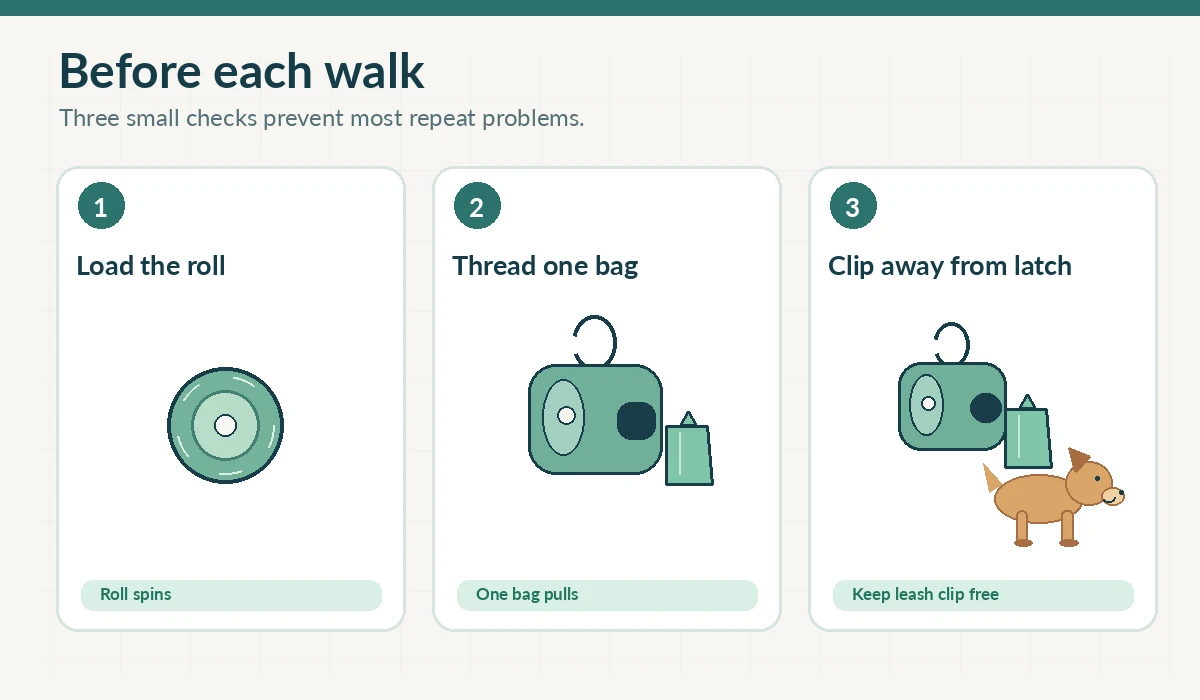
A suitable dispenser passes three ordinary tests: the roll spins, a single bag tears away at the perforation, and the holder does not move into the leash hardware. If any test fails with your preferred bags, choose a different opening or attachment style rather than altering the roll. Keep your initial setup simple until you know where the holder works on your walking kit. A spare bag stored in a separate pocket is still smart insurance. Buy for reliable retrieval, not for claims that a holder somehow makes pet waste environmentally harmless.
How We Research
We review public-health guidance, the actual functions of the tools discussed, and the practical disposal pathway before recommending a setup. Our checklist focuses on access, clean handling, failure points, and the difference between product claims and outcomes. We do not claim to have independently tested individual products, inspected local facilities, or verified a manufacturer’s unprovided performance data. Check current municipal rules and read our editorial approach. Sources reviewed October 28, 2026.
Sources
CDC, Dogs: Healthy Pets, Healthy People. Read the original guidance. Accessed October 28, 2026.
CDC, Ways to Stay Healthy Around Animals. Read the original guidance. Accessed October 28, 2026.
Philadelphia Water Department, Pet Waste = Pollution. Read the original guidance. Accessed October 28, 2026.
Safety note: Pet feces may contain germs or parasites. Use appropriate waste containers and wash hands after cleanup. This article offers general product and hygiene guidance, not veterinary advice. Read our veterinary information disclaimer.
No. Roll width, core size, and diameter vary. Measure a full refill roll and confirm the case closes without pinching the bags.
Neither is automatically better. Check the fastening and choose the version that stays secure without interfering with the leash clip.
The slot may be too wide, or the leading bag may not be threaded correctly. Test the feed position with a fresh roll.
Keep used waste separate from unused bags. Tie it closed and place it in an approved trash container as soon as practical.
Wipe the exterior when dirty, clean the dispensing slot after contamination, and let it dry fully before loading clean refills.