
General pet-care information, not veterinary advice. Special diets, allergies, chronic illness, puppies and kittens may require individualized guidance from your veterinarian. If your pet swallows a foreign object, seems unwell or may have eaten a toxic ingredient, contact a veterinarian promptly. Read our veterinary disclaimer. Lick pads for dogs, often called lick mats, have textured food surfaces that invite a dog to lick off a thin layer of an appropriate spread. They can turn part of a regular meal into a slower activity, but they are not a substitute for supervision, separation training or veterinary care for anxiety. The useful choice depends on the mat’s size, material, texture, grip and your dog’s habit of chewing objects. This guide shows a simple setup and when not to use one.
Choose a food-safe pad large enough for the dog to lick without folding, inspect for cracks and loose pieces, and introduce it on a non-slip floor while supervised. Begin with a small amount of the dog’s usual wet food or another veterinarian-approved filling, spread thinly through the grooves. Remove the pad as soon as licking changes to chewing. Clean and dry it thoroughly after each use, including deep channels.
Choose a lick pad by your dog’s actual habits
A large gentle licker may enjoy broad shallow grooves while a puppy that shreds rubber needs close supervision with the same mat. Check whether the manufacturer describes the material as food-contact safe and gives cleaning instructions. Suction cups can help on a smooth clean surface but may fail on textured flooring; never count on suction to prevent a powerful chewer from ripping up a pad. Choose manageable grooves rather than complicated deep patterns that trap food. A snuffle mat is different: it hides dry food in fabric and cannot replace a spreadable lick pad.
| Dog or home | Pad feature to seek | Caution |
|---|---|---|
| New user or short session | Broad shallow texture | Start with easy access, not difficult puzzles |
| Small dog or puppy | Size and thin spread suited to mouth | Supervise closely; chewing may make pad unsuitable |
| Large dog | Stable large food-safe surface | Do not let dog swallow corners |
| Tile or smooth floor | Reliable grip with easy release | Check suction each time |
| Dog with dietary restrictions | Use prescribed complete food only with vet approval | No peanut butter or extras by default |
Fill the grooves without adding hidden calories
A lick pad does not need a mountain of peanut butter, cream cheese or sugary fruit. For many dogs, a little of their regular complete wet food or kibble softened according to its feeding instructions can make the activity familiar. If using a separate treat, verify every ingredient is safe for dogs and count it in the dog’s daily allowance. In particular, avoid peanut butter containing xylitol, and never use chocolate, onion, garlic or grapes. Thin spreading makes the dog work with its tongue without consuming an oversized treat.

A calm introduction in five stages
- Place a clean pad on a stable, washable floor where the dog can move away freely.
- Let the dog sniff the unused pad, rewarding calm interest without forcing contact.
- Spread a thin, easy layer of the dog’s own approved food across a few grooves.
- Stay nearby and allow a short relaxed licking session; take it away if the dog lifts or chews the edge.
- Wash grooves thoroughly according to manufacturer instructions, rinse and allow complete drying before storing.
- At the next session, adjust the food amount or groove difficulty based on interest, frustration and hygiene.
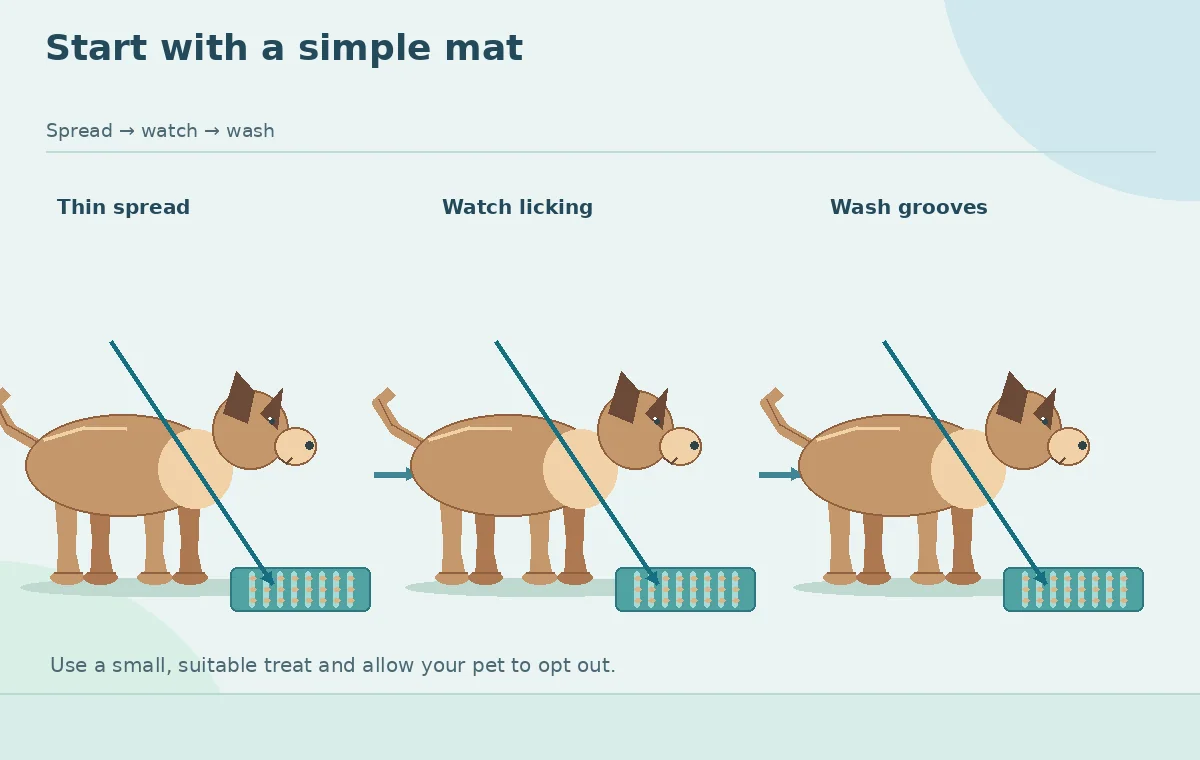
Dogs do not need to finish every groove. Watch posture: loose body and voluntary licking can suggest engagement; frantic pawing, chewing corners, carrying the mat away or guarding it means stop and reconsider the setup. Never use it to distract a dog through a procedure that is frightening or painful without a cooperative-care plan. If the pet guards food, begin with an easier alternative and get qualified help rather than grabbing a mat from its mouth. See why dogs guard food and toys for a separate resource on guarding.
Frozen versus unfrozen pads and common problems
Freezing a thin spread may extend the task for some dogs, but it also changes texture and difficulty. Introduce unfrozen food first and avoid a rock-hard frozen object for a dog with dental problems. Do not leave a pad on a crate door or vertical surface unless the product is explicitly designed and secured for that use; a falling pad or loose suction cup is an ingestion risk. Homemade DIY pads made from loose scraps, glued textures or sharp plastic are not equivalents to purpose-built food-safe products.
| Observation | Likely setup issue | Action |
|---|---|---|
| Pad slides across floor | Grip or placement poor | Use stable surface; supervise |
| Food remains stuck deep in grooves | Texture is too difficult or thickly loaded | Reduce depth or spread thinner |
| Dog bites off edges | Material is chewable for this dog | End use; check for swallowed pieces |
| Residue or odor after washing | Grooves not fully cleaned | Deep clean and dry or replace |
| Dog becomes tense when approached | Possible resource guarding | Give space; consult qualified professional |

Lick pads are enrichment—not anxiety treatment
Repetitive licking may occupy a dog briefly, but evidence that a particular pad treats separation anxiety is insufficient. When a dog panics during absences, cannot settle or injures itself, speak with a veterinarian or qualified reward-based behavior professional. A mat may be one optional environmental activity within a larger plan, not a treatment or an excuse to leave the dog in distress. For broad environmental ideas, visit the weekly pet enrichment checklist and choose activities that do not require edible extras every time. If you also have cats, the published cat chew-toy safety guide covers small detachable toy parts and other enrichment hazards.
When to Call Your Vet
Seek veterinary advice if your dog may have swallowed rubber, silicone, a suction cup or any broken mat piece. Repeated vomiting, abdominal pain, lethargy or difficulty swallowing after chewing a pad can be urgent. Discuss safe fillings in advance if your pet has food allergies, diabetes, obesity, pancreatitis or a prescription diet. An unexpectedly strong urge to chew or eat nonfood material can also warrant a medical assessment.
How We Research
We used VCA information about enrichment and foraging tasks, AAHA calorie guidance, and ASPCA toxic-food advice. The instructions focus on material integrity, easy entry-level activity and hygiene rather than unsupported claims that licking treats anxiety. Cleaning and dishwasher suitability depend on the exact product instructions, not an assumed universal temperature. Learn about our research approach on About HubPet.
Sources
VCA — Behavior Management: Enrichment and Activity Toys; AAHA — Prevention of Obesity; AAHA — Feeding Plans for Healthy, Appropriate Weight Cats and Dogs; ASPCA — People Foods to Avoid Feeding Your Pets.
Some dogs may engage calmly with a pad, but a lick pad is not a proven stand-alone treatment for anxiety or separation distress.
Usually the dog’s own veterinarian-approved wet food is a straightforward choice. Avoid toxic ingredients and account for all extra calories.
Try a thin unfrozen spread first. Freezing can increase difficulty and is not suitable for every dog or dental condition.
No. Puppies may chew and swallow flexible material; supervise closely and remove it when chewing starts.
Do not use improvised glued or sharp-textured plastic that can shed pieces. A purpose-built washable food-safe product is safer.