
This article is for general education, not veterinary advice. For pain, injury, serious distress or an unexpected behavior change, consult your veterinarian. Read our veterinary disclaimer.
The question where to cut my dog’s nails is about the position of each cut, not simply where to buy clippers. Inside the hard outer claw sits the quick, which contains blood vessels and nerves. Cutting into it hurts and may cause bleeding. With pale nails you may see a pink inner area; with dark nails you often cannot. The safe region is the small hard tip beyond the quick, and the amount you can remove differs from nail to nail. If you cannot identify a safe endpoint, ask a veterinarian or qualified groomer to demonstrate rather than guessing.
Locate the hard tip and avoid the quick
Look at the nail from the side under good light while your dog is comfortable. On a pale nail, the pink quick often shows through the shell, but its very tip can extend farther than it appears. Leave a cautious margin between the clipper and that area. VCA describes removing only a small amount beyond the quick rather than aiming for an arbitrary nail length. Do not cut into the fleshy toe, paw pad, or curved portion that seems close to the quick. The outer tip is the target; the live tissue is not.
With a dark nail, no visible pink line tells you where to stop. A cautious owner may shave tiny slivers from the end and inspect the exposed surface after every one, stopping immediately if the center changes or the dog’s response suggests discomfort. Do not keep trimming until you see blood; that is already an injury. If you feel uncertain at any point, stop before the quick and seek a demonstration. The published general home trimming guide covers the wider routine; this page concentrates on cut location and risk.
| Nail you see | Safe decision | When to stop |
|---|---|---|
| Pale with visible pink quick | Trim a small hard tip with margin | Before reaching pink tissue |
| Dark opaque nail | Remove only tiny end slivers cautiously | Any uncertain center or dog distress |
| Long curved dewclaw | Inspect tip and proximity to skin | If curved into pad or too close |
| Split or bleeding nail | Do not attempt routine shortening | Arrange veterinary assessment |
| Dog resists paw touch | Return to reward-based handling | Before restraint escalates |
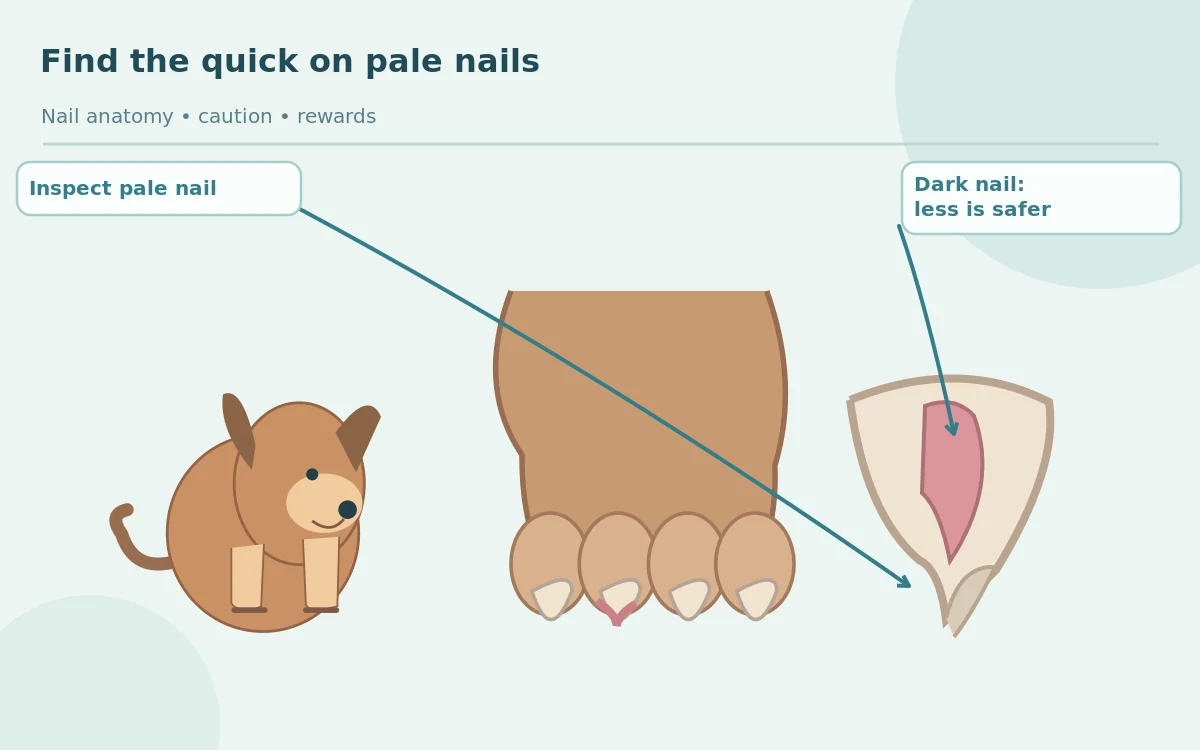
Match the cut angle to the nail you see
Dog nails curve differently. Assess the actual curved tip rather than clipping a preset amount from every toe. Support the paw gently without twisting a joint. Keep the clippers stable and make a modest cut only where you can see a clearly hard, free nail tip. Avoid a wide bite that could crush or split the nail. A grinder may allow gradual shaping, but heat, sound, and vibration can frighten a dog; introduce it slowly and never press in one spot for long. Filing does not remove the need to avoid the quick.
Check dewclaws on the inner side of the legs because they may not touch the ground. Some dogs have dewclaws on hind feet too. Unlike the walking nails, they rarely wear against pavement and can curl toward the pad. Use the same careful location assessment for them. If a claw is embedded in a pad, split, or misshapen, do not attempt to cut around the injury; contact a veterinarian. The aim is a comfortable functional nail, not a perfect visual match across all toes.
- Choose good lighting and a calm, nonslip position for the dog.
- Inspect each nail separately and identify a free tip beyond any visible quick.
- Hold the paw gently and align the clipper with only a small amount of hard tip.
- Make one conservative clip, inspect the new surface, and reward a comfortable dog.
- Stop for pain, uncertainty, bleeding, or fear; ask your veterinary team for help.
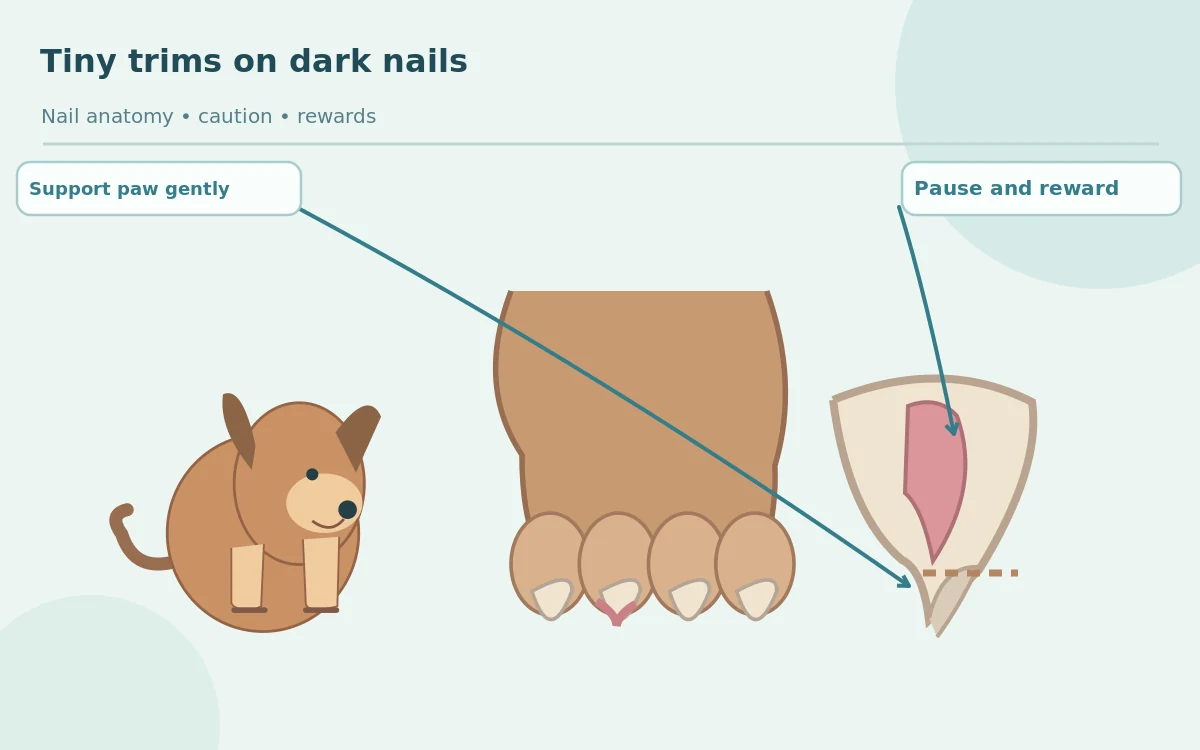
Use a stop-and-check method rather than a deep clip
Start only when your dog accepts a brief paw touch. Touch the clipper to the tip, reward, and release. A successful session might end after one nail, especially with a dog learning the routine. When you do trim, check each nail separately instead of copying the amount removed from a neighbor. Nail growth and quick length vary. Keep styptic powder available and know whom to call if bleeding persists, but do not treat having it nearby as permission to cut close to the quick.
Watch the dog’s body language. Pulling away, freezing, trembling, lip licking, growling, or snapping can mean the handling is too much. Stop and rebuild comfort with very short sessions. Never punish a warning or restrain a panicking dog to finish a paw. A professional can show you hand placement and help decide whether a clinic visit is appropriate. For owners looking for an appointment rather than an anatomical guide, the difference is between service selection and learning a safe cut position; do not confuse the two.

Recognize when the nail should not be trimmed at home
A broken nail may involve the sensitive quick even if the bleeding looks minor. Swelling at the nail bed, discharge, limping, a toe held off the floor, or a nail curling into skin deserves veterinary care. Sudden refusal to let you touch a paw can signal pain. Do not attempt to remove an embedded or partially torn nail yourself. Talk with your veterinary team about a comfortable plan before repeating a difficult procedure. For routine grooming and handling context, our published at-home dog grooming article covers additional daily checks.
After a successful small trim, let your dog walk naturally on a secure surface. Avoid chasing a cosmetic length target. Even if the nails still look longer than you expected, stopping short can be the correct decision when the quick is long. Future sessions can be gradual as advised by a professional. Keep notes about which nails were easy or difficult to see, and which type of clipper felt controlled. That information is more useful than trying to remove the same number of millimeters from every nail.
Anatomical illustrations are simplified: real quick length differs by animal and may not follow a tidy straight boundary. Dark pigment limits what you can see, and nails that have grown very long may have a long quick as well. No image can confirm the location of live tissue inside your own dog’s nail. If a nail is unusual or you cannot find a safe tip, do less or stop. The most useful skill is knowing when a tiny trim is safe and when it is time to ask someone trained to look directly at the paw.
When to Call Your Vet
Contact a veterinarian for persistent bleeding after a short cut, a torn nail, lameness, discharge, swelling, an embedded dewclaw, or pain with normal movement. If your dog becomes highly distressed or tries to bite during handling, stop and request a cooperative-care plan. This anatomical guide cannot diagnose a paw injury or replace a hands-on exam.
How We Research
HubPet reviewed the search question against animal-welfare, veterinary, and equipment-installation guidance as relevant. We used sources for safety principles, then translated them into checks you can perform at home. We did not claim to test or certify any named product or provider. Read our editorial approach.
Sources
VCA — precise dog nail cutting and quick guidance — background for the specific safety and behavior recommendations above.
ASPCA — nail tip inspection and handling guidance — background for the specific safety and behavior recommendations above.
SPCA New Zealand — nail anatomy and the quick — background for the specific safety and behavior recommendations above.
It lies inside the hard claw and varies by nail. A pink area may be visible in pale nails, but its tip can be difficult to judge.
There is no safe universal distance. Remove only cautious tiny end slivers, inspect each cut, and seek professional help when unsure.
The curve can be a visual clue, not a guarantee. Stay beyond the quick and stop sooner if live tissue may extend into that area.
Yes. They may not wear on the ground and can curl into the pad. Check them individually and ask a vet about embedded claws.
Stop clipping, apply gentle pressure and appropriate styptic product if available, and contact your veterinarian if bleeding continues or the dog is in pain.