
This article offers general humane dog-training guidance, not veterinary diagnosis or a guarantee of safety. Use secure, comfortable equipment and follow local leash and traffic rules. If your dog shows pain, sudden behavior change, intense fear, or aggressive responses, consult a veterinarian and an appropriate qualified reward-based behavior professional. Read our veterinary disclaimer.
A dog who knows a cheerful “This way” cue can move with you when a path becomes crowded or an unexpected distraction appears. The goal is an ordinary change of direction, not a sharp correction that twists the neck or surprises the dog. Teach the turn on a quiet floor, then move outside in small stages. A loose leash and a comfortable harness help you communicate without using pressure. The cue should predict a clear route, a reward, and room to breathe.
Begin where the dog can easily turn
Choose a level, uncrowded area with enough space for both of you to trace a broad curve. Put away other pets and rolling toys. Clip a standard leash to well-fitted equipment and check that the dog can turn its shoulders freely. Stand with the dog near your preferred walking side, without hauling it into position. Reward an ordinary glance toward you. Practice two or three steps in a straight line before attempting a curve. If the dog is already worried, panting hard, or fixated on something, increase the distance or end the session. This is a foundation exercise, not an emergency drill.
Show the path before naming it
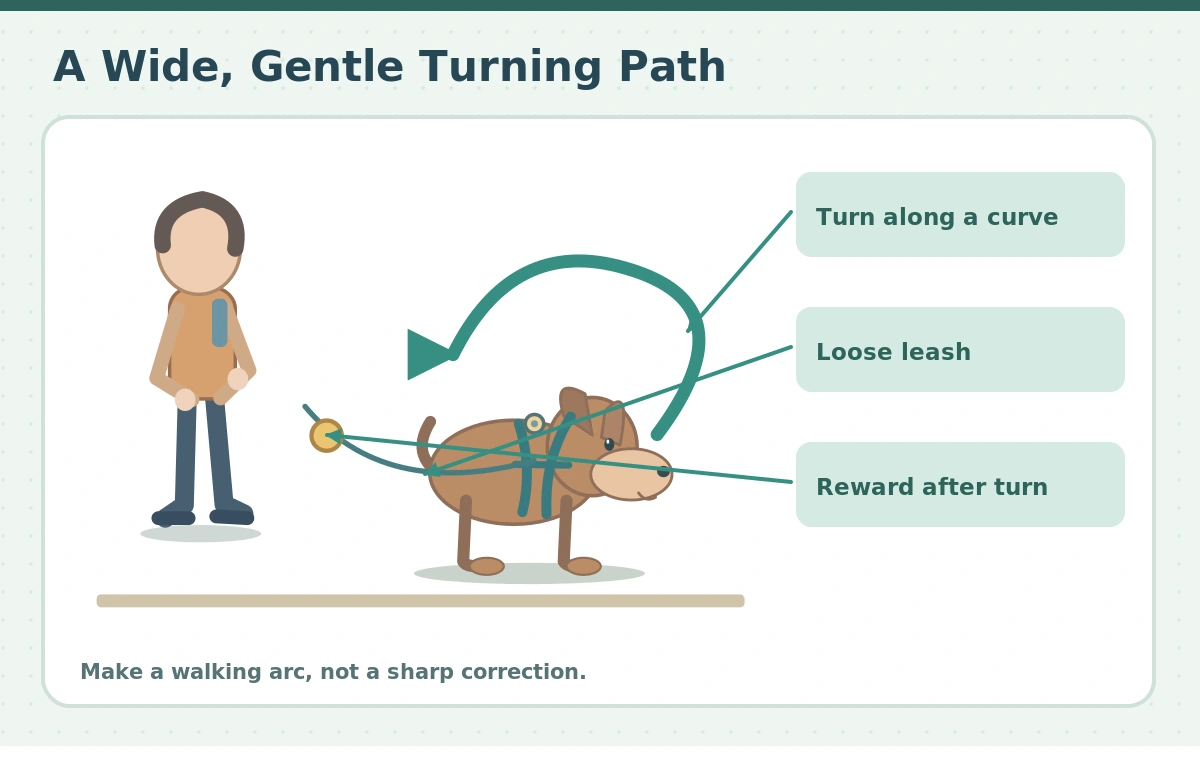
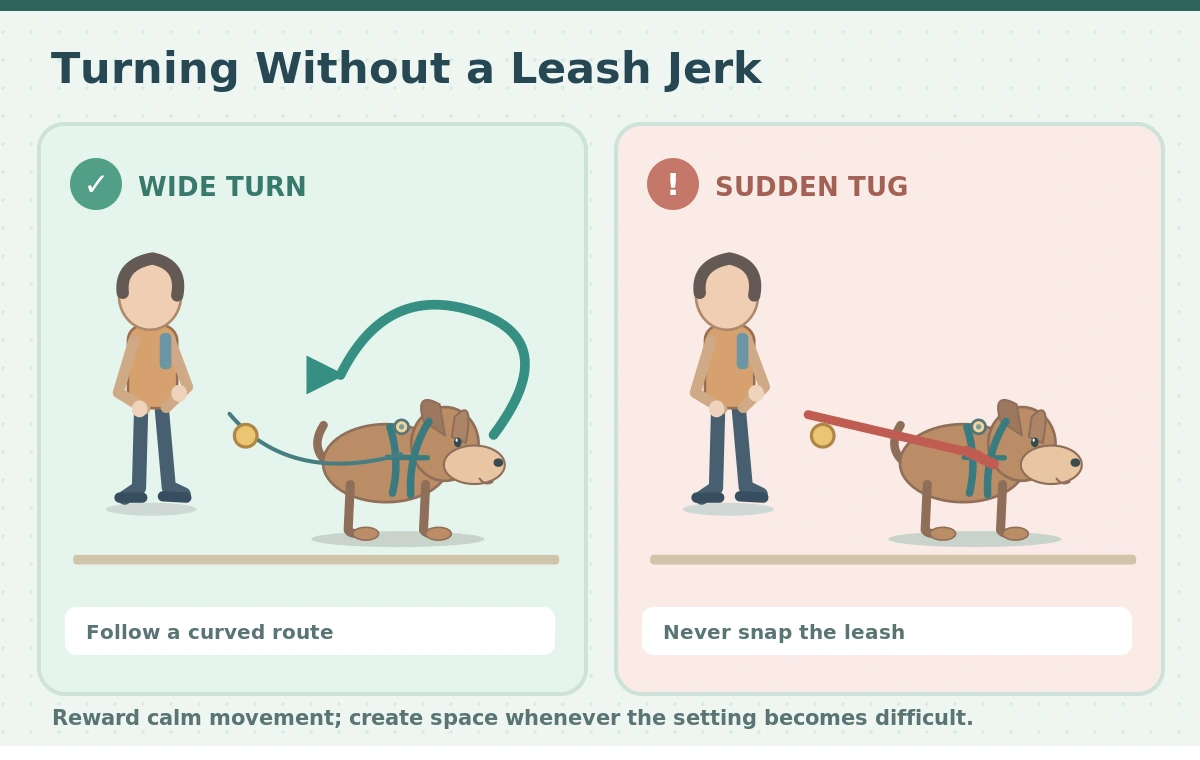
Hold a treat near your leg on the side where the dog is walking. Begin to arc away from the original direction, keeping the treat low enough that the dog does not jump for it. Mark and reward as its body follows your path. Your feet should walk a broad U, not pivot abruptly on a planted heel. Keep the leash soft and let the dog choose to move after you. Try both turning directions, but do not force a tight turn against stiff joints or limited mobility. A dog that stops may need a slower movement and an easier setup.
Add the cue before your feet turn
Once the dog follows the broad arc without being dragged, say “This way” in a friendly voice just before starting the turn. Use the same phrase each time. Reward when the dog turns and reaches the new walking line, not merely because you repeated the words. Your dog is learning that the sound predicts following a new route. Keep a brief pause between repetitions so that the cue remains meaningful. If you say it repeatedly while the dog ignores you, return to an easier indoor practice. Avoid pulling the leash to make the response happen.
Place rewards where you want the dog to land
The treat should appear beside the leg on the new direction of travel. If you feed directly in front of your knees, the dog may cross your feet and create a trip hazard. If you toss food behind the dog, the turn can become a sudden spin. Deliver one reward near your walking side and continue a few calm steps. You can also reward by moving toward a safe, interesting sniff spot after the successful turn. Battersea describes teaching turns with guidance and rewards; practice should stay voluntary and comfortable throughout.
Practice one distraction at a time
Start with a stationary object at a generous distance, such as an empty bench or a familiar person standing quietly. Give the cue before your dog reaches the object and reinforce the curved exit. Later, rehearse near mild outdoor distractions while keeping plenty of space. The aim is to leave before the dog becomes overwhelmed. If the dog barks, lunges, freezes, or cannot take its reward, do not shorten the distance. Walk away calmly, give it recovery time, and consider qualified reward-based coaching for persistent difficulty.
Use sidewalk space thoughtfully
A public sidewalk has curbs, bikes, pedestrians, and road traffic. Check behind you before changing direction, and make sure the new path remains on safe pavement. Do not step into traffic, swing the leash across a bicycle lane, or cause the dog to cross in front of moving people. Sometimes a simple pause behind a parked barrier is safer than a turn. A route change is a management option, not a promise that every encounter can be resolved through one cue. Keep your attention on the environment as well as the dog.
Fade the lure without losing clarity
After successful repetitions, make the same arm movement with an empty hand, then reward from your treat pouch after the turn. Gradually shrink the hand gesture until your spoken cue and body direction are enough. Change only one feature at a time: distance, walking speed, location, or distraction level. You do not have to remove rewards entirely. Intermittent rewards and access to safe sniffing can help maintain the skill. If the dog stops responding, rebuild a few easy repetitions instead of raising your voice or tightening the leash.

Check the equipment after turns
A turn can reveal a loose buckle, twisted strap, or leash clip that catches at an odd angle. Check harness fit and hardware before each outing. A standard-length leash gives useful slack without allowing the dog to rush far ahead. Avoid retractable mechanisms or harsh leash snaps during the lesson. Watch the dog for soreness, uneven movement, or reluctance to pivot; those signs deserve a veterinary conversation. The exercise should look smooth, with relaxed movement rather than sudden head rotation.
Judge progress by calm recoveries
Keep practice sessions short enough that the dog can succeed and finish interested. Note whether the dog follows the first cue on a quiet route, whether the leash stays slack through the arc, and whether both of you can continue walking comfortably. Progress is rarely linear in new places. A dog that turns well indoors may need much more distance outside. Do not test the cue near dangerous traffic simply to measure improvement. Better choices include an early calm departure, an accessible alternative route, and a handler who notices trouble before it becomes urgent.
How We Research
HubPet reviewed published reward-based leash-walking guidance from Battersea Dogs & Cats Home, RSPCA, Dogs Trust, and VCA Animal Hospitals, then applied it to the specific skill and illustrated setups in this guide. Additional sources are noted below when relevant. We did not observe these dogs, conduct controlled product trials, certify walking equipment, or replace individual veterinary or behavior assessments. Different dogs, environments, and local traffic rules may require a different plan. See About HubPet for our editorial approach. Prioritize relaxed body language, safe distances, and the dog’s voluntary participation.
Sources
Battersea — Teaching a dog to walk on a lead
RSPCA — Teach your dog to walk without pulling
Dogs Trust — Positive reinforcement with rewards
Battersea — Teach your dog a This Way cue
No. Teach a broad walking curve with slack leash. A tight pivot can surprise the dog and may be uncomfortable for pets with mobility limitations.
Say it just before you begin changing direction, after the dog already understands the reward-based turning exercise in a quiet place.
No. Always confirm the new path is safe. Stop, move away, or choose a different route when a turn would place either of you at risk.
Increase distance and return to easier repetitions. If the dog cannot respond or relax, end the exercise and consider professional help.
No. Avoid jerks or dragging. Guide with your own movement, practice in easier spaces, and reward voluntary following.