
Leather dog leashes can feel smooth and flexible once broken in, but a polished finish alone says little about strength. The important parts are the leather strip, folded handle, fastening points and the connector at the dog’s end. Moisture and abrasive dirt can also change how a leash feels over time. This guide focuses on visible construction checks and straightforward care rather than claims that one material is best for every dog. Compare the leash’s full width, edge finish and stitching with the conditions in which you usually walk. See our veterinary disclaimer if pain, injury or mobility affects equipment use.
Start with the entire load path
Follow the leash from your hand to the dog’s harness ring. Look at the leather section, the folded handle, every stitch or rivet and the metal clip. A thick strip is not automatically durable if one folded connection has loose threads or cracked leather. Hold the unloaded leash up to good light and inspect both faces. Watch for hard creases near metal hardware, deep edge cuts and delamination where layers separate. Reject parts that look brittle or uneven before clipping on a dog. Appearance, color and decorative embossing are not safety ratings.
Look at width and the feel of the grip
A narrow leather strip can feel elegant, but it may dig into a hand during sudden tension. A wider strap spreads contact across more skin yet can become bulky when folded. Try holding the loop with an open, natural grip and check whether a seam rubs your knuckles. Avoid wrapping a long length around your wrist or fingers. Choose a handle size you can release promptly if it catches. Gloves may change how slippery or comfortable the surface feels. A good fit for one walker’s hand can be awkward for another.

Inspect stitching and rivets separately
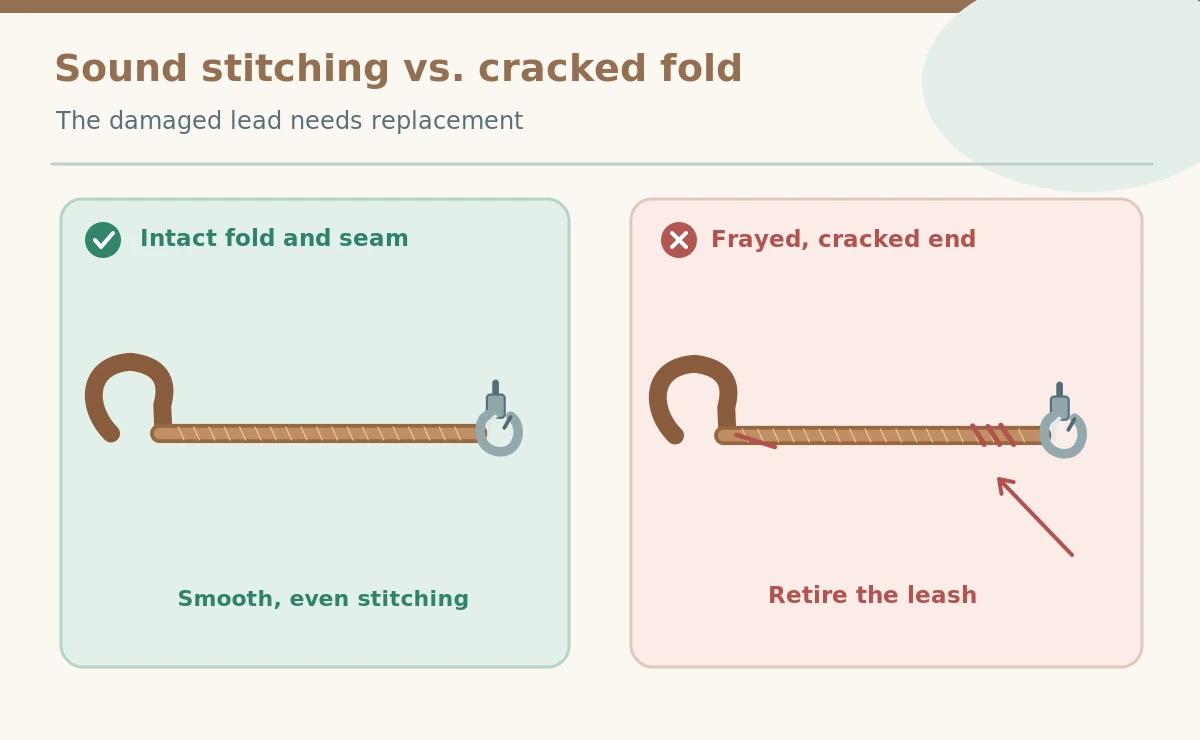
Some leather leads use stitching, some use rivets, and some combine them. Look for even, intact stitch runs at the handle fold and snap-hook fold. Pull out loose threads are a warning, especially when several stitches share a stressed edge. Rivet heads should sit flush without tearing the leather around them or exposing a sharp edge. Neither construction guarantees strength by itself; material thickness and overall design still matter. Do not tug-test violently while holding the snap hook toward a person. If a connection looks compromised, replace the leash rather than trying household glue.
Choose a clip that closes reliably
Check that the snap hook opens smoothly and closes all the way when released. A swivel should rotate without grinding, and the hook opening must fit the designated harness or collar ring. Oversized hardware may weigh down a small dog; tiny hardware may be awkward with a thick attachment ring. Always attach the clip to a rated walking connection, not to a decorative tab. Run your finger carefully over the metal for burrs and corrosion. A sturdy leather body cannot make a defective snap safe. Retire the leash if its gate no longer closes fully.
Compare flat leather and braided sections
Flat leather is usually easy to inspect along its edges and provides a uniform place to hold. A braided section may offer a distinctive grip, but dirt and moisture can accumulate in the crossing strands. Braiding can also hide wear between layers. Look carefully where a braid meets a flat end or metal connection. Do not equate decorative knots with structural fasteners. Choose a design whose attachment points you can examine regularly and clean without trapping moisture. Some soft leathers stretch or deform with repeated wetting, so visual inspection matters more than a label saying premium.
Dry a damp leash without harsh heat
After a rainy walk, wipe away grit with a soft cloth and let the leash air-dry at ordinary room temperature. Avoid a radiator, high-heat hair dryer or direct high sun, all of which can dry leather unevenly. Follow the maker’s care instructions before applying any conditioner; products that soften one finish may damage another. Keep conditioner away from the metal clip opening. Do not soak leather for long periods or store it folded tightly while wet. Reinspect the folds once dry because small cracks become easier to notice at stressed points.
Notice early signs of material fatigue
An old leash may develop lighter crease lines, rough edges or a handle fold that no longer lies flat. Distinguish a harmless surface scuff from a deep crack that crosses the grain or splits the strap. Pay special attention near the clip, where repeated bending occurs. A leash that suddenly feels stiff, stretchy or weak should be retired until you can obtain a safe replacement. Do not cut off a damaged section and tie a new knot to make a shorter leash. Knots in leather are unpredictable under load and can reduce useful control.

Match the leash to your walking environment
A manageable fixed length helps keep the dog near you on sidewalks and at street crossings. Long leather leads may be heavy to gather quickly, while a very short lead leaves little room for relaxed sniffing where safe. In muddy or salty conditions, webbing may be easier to wash and dry than leather. Choose equipment according to where you actually walk and whether you can maintain a steady grip without force. A dog who pulls hard needs humane training and a comfortable harness assessment, not simply a thicker leash.
Keep one repeatable care routine
Before walking, inspect both folded ends, test the clip gate and check the strap for new deep cuts. After walking, remove dirt, let the leather dry and store it away from chewing pets. Once a week, compare the current shape with how it looked when new, especially around rivets and the handle crease. Replace gear that shows spreading cracks or loose attachments. Keep a practical backup leash available for wet weather or unexpected damage. A careful routine protects the dog and handler more reliably than expensive materials alone.
How We Research
We reviewed veterinary and humane handling guidance alongside product construction principles. We reviewed these sources on October 28, 2026. Our original diagrams show specific fit checks and equipment limitations; they are not manufacturer certifications or load tests. Individual products differ, so the maker’s instructions and a veterinarian’s advice when health or mobility affects fit take priority. Our About page explains the editorial approach.
Sources
VCA Animal Hospitals, Collar and Harness Options for Dogs. Read source.
Edmonton Humane Society, Selecting Walking Gear. Read source.
Safety note: This guide gives general equipment information, not veterinary diagnosis or a guarantee of product safety. Stop using any gear that causes pain, injury, escape risk or damaged hardware. Seek veterinary or qualified reward-based training help when needed.
Brief rain is manageable for many models, but dry according to the maker’s instructions and watch for cracking or stiffness.
Neither is automatically safer. Inspect the complete construction, leather condition and attachment points.
It must close fully, rotate smoothly when designed to swivel and fit the designated walking ring.
No. Use conditioning products only as recommended for the particular leather finish.
No. Replace a damaged load-bearing leash rather than improvising a repair.