
This article offers general humane dog-training guidance, not veterinary diagnosis or a guarantee of safety. Use secure, comfortable equipment and follow local leash and traffic rules. If your dog shows pain, sudden behavior change, intense fear, or aggressive responses, consult a veterinarian and an appropriate qualified reward-based behavior professional. Read our veterinary disclaimer.
Waiting at a curb can help a dog move with its handler instead of rushing toward a road. It is not a safety guarantee: even a well-trained animal can react to a siren, squirrel, or sudden noise. The person holding the leash is responsible for traffic checks, crossing choices, and maintaining enough control to keep the dog on the sidewalk. Teach the pause first at a harmless line on the ground, then practice at quiet crossings where you can keep both feet and paws well back from moving vehicles.
Teach the pause away from traffic first
Set a strip of tape on a floor or use a natural seam in a quiet paved area as a pretend curb. Walk together and stop with your own feet before the line. Mark and reward when the dog pauses nearby on a slack leash. You do not need a long sit or a rigid posture; a standing pause is often easier for dogs of different ages and body shapes. Repeat at a comfortable pace, occasionally turning away from the line instead of moving across it. This prevents the dog from learning that every stop must be followed by rushing forward.
Set a safe position for your body and leash
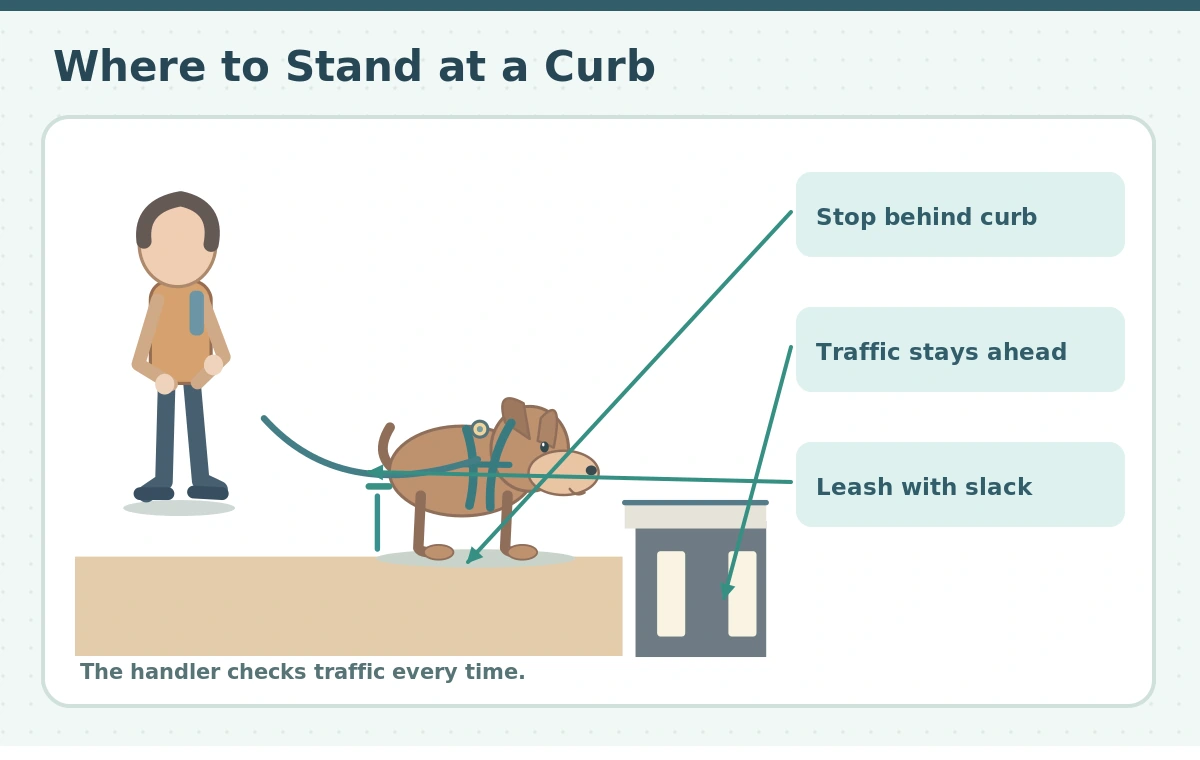
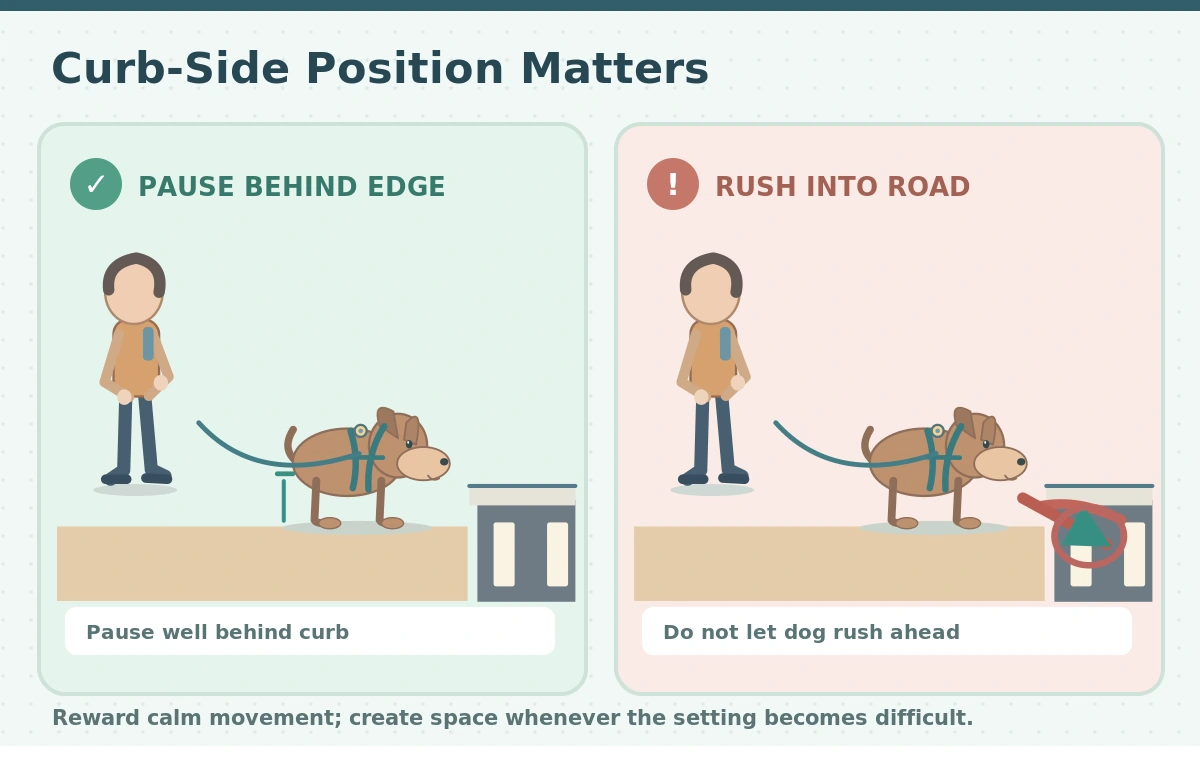
Stand entirely on the sidewalk, leaving room between the dog and the curb edge. Keep the lead secure but not tight, and avoid wrapping it around a wrist. If your dog walks on the traffic-facing side, consider choosing a safer handler position before reaching the curb, where space allows. Keep treats ready without dropping them into the street. Look for bicycles, turning cars, or people stepping off the edge. The training position must not block mobility access or require the dog to stand close enough to a moving vehicle to sniff it.
Add a consistent stop signal
As the dog understands stopping with your movement, introduce a calm word such as “Wait” just before you halt at the pretend line. Reward stillness for a moment, then use a separate release such as “Let’s go” when you decide to move. Make the release cue clear but avoid launching the dog forward with an excited voice. Alternate crossing the line and turning away, so the cue predicts attention and safety rather than automatic acceleration. If the dog steps ahead, calmly guide your own position backward and repeat in an easier space.
Practice at a quiet real crossing
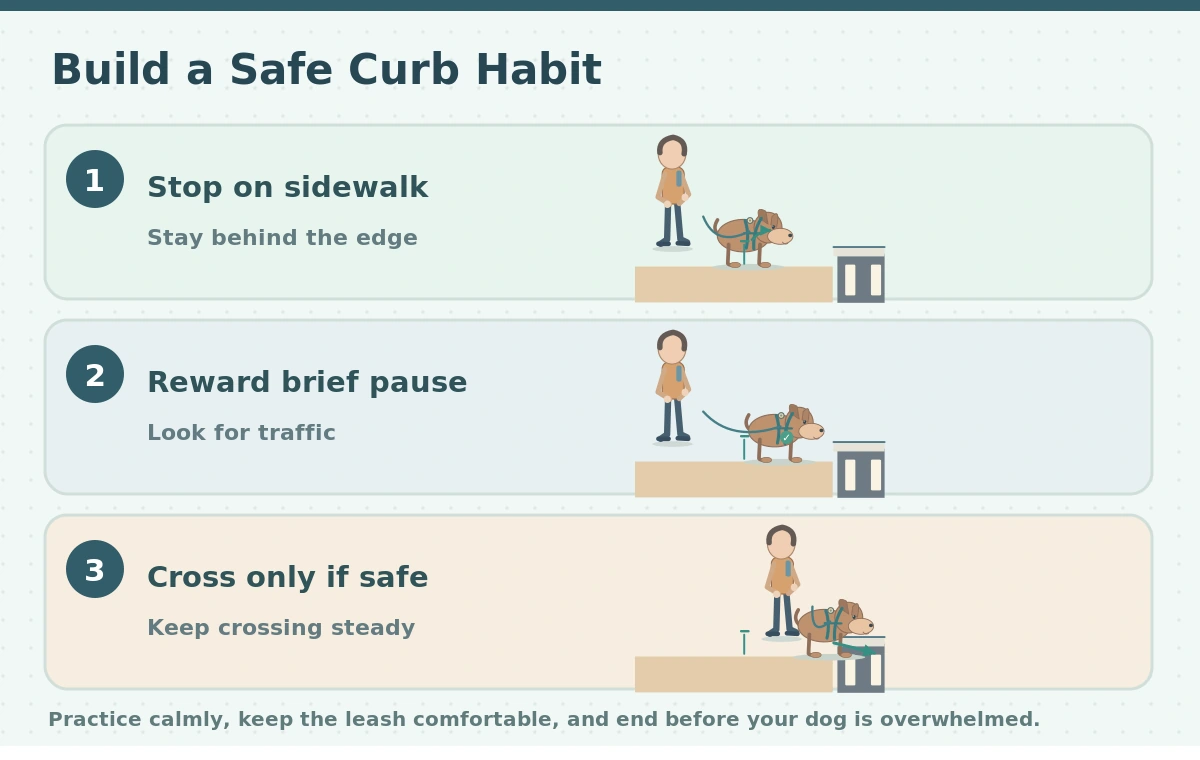
Choose a low-traffic area with good visibility and a legal pedestrian crossing. Stay on the sidewalk while rehearsing a short pause. Check traffic carefully and obey road signals; do not prioritize a training repetition over a safe crossing opportunity. If a vehicle stops, you still must confirm that other lanes and turning vehicles are clear. Reward the dog for waiting in position, then move together only when you determine crossing is safe. A curb cue never replaces a leash or the adult’s responsibility.
Keep the crossing itself simple
Once you step onto a safe crossing, focus on walking steadily across rather than asking for tricks in the roadway. Have rewards available after reaching the next sidewalk if needed. Do not scatter food onto the road or stop in a traffic lane to practice eye contact. Keep the dog on a manageable leash length so it cannot veer toward another pedestrian, vehicle, or bicycle. If the dog hesitates, do not drag it. When crossings are repeatedly frightening or physically difficult, choose a quieter route and seek appropriate professional or veterinary guidance.
Account for surprising movement
Some dogs lunge at rolling wheels, fast runners, or fallen food. Practice the curb pause only in conditions where your dog can remain relaxed. If something unexpected happens, move to a secure position away from traffic and use a familiar turning cue where possible. A separate “This way” skill can help with leaving an unsafe approach before reaching the road. Avoid using leash pops, shouting, or harsh corrections: they may increase uncertainty while drawing attention away from real hazards. The practical objective is cooperative movement and a handler who plans ahead.
Teach other household walkers the same pattern
Different people should use the same stop and release signals and keep the same basic safety margin at a curb. Children should not be expected to control a strong dog in traffic without capable adult supervision. Explain that a dog’s apparent pause is not permission to cross. Practice on the pretend line whenever someone new handles the leash. Watch whether the dog can stop with a person who walks more slowly or has a different stride. Safety depends on the handler’s decisions, not a pet’s memory alone.
Do not demand a sit from a dog in discomfort
A standing pause is acceptable. Dogs with sore hips, knee problems, limited mobility, or certain body shapes may find repeated sits uncomfortable. Watch for limping, reluctance to move, or a sudden change in pace and consult a veterinarian when appropriate. Keep the pause brief enough to avoid long exposure to hot pavement or icy conditions. Check the walking surface and use shaded or cleared sidewalks when possible. Safety at a curb includes the animal’s comfort as well as road awareness.
Measure success by safety, not obedience theater
A useful outcome is a dog that usually slows or stops when you stop, remains behind the curb while you check the road, and crosses with you at a controlled pace. Do not set up surprise tests at busy intersections. Revisit simple practice after a break or change in route. General loose-leash guidance from RSPCA and Battersea supports calm rewarded movement and manageable distractions; the precise location and traffic decision still belong to the person. When conditions are too busy, select another crossing rather than trying to prove the dog can perform.
How We Research
HubPet reviewed published reward-based leash-walking guidance from Battersea Dogs & Cats Home, RSPCA, Dogs Trust, and VCA Animal Hospitals, then applied it to the specific skill and illustrated setups in this guide. Additional sources are noted below when relevant. We did not observe these dogs, conduct controlled product trials, certify walking equipment, or replace individual veterinary or behavior assessments. Different dogs, environments, and local traffic rules may require a different plan. See About HubPet for our editorial approach. Prioritize relaxed body language, safe distances, and the dog’s voluntary participation.
Sources
Battersea — Teaching a dog to walk on a lead
RSPCA — Teach your dog to walk without pulling
Dogs Trust — Positive reinforcement with rewards
Dogs Trust — Doorway patience and transitions
No. A dog can be startled or distracted at any time. The handler must always check traffic, obey signals, and manage the leash.
No. A comfortable standing pause works well. Do not demand repeated sits from a dog that finds them painful or difficult.
Use an indoor line or quiet path seam. Reward stopping behind it, then add a clear release after the dog understands the pattern.
Do not stop in a traffic lane to feed or scatter treats. Practice on the sidewalk and reward again once you reach a safe position.
Create distance from traffic, avoid risky practice, and seek a qualified reward-based trainer when needed. Never test the behavior beside moving vehicles.