
This guide covers general dog bedding and household safety, not individual veterinary treatment. If your dog struggles to rise, appears to be in pain, or may have swallowed bedding, contact your veterinarian; see our veterinary disclaimer. Woven dog baskets add a distinct frame around a soft cushion, but the attractive weave is also the part that deserves scrutiny. Natural rattan, wicker blends, and synthetic woven strands behave differently when wet or chewed. This guide treats a rattan-style dog bed as furniture that must pass a pet-safety inspection: smooth edges, solid support, a removable cushion, easy entry, and no loose ends within reach.

Identify the actual weave and frame
The words rattan, wicker, and woven are not interchangeable material specifications. Wicker describes a weaving method, while listings may use natural plant cane, paper cord, resin, or combinations over a wood or metal frame. Ask for the exact materials and finish. Do not assume every woven bed tolerates outdoor washing. Feel across the inner wall, top rim, and underside for sharp ends and raised splinters. A rough finish near a dog’s nose or paws is a reason to choose another bed. Decorative weaving should never make the pet’s resting surface hard to inspect.
Look closely at snags and loose strands
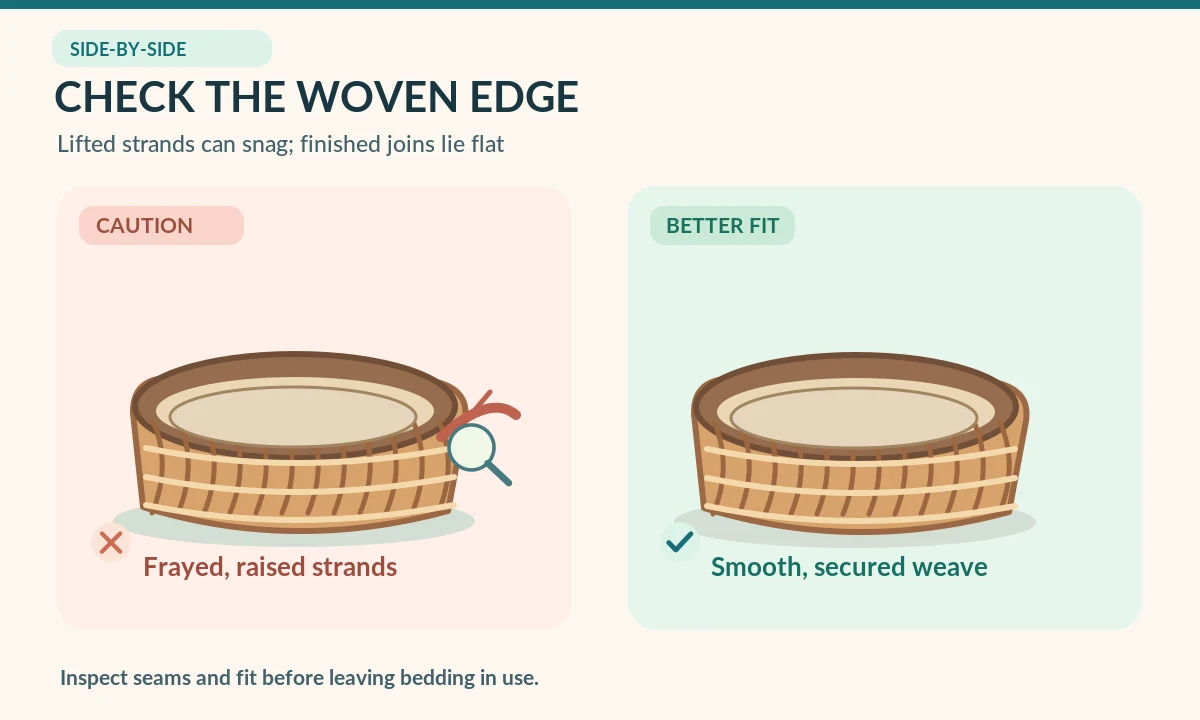
Examine places where the weave turns around the top lip, joins at a corner, or passes through frame supports. Run a soft cloth along the interior; if it repeatedly catches, the dog’s coat or nails may catch too. Check for snapped strands, unprotected staples, protruding wire, and gaps where a paw might wedge while stepping in. If a section lifts, remove the bed. Have a qualified professional assess repairs or choose a replacement. Do not hide loose strands under a cushion. Dogs can push the cushion aside and expose a snag.
Check stability and weight distribution
Place the empty frame on a flat floor and press gently at each corner. It should remain steady without rocking or flexing noticeably. Then add the cushion and look for a supported base rather than an unsupported pocket between widely spaced bars. A dog stepping over one rim should not cause the frame to tip toward the entrance. Check that feet or glides will not scratch the floor, slide, or detach. A decorative basket that shifts under ordinary body movement is not a comfortable choice even if it photographs well in a living room.
Measure the cushion, not just the basket
Measure the flat interior across its narrowest dimension and account for the thickness of the surrounding weave. The cushion should sit flat against the base without curling up at the edges or falling through a gap. Watch for a removable pad that slides toward one corner as the dog turns. If it bunches, choose an insert matched to the inside dimensions or a different frame. Leave enough space for the dog to lie in its natural resting position. The exterior basket dimensions are largely decorative and can substantially overstate the actual usable sleeping area.
Make entry height part of the purchase
A higher woven lip may suit an agile dog that easily steps into its bed, but it can be inconvenient for very small dogs or those with movement difficulties. Prefer a clearly lowered opening with smooth edges and enough width for paws and shoulders. Do not assume that a shallow notch works if the bottom edge still catches the dog’s feet. Observe the real entry and exit during a supervised introduction. Veterinary mobility advice emphasizes easy-access bedding and safe home layout rather than forcing a dog to negotiate tall furniture.
Clean the basket and cushion differently
Remove the cushion before cleaning the woven frame. Follow the maker’s instructions: a soft brush or lightly damp cloth may be appropriate, while soaking a natural plant-fiber basket can damage it. Do not use harsh disinfectants on a finish without checking material compatibility. Clean the washable cushion according to its care tag; the CDC recommends routine bedding cleaning, including weekly care as a general guideline. Let both frame and cushion dry thoroughly before reassembly. Inspect weave joints again after wiping, since moisture or handling can reveal newly loose ends.
Be cautious with dogs that chew furniture
A curious dog may try to pull an exposed wicker strand and turn it into a chew target. That creates risks from splinters, synthetic strips, coating fragments, and loose fastening pieces. Supervise early use and remove the basket if chewing begins. Offer appropriate alternatives and address repetitive destructive chewing without punishment. Do not coat the bed with improvised deterrent chemicals or pretend that natural-looking fiber is safe to swallow. The ASPCA describes chewing as a common dog behavior and advises attention to materials dogs may ingest.

Decide whether the appearance is worth the care
A woven frame may work for a dog that rests gently, rarely chews furniture, and likes a supportive cushion with a defined edge. It is less useful in muddy entryways or homes where washing an entire bed quickly matters. Check the finish periodically for loosened tips, wobble, odor, and hidden moisture under the pad. If you cannot clean beneath the cushion or the basket keeps snagging nails, a smooth solid-sided frame or simple floor cushion is easier to manage. Choose the construction that serves the dog rather than the room’s decorative theme.
How We Research
Our research draws on veterinary, animal welfare, and public-health advice about cleaning, chewing, comfortable access, and home setup. The inspection covers woven rim finish, strand attachment, frame stability, cushion size, and cleaning limits. No laboratory product tests inform these guides. These articles do not rank or endorse products. Learn more about HubPet.
Sources
CDC — Cleaning and Disinfecting Pet Supplies — Evidence about pet care, household safety, or bedding maintenance.
ASPCA — Destructive Chewing — Evidence about pet care, household safety, or bedding maintenance.
American Kennel Club — How to Clean a Dog Bed — Evidence about pet care, household safety, or bedding maintenance.
VCA Animal Hospitals — Comfortable Home for Dogs With Mobility Limitations — Evidence about pet care, household safety, or bedding maintenance.
No. Wicker names a weaving method and many products use synthetic or mixed strands. Check the exact materials, coating, and care directions.
Inspect the inside rim, joins, and underside. Gently pass a cloth across the weave; repeated snags or exposed wire are reasons not to use the frame.
Do not assume so. Natural fibers and finishes may react poorly to soaking. Follow the manufacturer’s cleaning directions for the specific material.
Remove the bed and prevent access to loose pieces. If you suspect your dog swallowed material or your dog seems unwell, seek veterinary advice.
Measure usable inner floor dimensions, entrance height, the dog’s relaxed sleeping footprint, and whether the pad fits flat without bunching.