
This is a paper wildlife-science project, not a live-animal handling lesson or veterinary advice. Keep art materials out of reach of dogs and cats. For pet health questions, see HubPet’s veterinary disclaimer.
A magnificent frigatebird is recognizable by its extraordinarily long, narrow wings and a deeply forked tail that helps distinguish its shape in flight. During courtship, the adult male can inflate a conspicuous red throat pouch while perched. Those features belong to different poses: the large red balloon-like pouch is a display structure, not something the bird needs to keep swollen whenever it flies. This paper lesson deliberately separates the courtship side view from an overhead soaring silhouette.
The cover illustrates a dark male bird perched above coastal vegetation with the bright pouch beneath the throat. The first diagram labels bill, pouch, folded wing, and forked tail; a second contrasts the courtship pose with long-winged flight. A four-step sheet teaches how to draw the same bird without misplacing the pouch on the chest or making the wings look like a short, rounded backyard songbird’s.
Find the magnificent frigatebird in the drawing
Start from a slender, dark-bodied seabird with a relatively small head. The magnificent frigatebird has a long bill with a hooked tip; make the upper bill curve downward gently near the end rather than rounding into a parrot beak. The eye is small compared with the bill. A perched male may look compact only because the long wings fold tightly along the sides. Leave room for the tail behind the perch.
The red gular pouch is skin at the throat that a male inflates in a display. Attach it beneath the bill and front neck, not from the abdomen like a hanging belly or crop. In the diagram, a red oval represents the enlarged pouch, with a dark outline showing the neck just above. The position matters more than an exaggerated balloon size; it should not cover the bird’s eyes or beak.
Make the folded wing long and pointed, reaching well down the body. In an open-wing flight view, extend narrow wings dramatically to either side, with a crook rather than a perfect straight bar. A forked tail has two diverging pointed sections behind the body. In some photographs it looks less forked when closed, so the comparison should show it clearly spread in flight.
Use a coastal tree branch or low shrub as a simple display perch. The legs and feet are relatively small, so do not turn the bird into a thick-legged ground walker. Cornell’s identification material distinguishes the adult male’s dark body and red display pouch from the female’s pale chest. Label your drawing as an adult male display, not a typical appearance of all frigatebirds.
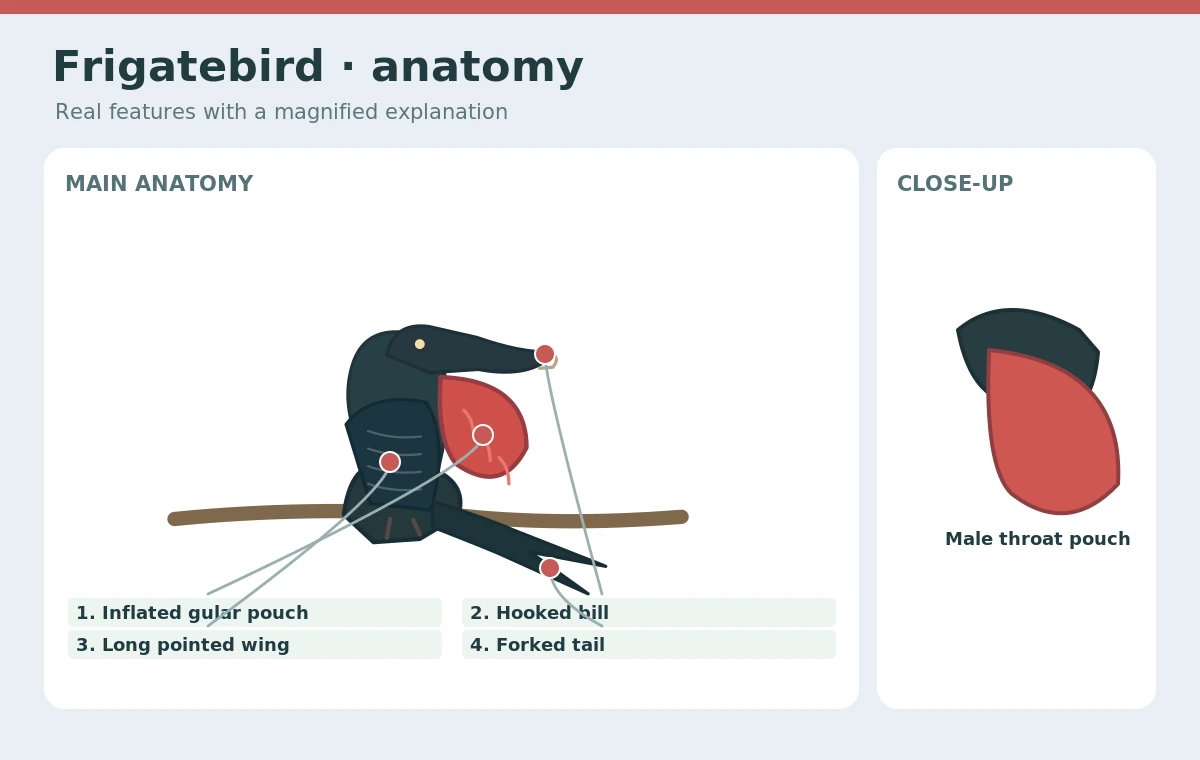
Check the labels against the actual drawn body parts, not merely their approximate position in the picture. The magnified detail separates small biological features that would disappear at full-scene scale.
How the structure works in its natural setting
Cornell Lab describes males inflating the bright red gular sac during courtship, often while gathered near other males in display groups. The expanded pouch is a visual signal; it is not a storage bag for fish, an egg pouch, or a respiratory organ that must remain large for flight. Draw a small line from the pouch to the throat and keep the bill and neck contours intact above it.
Magnificent frigatebirds spend long stretches soaring on air currents over tropical oceans. Their long, pointed wings form a distinctive airborne outline, while the forked tail can help with steering. The paper model can show curved motion arrows behind the wings, but it should not claim that the tail acts like a motor or that the bird never flaps. Draw the flight silhouette against sky and ocean, not against a dense woodland floor.
Frigatebirds may take food near the sea surface and can pursue other birds to steal food. The adaptation visible in this lesson, however, is the bill shape and aerial body plan, not an invented scene of fighting with pets or grabbing human food. Keep the animal in a coastal context and focus on the structures that an observer could identify from a safe distance.
Compare two meaningful views
For the left panel, draw a perched adult male from the side with a large scarlet pouch beneath the throat. Use one folded dark wing with a tapered tip and the hooked bill pointing outward. A stout branch supports the small feet. This is a close-range study of a courtship pose, not a bird hovering in midair with the pouch inflated like a parachute.
For the right panel, change perspective to a distant bird seen in flight. Spread both long wings in a shallow M-shape, make the body small by comparison, and draw a two-pronged tail. The pouch should be deflated and barely conspicuous in this view. Keep the bill as a narrow hooked extension of the head so the silhouette remains a frigatebird rather than a bat or swallow.
The two panels teach different recognition tasks. In a close perched view, the pouch is the easy feature to spot. From farther away, long wings and a forked tail are more useful. Labels must not imply that females have bright inflated pouches; Cornell’s identification page illustrates the female’s contrasting white chest. A simple note can tell learners to check sex and pose before copying a photograph.
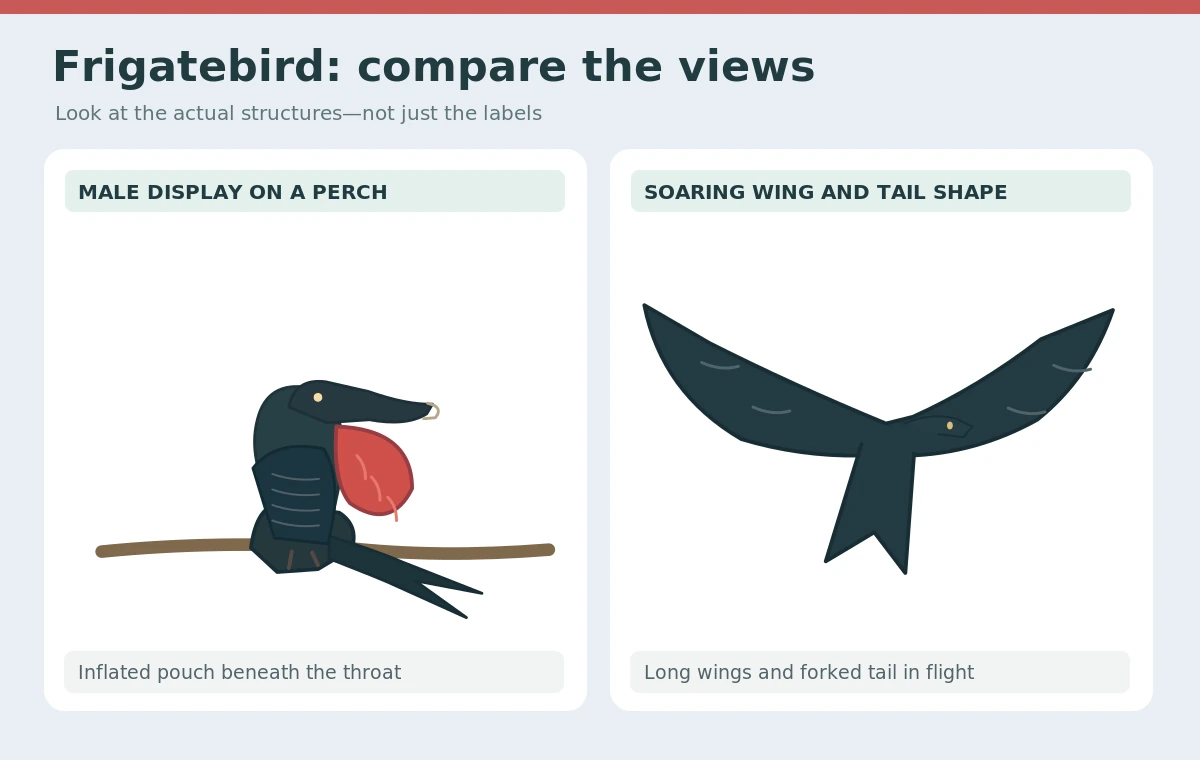
Cover the captions and look at the actual outlines and positions. The difference between the illustrated views should remain visible without relying on words alone.
Draw the science map in four stages
Step 1: Outline the main shape
Draw a lean bird body balanced on a sloping branch. Add a small head at one end and an extended tail behind it. Place the bill so it projects forward and hooks down at the tip. Leave an open space under the throat for the male’s red display pouch, and do not shade the head solidly until its outline is clear.
Step 2: Add defining structures
Shape one long folded wing along the body, narrowing it into a pointed tip. Divide the tail behind the perch into two slim branches with an obvious V-shaped opening. Use tiny feet grasping the branch rather than large walking feet. Check that the wing is attached at the shoulder, not growing from the tail.
Step 3: Show the crucial detail
Add the inflated gular pouch beneath the throat as a rounded red form with a narrow attachment above. Draw a magnified inset that locates the pouch relative to the bill. In a second small corner view, sketch two long flying wings and a forked tail, keeping the inflated display pouch out of this flight silhouette.
Step 4: Finish color and review
Color the male nearly black with subtle blue-gray wing highlights, and make the pouch red enough to stand out. Use light blue coastal sky and a small branch for context. Label the hooked bill, folded wing, gular pouch, and forked tail. Let students compare the completed page with Cornell’s male and female photographs before treating the drawing as a reference.
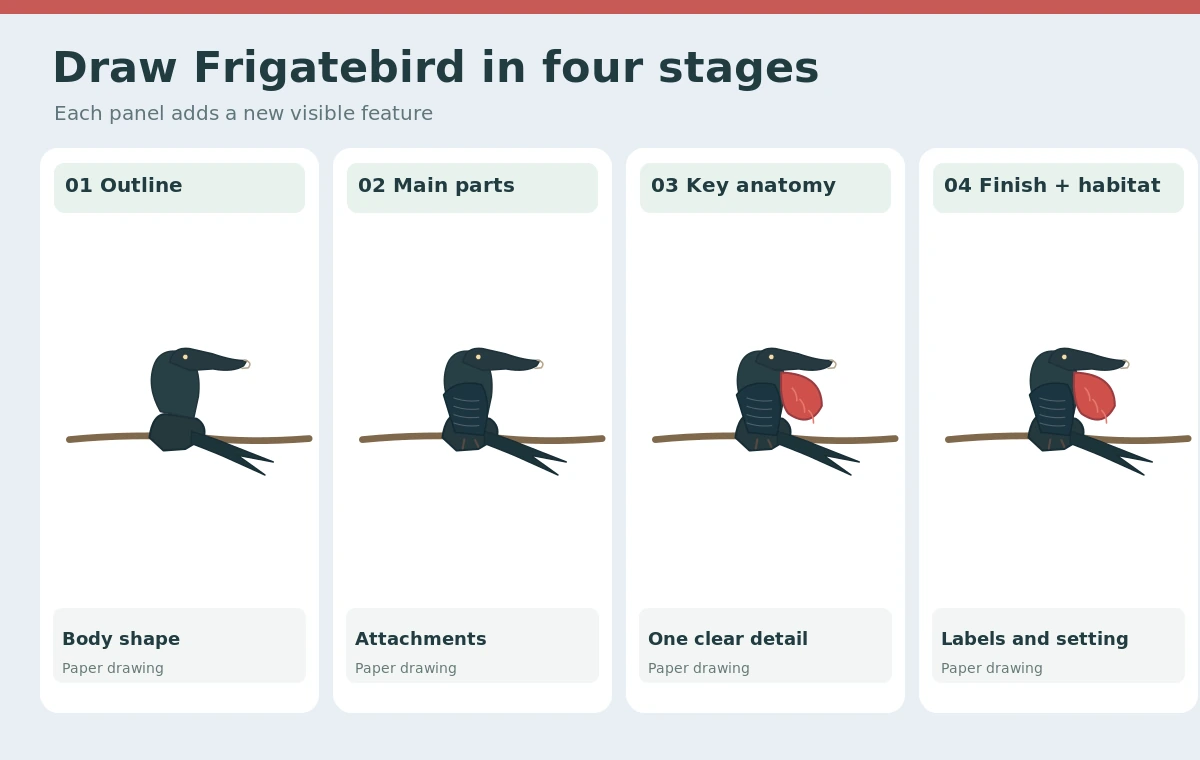
Each stage adds a specific visible anatomical detail. The sequence is a drawing method, not a procedure for touching, keeping, or testing a live animal.
Fix common drawing mistakes
A common error puts the red pouch below the whole belly, as though the bird carries a red fruit. Move it forward to the throat beneath the bill. Another error makes it an anatomical feature of all frigatebirds. Write ‘male display’ next to the enlarged pouch and explain that sex and courtship state change what observers see.
Do not draw short rounded wings in the flight view. The characteristic frigatebird outline has exceptionally long, narrow, pointed wings. A broad ducklike tail is equally misleading: draw a forked pair of narrow streamers, even if the fork would sometimes be less visible when the feathers close together.
Finally, do not transform the pouch into a flotation device, a nest, or a feeding sack. The illustration should keep the purpose to signaling. A quick check is to cover the text and ask: Which pose shows courtship, and which shows flight? If the difference cannot be seen from the bird’s body alone, revise the shapes.
Pet-safe craft setup and a simple learning check
Make the illustration indoors with paper rather than trying to approach nesting seabirds. Display areas can be sensitive wildlife spaces, so do not disturb birds to see a better pouch angle. When drawing with dogs or cats in the room, keep long string, rubber bands, glue caps, and small cutouts in a container beyond their reach.
Ask a child to identify what is inflated, what is forked, and what folds along the body. Those three structures belong to different regions, so each question checks a useful drawing decision. For a more careful comparison, have the learner mark the adult male as a special display example rather than calling all frigatebirds red-throated.
How We Research
We compare the visible anatomy and behavior against museum, aquarium, zoo, and scientific educational references named below. The HubPet editorial overview describes our source-led approach. The result is an original paper reconstruction designed for understanding, not a reproduction of any source photograph.
We separate visible structures from inferred mechanisms, distinguish special sex or posture examples where relevant, and flag simplifications in the captions. The anatomy inset, the comparison, and the drawing steps answer different questions; each label should point at something a student can actually see.
Sources
Cornell Lab — Magnificent Frigatebird Overview — reference for the anatomy, environment, and behavior described in this educational drawing lesson.
Cornell Lab — Magnificent Frigatebird Identification — reference for the anatomy, environment, and behavior described in this educational drawing lesson.
Frequently asked questions
The red gular pouch is an inflatable courtship display structure beneath the throat. It becomes conspicuous when the male inflates it to attract a mate.
Females do not display the inflated scarlet pouch of adult males. Magnificent frigatebird females have a contrasting pale chest.
Frigatebirds have a deeply forked tail, particularly clear when its two outer sections spread during flight or steering.
No. The lesson shows it as a courtship signal, not a flotation device or an adaptation that must stay expanded for flying.
Look for exceptionally long pointed wings, a small body, and a forked tail rather than relying on the tiny red throat area.