
This is a paper-only science lesson for a U.S. family with pets, not veterinary advice, live-animal handling guidance, or a field experiment. Keep pencils, paper scraps, and all craft supplies beyond your dog’s reach. If a pet ingests an object or develops concerning symptoms, contact a veterinarian and see our veterinary disclaimer.
Fireflies are beetles, and many kinds communicate with light from special organs on the abdomen. A glowing patch belongs on the underside near the rear, not at the end of an antenna like a light bulb. The light comes from a chemical reaction inside the body.
Paper signal strips can show a short flash followed by a pause or several separated flashes. Different species may use different patterns, and some adult fireflies do not flash. The illustration represents a flashing kind rather than all fireflies.
Draw everything indoors with dry supplies. Do not catch fireflies in jars, flash bright lights at wildlife, or take a dog through tall wet grass for a nighttime experiment. A diagram explains the idea without disturbing insects.
The beetle body and underside lantern
Start with a head, two feelers, a central thorax, and a longer segmented abdomen. Give the insect six legs and two wing covers, called elytra, which are beetle features. A firefly is not a glowing moth or a tiny lantern with four legs.
Place the light organ beneath the abdomen toward the rear in the labeled side view. Many familiar flashing species have adult lanterns there, although their size and placement can vary with sex and species.
Show the lantern with a warm yellow or yellow-green glow. A translucent halo is an artistic way to represent emitted light, not a separate physical membrane around the abdomen. Keep the organ itself clearly attached to the beetle.
Luciferin and the enzyme luciferase contribute to the light-producing reaction, which also needs oxygen. Use a tiny inset with three labeled ingredients and a glow arrow rather than a fake battery, flame, or electrical cable.
In a second small strip, draw dark intervals between bright blocks to indicate timing. These are example rhythms rather than measured flash durations; do not claim one exact rhythm represents every firefly species.
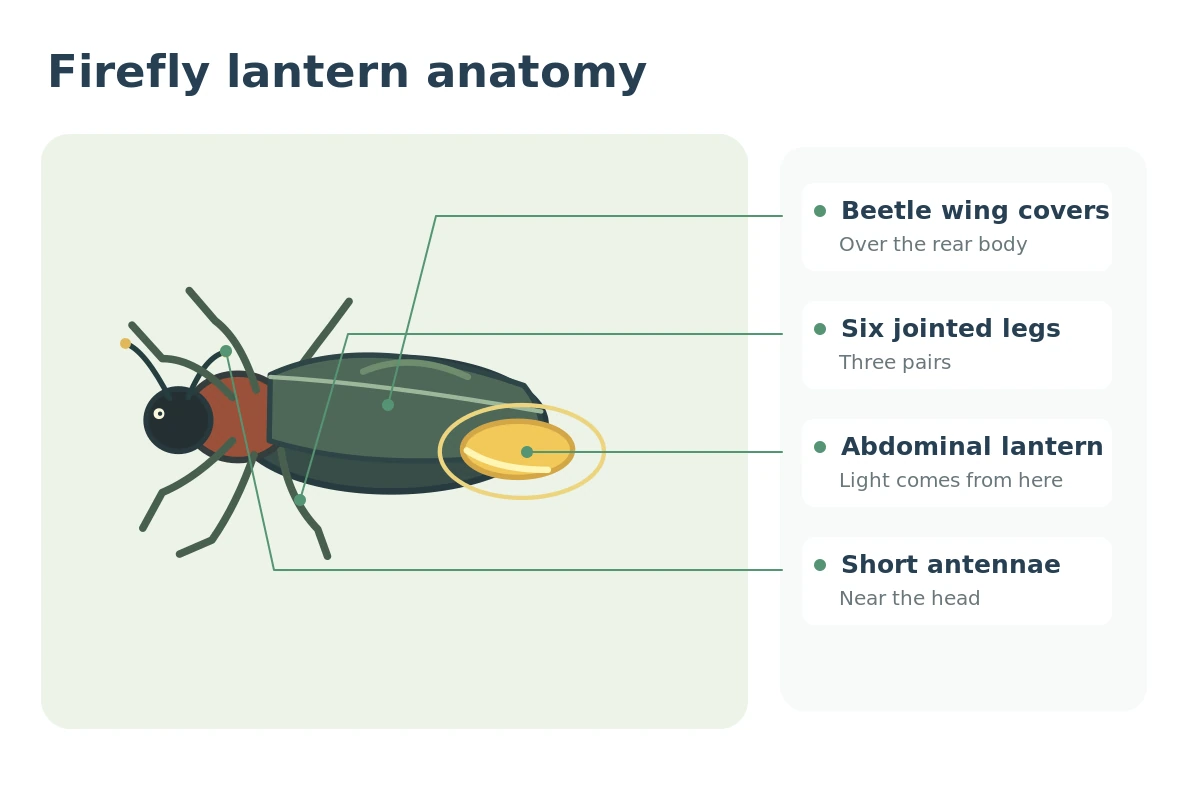
Examine the labeled illustration as a guide to physical relationships, not as a measurement or a dissection photograph. Each line should end on the actual object it names. Colors and proportions help readers see small details without claiming exact scale.
A flashing underside versus a fake tail bulb
One drawing shows light emerging from a patch on the rear underside of a normal six-legged beetle. The other attaches a round lamp to the tip of the abdomen. The lamp shape looks familiar but misplaces the organ.
Likewise, a row of separated yellow pulses means intermittent light, while a solid unbroken yellow bar would mean continuous glow. Some species really do glow continuously, so the difference here concerns the example flashing firefly.
Use a calm dark habitat behind the beetle. Artificial light can interfere with courtship signals; the paper model should never suggest that children need to illuminate living insects for the lesson.
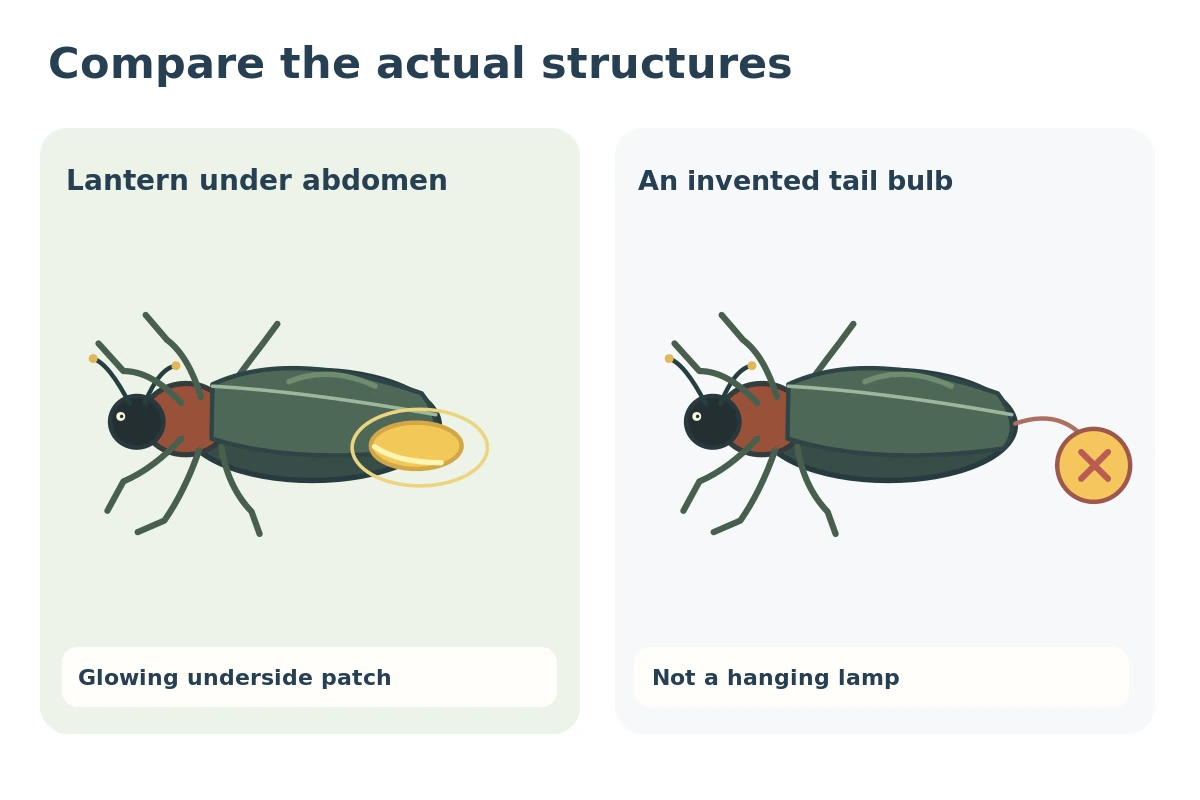
Try covering the captions and looking only at the objects. If the key contrast disappears, move the two physical parts farther apart or change their outlines; additional text alone will not fix a confusing comparison.
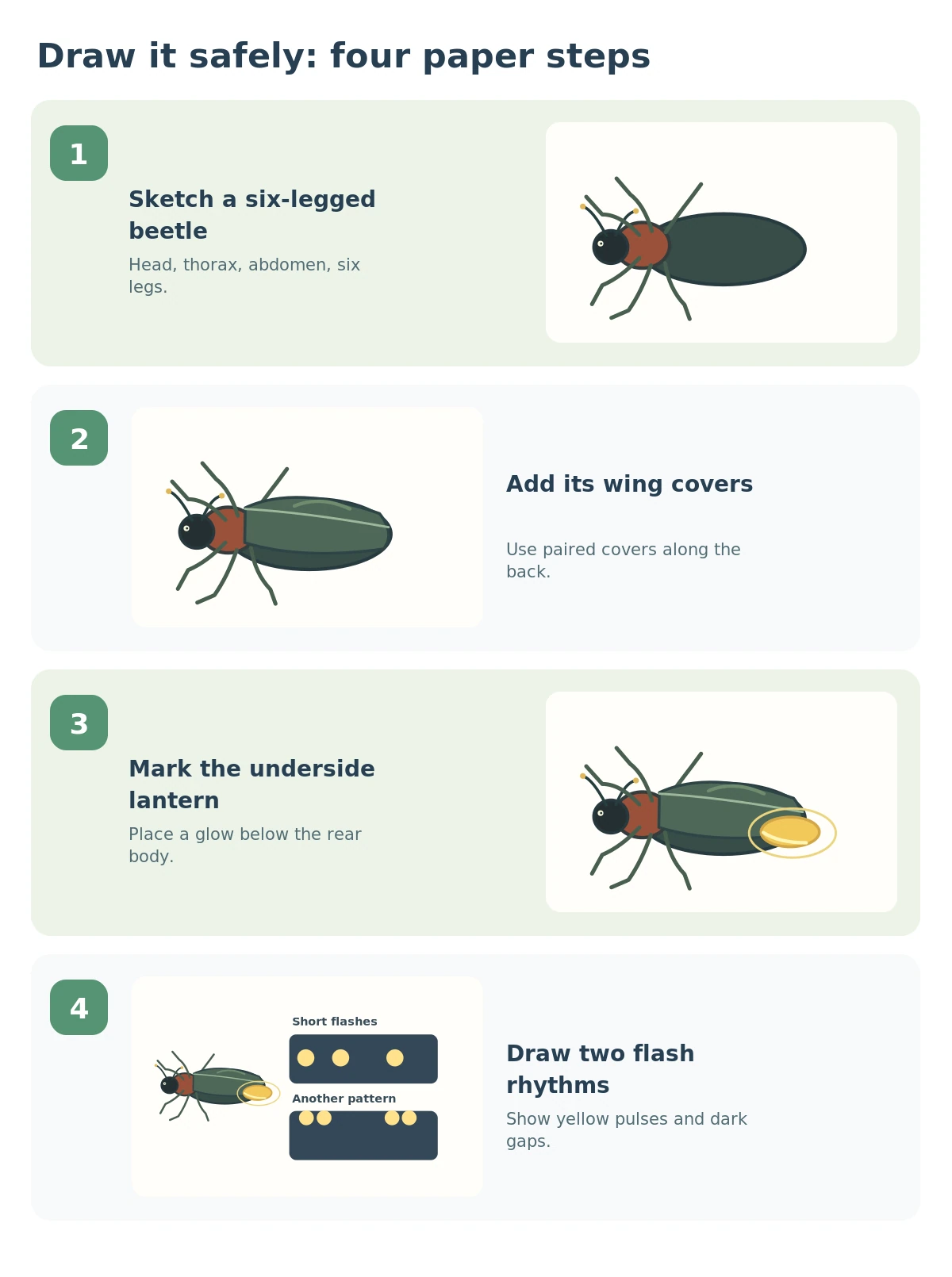
Four paper-only drawing steps
Set a clean sheet on a stable table and draw with ordinary colored pencils. Each frame adds an identifiable feature or changes the structure’s position. The activity needs no captive animals, outdoor samples, water basin, heat source, or special tools.
Step 1: Sketch a six-legged beetle
Sketch an oval abdomen, a smaller thorax, and a head with two short antennae. Attach three pairs of legs around the thorax. Count six legs before adding any wings.
Leave the abdomen long enough to add several gentle segment lines. Keep the head and thorax separate so the insect reads as a beetle.
Step 2: Add its wing covers
Draw two dark wing covers down the back and give the thorax a contrasting border. Avoid replacing the body with large butterfly-shaped wings.
A small exposed hind wing can hint at flight, but the solid covers should remain the visual clue that the insect belongs among beetles.
Step 3: Mark the underside lantern
Color a short zone on the underside of the rear abdomen with pale yellow. Surround it with a soft halo to show light traveling into the dark background.
Leave the antennae unlit. Draw the glow as part of the abdomen, not as a bulb dangling from a string.
Step 4: Draw two flash rhythms
On a separate strip of paper, make one sequence with isolated yellow dots and another with two close flashes and a pause. Label them illustrative patterns.
Do not assign species names or exact timing without species-specific evidence. Store all supplies and observe night wildlife only from a distance.
Common mistakes and visual fixes
A glowing antenna would place the lantern on the wrong body part. Move the yellow area to the underside of the abdomen.
Fireflies have six legs. If a drawing shows eight, remove the extra pair rather than confusing the beetle with a spider.
A glowing patch is not a flame. Eliminate drawn smoke, heat rays, and a candle wick; bioluminescence is a chemical light process.
Not every adult firefly flashes. Present the pulse strip as one possible signaling pattern, not a universal code all species understand.
Three checks for understanding
Ask someone to count the legs and identify the head, thorax, and abdomen from the actual drawing, not just from its labels.
Point to the yellow area and trace its position on the underside of the body. A floating glow alone is not enough to locate the organ.
Compare the yellow pulse strips. Can the reader distinguish a pause from a second flash without interpreting either as a real-time clock?
Limits, wildlife respect, and home safety
The lantern and chemical inset are deliberately enlarged. Exact lantern anatomy, brightness, flash timing, and behavior vary across groups and life stages.
Do not collect fireflies, expose them to bright light, or bring small glowing decorations home as pet toys. Keep the entire activity on paper and store craft supplies away from dogs.
How We Research
We checked the anatomy, terminology, and habitat details against the museum, university, and public-agency sources listed below. Our illustration review focused on correct attachment points, meaningful side-by-side differences, leg or limb counts, and practical paper-only safety.
HubPet presents this as a visual learning activity rather than a veterinary diagnosis, wildlife care protocol, or scientific measuring method. See About HubPet for information about the site’s editorial approach.
Sources
American Museum of Natural History — Talking to Fireflies. Consulted for the anatomy, examples, and limits described in this paper lesson.
Washington State University — What Makes Fireflies Light Up?. Consulted for the anatomy, examples, and limits described in this paper lesson.
Frequently asked questions
It lies on the underside of the abdomen toward the rear, rather than on the head or antennae.
A chemical reaction involving luciferin, luciferase, oxygen, and other cellular components produces light.
No. Some adults signal with flashes, others glow differently, and some daytime kinds do not produce visible adult flashes.
No. Signal timing and response patterns vary across species, so the paper pulse strips serve as simplified examples.
No. Use an illustration and leave insects in their habitats. Keep dogs away from small craft materials.