
This guide covers general dog bedding and household safety, not individual veterinary treatment. If your dog struggles to rise, appears to be in pain, or may have swallowed bedding, contact your veterinarian; see our veterinary disclaimer. A bean bag style dog bed may look like a soft place to sink in. Its moving fill behaves differently from a shaped foam mattress. The important question is whether your dog can lie down, roll, stand, and step off without wrestling a shifting cushion. Fill containment, seams, usable space, and cover care deserve more attention than a plush photograph. This guide focuses on practical home checks, not a claim that loose-fill beds provide orthopedic support.
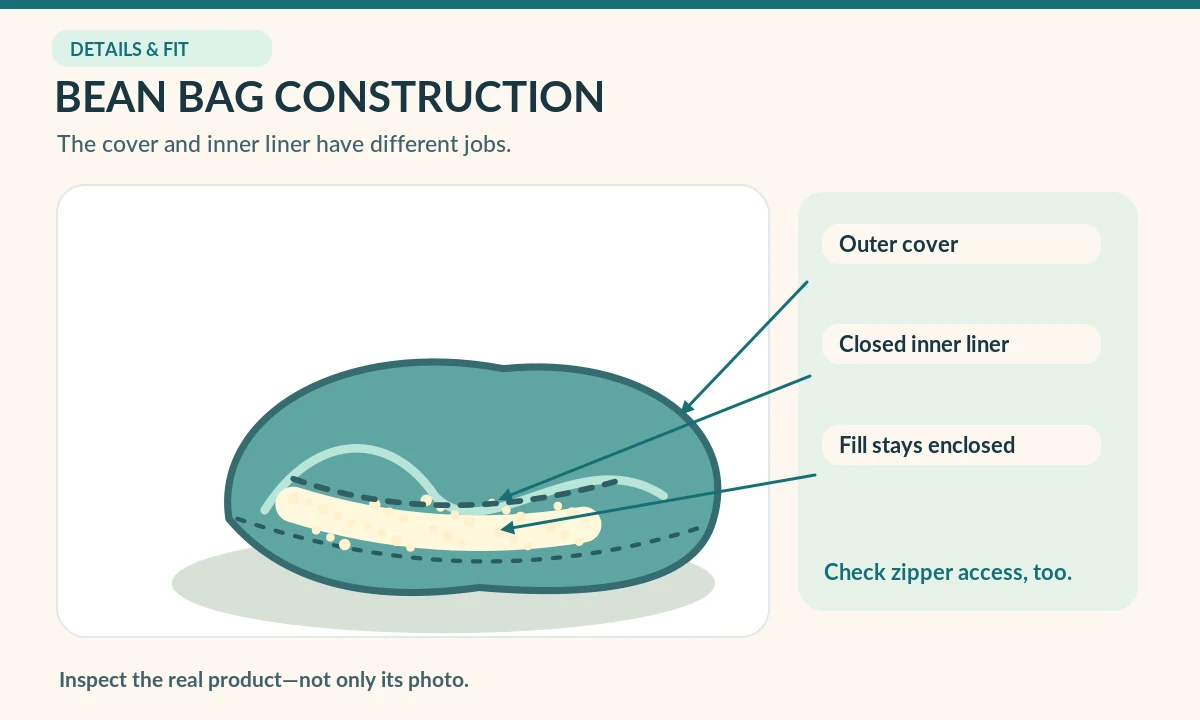
Understand what is actually inside
The name bean bag may describe shredded foam, loose fiber, or small beads, and each behaves differently under a dog. Ask the manufacturer to identify the fill. Check that a separate, closed liner surrounds it. Small loose beads create a particular concern if a seam fails and the contents scatter. Look for a secure inner enclosure rather than a single decorative zipper between your dog and the filling. A product that cannot disclose its fill or washing method is difficult to evaluate. Avoid assuming that a dense-looking cover means the interior stays evenly distributed after use.
Test support after the dog settles
A tall-looking lounger can flatten beneath the dog’s chest. The fill then piles around the edges. Before keeping one, let your dog lie in its usual position and inspect the space beneath the torso. Notice whether the dog must scramble out of a deep pocket or slides toward one end. You can press the cushion at several points to find hollow zones, but an actual comfortable exit is more informative. For dogs that struggle to rise or move, ask a veterinarian about low-entry supportive bedding. Avoid treating a bean bag as a substitute for individualized care.
Measure the useful surface, not the puffed edge
Measure your dog while comfortably stretched on a familiar resting surface. Compare that outline with the bed’s flat area after settling. The advertised outer width often includes a tall puffy perimeter that does not act like flat sleeping space. If your dog circles before lying down, allow room for that movement as well. Check the bed on the intended floor rather than only on a carpeted display. A large bag can occupy substantial room while offering a surprisingly small stable center, particularly after its filling migrates toward one side.
Inspect seams, closures, and chewing points
Run a hand around every stitched junction. Look for skipped stitches, thin piping that can peel, a loose pull tab, and exposed fasteners. A double enclosure can reduce the chance of loose contents escaping, but no fabric bed becomes chew-proof. Dogs that pull threads, open zippers, or swallow bedding pieces need close supervision and a different resting surface if the habit continues. Do not leave a torn bean bag in use while waiting for a cover to arrive. Remove loose filling promptly, keep the dog away from it, and contact your veterinarian if you suspect your dog swallowed material.

Plan how the entire bed will be cleaned
Check whether you can wash the outer cover. Ask how to maintain the inner compartment. An outer cover may go into a washer while the inside is not safe for machine washing. Follow the maker’s wash and dry limits and keep the inner bag sealed. Wet filling that cannot dry completely can become an ongoing hygiene problem. The CDC advises routine cleaning of pet bedding, with more cleaning when soiled. If the cover is awkward to remove, you may rarely clean it. A simpler flat bed can work better in a busy home.
Keep the lounger stable in the room
Set the bed on a flat, dry, nonslip surface. Keep it away from doorways and areas where people might trip. Watch the cushion while your dog enters and turns: the whole bag should not scoot across tile. A thin nonslip mat beneath it may help if the material is safe and does not curl into a new trip hazard. Avoid placement beside a heater or in direct hot sun where a thick fabric cover might hold unwanted warmth. The dog should always have an easy alternative place to rest.
Use a realistic seven-day trial
For several ordinary rest periods, observe how easily your dog approaches, lies down, changes position, and rises. Note where the fill collects and whether the seams look stressed. After a week, move the dog away before opening the cover. Check the inner liner and reposition fill only as the maker directs. Keep a familiar resting option available so the dog can show a preference instead of pressure to use the new purchase. Frequent avoidance or obvious difficulty exiting the bed matters more than a marketing description such as cloud-like comfort.
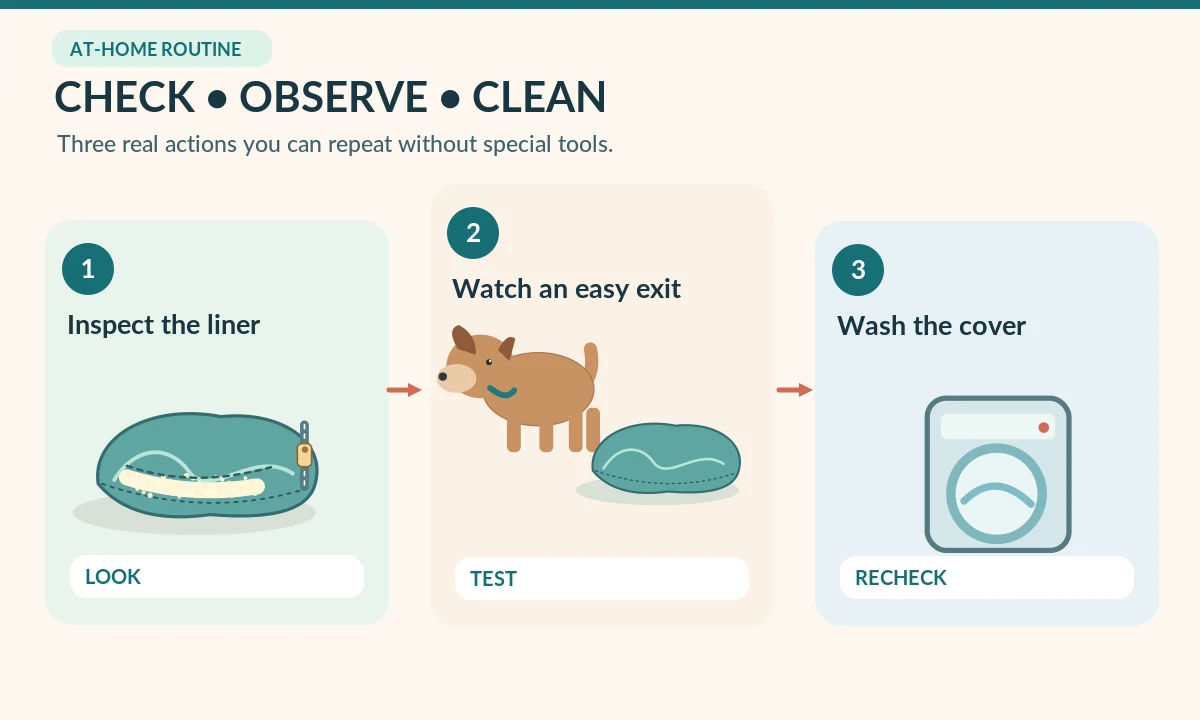
Know when to choose another construction
A stable slab cushion or low-profile mattress can be easier to climb onto and clean than moving fill. For frequent muddy paws, consider a removable cover. When the dog struggles to step out of a recess, a flatter bed may help. None of these choices is a universal solution. Compare the individual dog’s behavior, the location, and your cleaning capacity. Retire a bed with an exposed zipper, leaking beads, lingering dampness, or collapsing support. An extra blanket cannot correct these defects.
How We Research
Our research draws on veterinary, animal welfare, and public-health advice about cleaning, chewing, comfortable access, and home setup. The assessment covers fill containment, real exit movement, cleaning feasibility, and seam integrity as our inspection framework. No laboratory product tests inform these guides. These articles do not rank or endorse products. Learn more about HubPet.
Sources
American Kennel Club — How to Clean a Dog Bed — Evidence about pet care, household safety, or bedding maintenance.
CDC — Cleaning and Disinfecting Pet Supplies — Evidence about pet care, household safety, or bedding maintenance.
ASPCA — Destructive Chewing — Evidence about pet care, household safety, or bedding maintenance.
VCA Animal Hospitals — Comfortable Home for Dogs With Mobility Limitations — Evidence about pet care, household safety, or bedding maintenance.
No. A dog that has difficulty rising, a dog that chews fabric, or a dog that becomes trapped in deep, shifting fill may do better with a firmer low-entry design.
Ask exactly what the manufacturer uses and whether the maker encloses it in a strong, separate inner liner. A vague fill description makes seam and cleanup risks harder to judge.
Only the parts identified as machine-washable by the maker should go into the washer. Many models have a washable outer cover but a nonwashable filled insert.
Watch your dog turn, stand, and step off during normal use. If the center bottoms out or the dog struggles to climb from the pocket, consider a different shape.
Move your dog away, collect loose fill, and remove the bed from service. If you suspect your dog swallowed any material, contact your veterinarian promptly.