
This is a paper wildlife-science project, not a live-animal handling lesson or veterinary advice. Keep art materials out of reach of dogs and cats. For pet health questions, see HubPet’s veterinary disclaimer.
A mandrill’s face is one of the more colorful patterns in the primate world. In adult males, vivid blue ridges flank a bright red nose and muzzle. Pale whiskers and a golden beard frame the lower face, while dark fur and a head crest surround the eyes. However, these colors do not appear with the same intensity on every mandrill. This paper lesson uses a clearly identified adult male as its main subject and a separate comparison of a subtler female face.
The cover places a sturdy mandrill on a shaded Central African forest floor. An anatomy diagram traces the red centerline, the blue ridges on both sides, the beard beneath the mouth, and the short tail behind the body. A second view compares adult male and female markings rather than pretending the species changes colors on command. Four drawing stages start with a compact monkey outline and only then add the precise facial pattern.
Find the mandrill in the drawing
Sketch a broad, strong monkey body with a relatively large head and four capable limbs. Mandrills often forage on the ground but can climb trees, so draw flexible arms and legs rather than the long swinging arms of a gibbon. The torso should feel compact and substantial. A short tail rises behind the rump; avoid the long curling tail often used in generic monkey cartoons. The distinct face must still be big enough for an enlarged detail.
Place two forward-facing eyes high on a long muzzle. From between the eyes, draw a red stripe down the middle toward a rounded red nose. The colored bridge is not a separate tongue, tie, or strap. San Diego Zoo describes thick blue-to-purple ridges along the sides of the nose. Add the blue areas as paired ribbed shapes on either side of the red center, not as a single blue mask across the whole face.
Below the nose, give the mandrill a defined mouth and a pale yellow or golden beard. Broad whiskery cheek fur can extend out to the sides. Keep the beard below the lips, not above the eyes. Mature males have prominent dark head fur and a crest, which helps frame the colored muzzle. Use a frontal inset for facial placement even if the main body is turned three-quarters toward the viewer.
The hands and feet should appear able to grasp, with individual digits kept simple. Add a short, upright tail rather than a prehensile loop. Denver Zoo notes that mandrills also have colored skin on the rump, especially bright in adult males, but the front-facing face remains this lesson’s focus. A modest forest floor of leaf litter and tree roots gives context without implying that mandrills live in open grassy savannas.
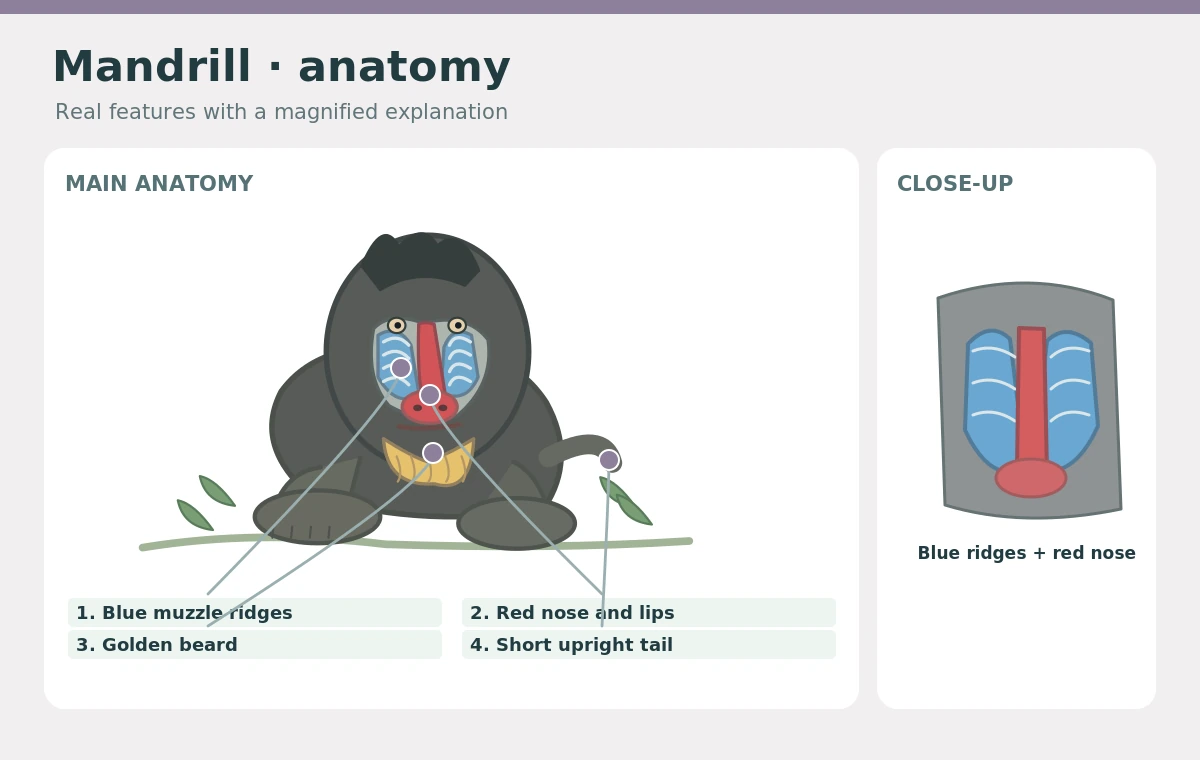
Check the labels against the actual drawn body parts, not merely their approximate position in the picture. The magnified detail separates small biological features that would disappear at full-scene scale.
How the structure works in its natural setting
Adult male coloration is not just decoration. San Diego Zoo describes the blue facial ridges, red nose, and beard as particularly conspicuous in mature males, with visual differences between sexes. The anatomy diagram should show the ridge texture through repeated parallel curved marks. Do not turn the blue ridges into feathers or glued-on face paint. Their position on the muzzle is the biological observation a student needs to learn.
Mandrills use both the forest floor and trees. They forage for a range of plant and animal foods, according to Denver Zoo. Show the animal standing or seated safely among roots and leaves, with the head angled toward the viewer so the face remains clear. The drawing does not need a dramatic attack, a chase scene, or large exposed teeth to communicate species identity. A calm observation pose is more useful for labeling structures.
The short tail helps identify the mandrill as different from a stereotypical long-tailed monkey drawing. Its compact body and heavy limbs also differ from an ape with no tail, even though the head and expression can look familiar to children. Compare a full-body drawing with the enlarged face to establish scale: the diagram is not claiming that a mandrill’s muzzle equals the size of its entire torso.
Compare two meaningful views
In the left panel, draw an adult male with bold blue vertical ridges beside a bright red nose. Add a golden beard and a substantial dark hair crest. Keep the eye position and muzzle length anatomically aligned. The colors should be easy to see, but do not color the entire head blue or red. A few short rib-like lines across each blue section make the actual ridge texture visible.
In the right panel, draw a female face using the same basic mandrill head shape but more muted markings. The eyes, nose location, beard region, and muzzle remain in comparable positions. San Diego Zoo and Denver Zoo both note sexual differences in size and coloration. This is a visual comparison, not a claim that every female has identical tones or that each individual’s appearance reveals exact age or social status.
Cover both captions to check the difference. A viewer should recognize the same species by its long muzzle and facial layout while noticing the relative strength of the colors. If the female panel has an unrelated flat monkey face, correct the ridge placement instead of removing the feature completely. The lesson is about a difference in degree of display, not two unrelated kinds of animals.
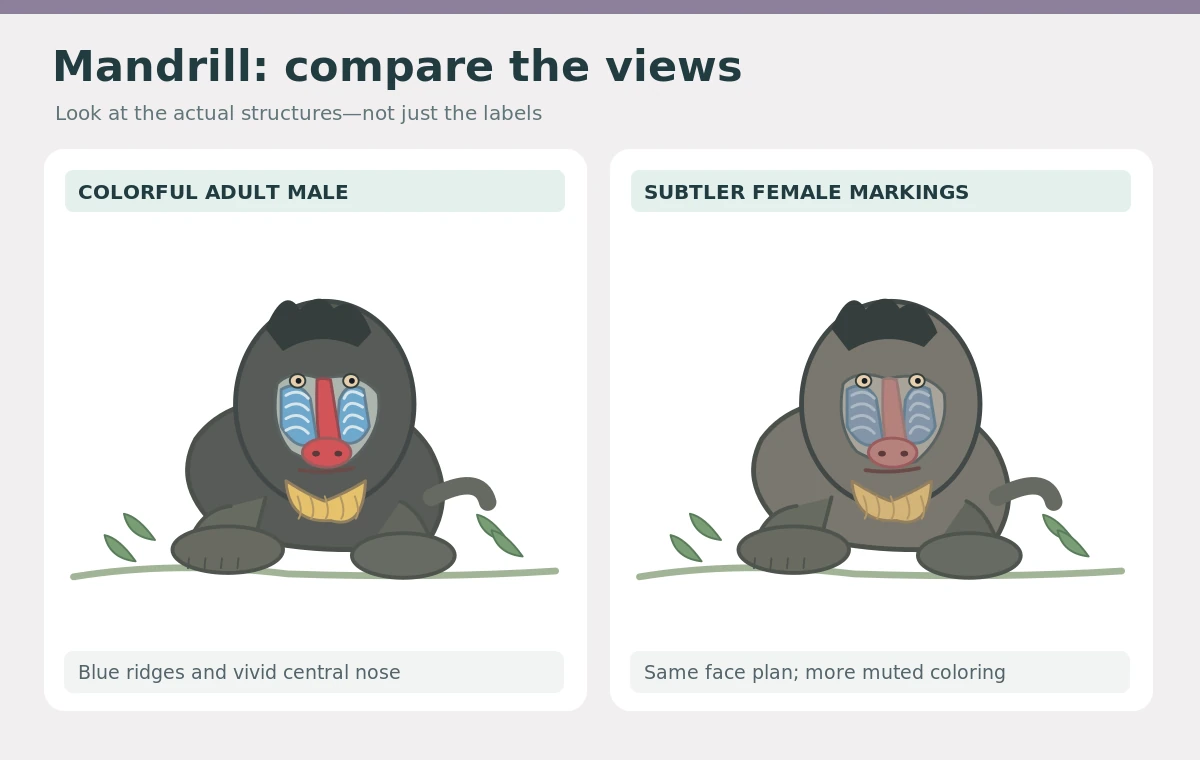
Cover the captions and look at the actual outlines and positions. The difference between the illustrated views should remain visible without relying on words alone.
Draw the science map in four stages
Step 1: Outline the main shape
Begin with a sturdy oval body, a roundish head with a longer lower muzzle, and four limbs. Mark a short tail rising slightly behind the body. Use a gentle line for the forest floor under the feet. Leave the front of the face pale so the colored areas have room. Avoid a human nose at the center of a flat circle; the mandrill’s muzzle projects downward.
Step 2: Add defining structures
Place the eyes above the muzzle and draw a narrow center strip reaching down to the nostrils. Add two symmetrical cheek-ridge regions on either side, leaving visible space for the red nose between them. Shape the mouth below the nose and the beard below the mouth. At this stage, use outlines without heavy color to test the positions.
Step 3: Show the crucial detail
Inside each cheek-ridge region, draw several parallel blue lines that bend with the muzzle. Color the central nose and lips red, then add the yellow-beige beard and a dark head crest. A separate frontal inset makes this easier to explain than a tiny face on a full-body drawing. Keep the eyes clearly outside the colored nose strip.
Step 4: Finish color and review
Finish with gray-brown body fur, a shaded rainforest floor, roots, and a few broad leaves. Leave the blue and red face vivid on the adult male subject but do not paint the whole torso with those colors. Label the blue ridges, red nose, golden beard, and short tail. Compare the bright male face with a subtler female example so the final page does not imply all mandrills are identical.
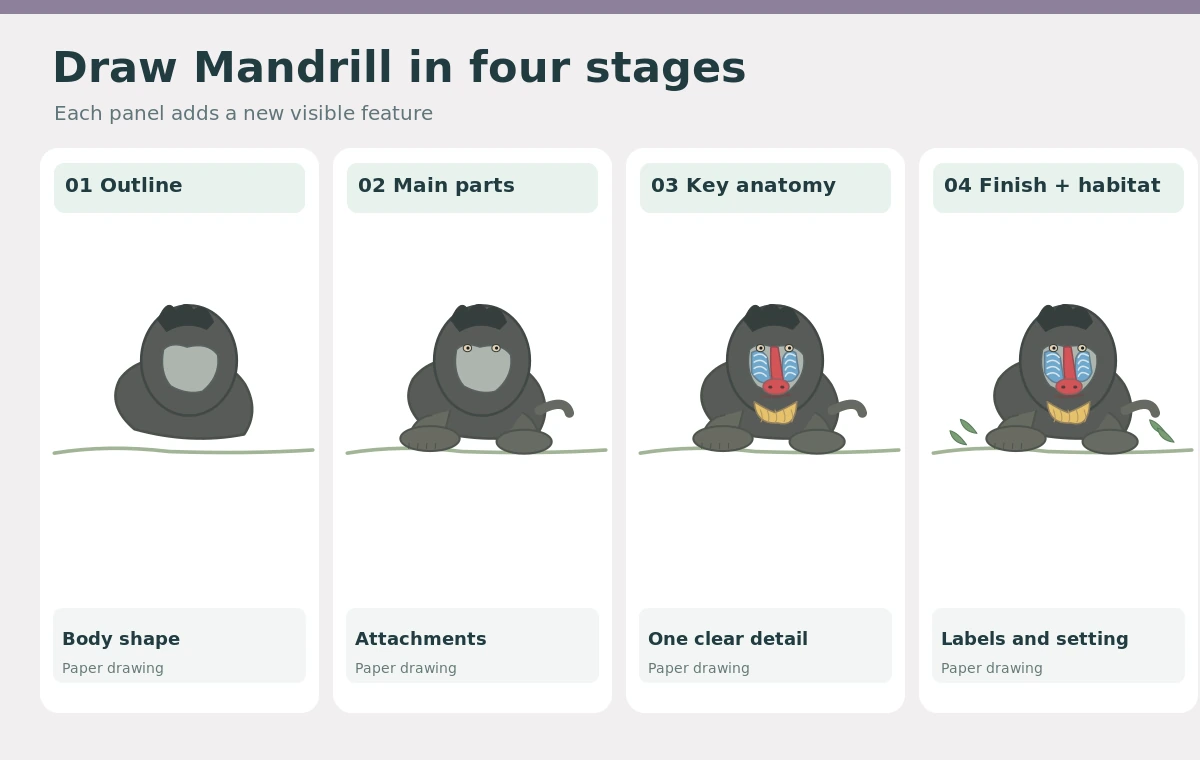
Each stage adds a specific visible anatomical detail. The sequence is a drawing method, not a procedure for touching, keeping, or testing a live animal.
Fix common drawing mistakes
The easiest mistake is to paint a generic monkey’s cheeks solid blue and the forehead red. Move the blue into paired, raised muzzle ridges and keep the red in the central nose-and-lip region. The ridge lines must follow the shape of the snout rather than float across the face like stripes on a shirt. A labeled close-up helps students make this correction without redrawing the whole body.
Another shortcut gives the animal a long, curled tail. Mandrills have a stubby tail, as described by Denver Zoo. Trim the cartoon tail and check that the legs, arms, and heavy torso still read as a ground-foraging monkey. Do not exaggerate the ears into a batlike pair or remove the muzzle projection, because both changes distract from the characteristic facial pattern.
Finally, do not present adult male coloring as the face of every female or young mandrill. The comparative drawing intentionally uses a quieter color treatment on the female example. Avoid treating social ranking as something a child can determine exactly from a few pencil shades. This lesson draws visible anatomical differences and broad patterns, not a diagnostic guide to an individual’s status.
Pet-safe craft setup and a simple learning check
Use printed zoo photographs or trusted educational pages to observe mandrills without approaching or feeding real animals. Keep paper, colored pencils, small sharpeners, beads, and loose scraps away from dogs and cats during the activity. Children can create muzzle-ridge texture with lines on paper; there is no reason to use actual fur, paint on pets, or collect objects from wildlife habitats.
At the end, ask three questions: Where do the blue ridges sit relative to the nose? Why is the beard drawn beneath the mouth? Does the female comparison have the same intensity of coloring? A successful science map answers those questions visually. The goal is a recognizable mandrill with carefully placed color, not a decorative mask that could belong to any monkey.
How We Research
We compare the visible anatomy and behavior against museum, aquarium, zoo, and scientific educational references named below. The HubPet editorial overview describes our source-led approach. The result is an original paper reconstruction designed for understanding, not a reproduction of any source photograph.
We separate visible structures from inferred mechanisms, distinguish special sex or posture examples where relevant, and flag simplifications in the captions. The anatomy inset, the comparison, and the drawing steps answer different questions; each label should point at something a student can actually see.
Sources
San Diego Zoo — Mandrill — reference for the anatomy, environment, and behavior described in this educational drawing lesson.
Denver Zoo — Mandrill — reference for the anatomy, environment, and behavior described in this educational drawing lesson.
Animal Diversity Web — Mandrillus sphinx — reference for the anatomy, environment, and behavior described in this educational drawing lesson.
Frequently asked questions
An adult male mandrill has conspicuous blue-to-purple ridged skin on either side of the red nose. The markings are part of its natural facial appearance.
No. Adult males generally show much brighter red and blue facial areas than females or younger animals. Individual appearances still vary.
Place a red center strip along the nose and muzzle, with red lips below. The blue ridges belong on both sides of the central stripe.
No. A mandrill has a short, stubby tail rather than a long prehensile tail that curls around branches.
Mandrills inhabit Central African forest environments and forage on the ground. Roots, leaf litter, and shaded vegetation fit this drawing better than open grassland.