
This article is general information, not veterinary advice. If your pet seems unwell, is in pain or may have eaten something harmful, contact your vet or an animal poison control line right away. Read our vet disclaimer.
Why cats bite during petting can have more than one explanation. The VCA petting-aggression review, accessed 2026 says some cats stop enjoying touch after a point, while pain, fear, frustration, or a dislike of restraint can also reduce tolerance.
The Cornell Feline Health Center aggression guide, accessed 2026 describes warning signs such as tail lashing, ears moving backward, and dilated pupils before petting-induced aggression. A safer response is to stop before escalation, not punish the cat.
Why Cats Bite During Petting: Watch the Threshold
Petting tolerance varies by cat, body area, context, and day. A cat may choose to sit close without asking for prolonged stroking. The VCA review, accessed 2026, recommends learning the individual threshold and ending petting while the cat is still calm.
Look for a change from the cat’s relaxed baseline: the body stiffens, the tail begins to flick, ears rotate back, skin twitches, the cat turns toward the hand, or the cat shifts away. Use the shy-cat support guide and the sudden-hiding guide to read distance-seeking behavior without forcing contact.
| Signal during petting | What it may mean | Safer response |
|---|---|---|
| Body stiffens | Tolerance is dropping | Stop touching |
| Tail flicks or lashes | Arousal is rising | Give space |
| Ears turn back | Discomfort or concern | End interaction |
| Cat turns toward hand | Possible warning | Move hand away calmly |
| Biting is new or localized | Pain may contribute | Arrange a veterinary exam |

Why Cats Bite During Petting in Certain Places or Situations
Pain can change how a cat responds to touch. Cornell guidance, accessed 2026, notes that cats with painful areas may hiss, scratch, or bite to avoid contact. VCA also lists dental, skin, joint, neck, and back discomfort as possible reasons for a sudden change in petting tolerance. A new pattern deserves a veterinary check.
Context matters too. Some cats want proximity without stroking, and others prefer short contact around the head rather than long strokes. Let the cat initiate and control interaction, consistent with cooperative handling practice and the broader consent-based handling principle.
If hands have become part of rough play, redirect hunting behavior toward appropriate toys. Use the feet-under-blankets guide, indoor-cat stimulation ideas, and toy rotation to create play outlets that do not involve grabbing skin.
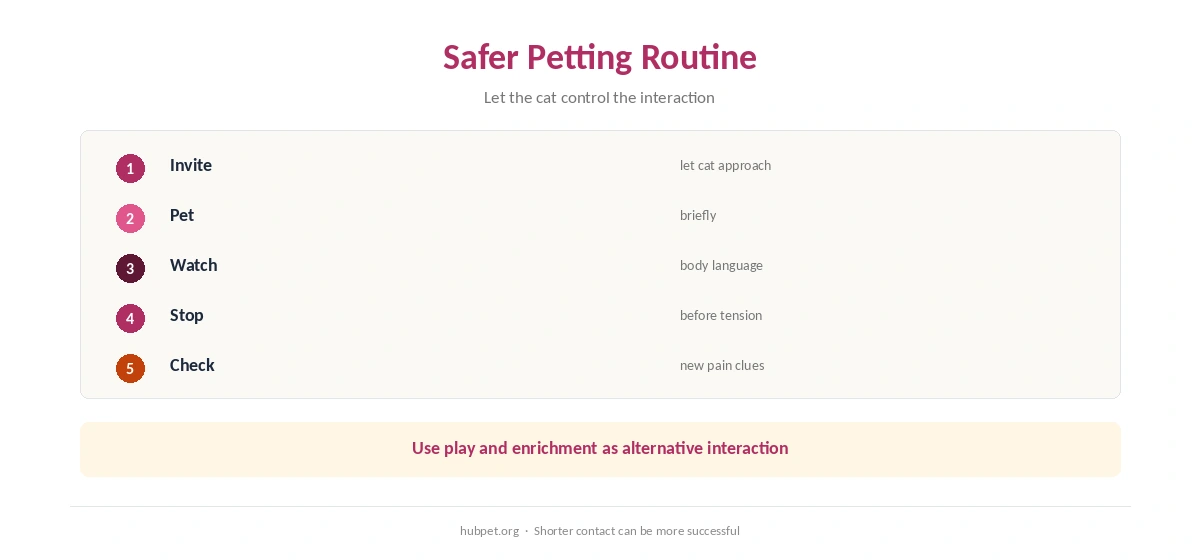
- Pet only when the cat is choosing contact and appears relaxed.
- Keep early sessions shorter than the point where warning signals usually begin.
- Stop at the first consistent sign of tension or withdrawal.
- Do not restrain, yell at, hit, or chase the cat after a bite.
- Use play, perches, hiding places, and other chosen interactions instead of demanding touch.
- Arrange a veterinary exam if biting is sudden, severe, or linked to one body area.
When Petting Bites Need Professional Help
Do not assume a sudden change in petting bites reflects personality alone. If touching one area reliably triggers a strong reaction, or the cat also shows reduced movement, hiding, grooming changes, or other signs of discomfort, contact a veterinarian. The home skin-check guide can help you notice surface changes without trying to diagnose them.
If a bite breaks human skin, VCA guidance, accessed 2026, advises taking the wound seriously because cat bites can become infected. Clean the wound and contact an appropriate human healthcare professional for advice. Do not punish the cat afterward.
After your veterinarian rules out medical contributors, ask about a qualified feline behavior professional for ongoing fear or aggression. Meanwhile, improve choice and environmental control with safe climbing spaces, an enrichment corner, and predictable routines.
In multi-cat homes, social tension can lower tolerance for handling. Review the pet-introduction checklist and the multi-pet household checklist if the biting began after a household change. In practice, assess why cats bite during petting by considering household stressors alongside touch preferences. Knowing why cats bite during petting also means tracking when the interaction stays comfortable.

How We Research
HubPet reviewed these sources on October 11, 2026. We used the VCA petting-aggression review, accessed 2026 and the Cornell Feline Health Center aggression guide, accessed 2026. Our research process separates behavioral explanations from medical causes that require a veterinarian.
Some cats seek closeness without wanting prolonged stroking. Sitting nearby or on a lap does not always mean the cat wants continuous petting.
Common clues include body tension, tail flicking, ears moving back, skin twitching, turning toward the hand, or moving away.
No. Cornell and VCA guidance recommends avoiding physical punishment and ending the interaction calmly.
Yes. Pain or skin, dental, joint, neck, or back discomfort can lower tolerance for touch, especially when the change is new or localized.
Arrange a veterinary exam for sudden biting, strong reactions to one body area, or other behavior or movement changes that could reflect discomfort.
The Bottom Line on Why Cats Bite During Petting
Why cats bite during petting is usually a cue to reduce pressure and read the individual cat more carefully, not a reason to punish. Stop before the threshold, respect chosen contact, and involve a veterinarian when the response is sudden or may be linked to pain.