
This article is general information, not veterinary advice. If your pet seems unwell, is in pain or may have eaten something harmful, contact your vet or an animal poison control line right away. Read our vet disclaimer. A 6 ft leash is a practical default for everyday dog walks. It leaves room to sniff while the handler stays close enough to respond. Six feet is not a promise of better behavior or the correct length in every place. A narrow sidewalk, a strong puller or a busy trail changes the line you should allow. A fenced field can be different. Choose a fixed-length leash you can comfortably hold. Teach a relaxed line instead of using the leash as a steering device.
The short answer: start by inspecting the clip, stitching, grip and dog-to-leash weight match. A standard four- to six-foot fixed leash is generally easier to manage in ordinary pedestrian areas. Long lines serve other purposes. Save 10-, 15-, 20-, 30- or 50-foot lines for appropriate open-space work. A retractable leash is not a fixed long line.
What a six-foot leash does—and what it cannot fix
Length gives you working distance; equipment does not teach manners by itself. With a 6-foot dog leash, gather excess length into loose folds to shorten the working span. Some leashes provide another fixed handle. Do not wind the line around your hand, wrist or fingers, especially with a large dog. If your dog rushes toward people, create distance early. Shorten the working span smoothly and reward calm attention where there is room.
| Leash length | Useful situation | Main limit |
|---|---|---|
| 4 ft | Crowded paths or close practice | Less sniffing room; dog and person may crowd one another |
| 6 ft | Everyday sidewalks and loose-leash practice | Requires awareness when passing traffic or other dogs |
| 10–15 ft | Quiet open-space exploration and introductory recall | More slack to gather; tangling risk rises |
| 20 ft | Recall work in a clear field | Needs active two-hand management and secure harness |
| 30 ft | Advanced open-space practice with unobstructed ground | Harder to manage safely around people or trees |
| 50 ft | Specialized open-field training with an experienced handler | High entanglement and stopping-distance demands |
Choose the material, handle and clip by real handling—not color
A flat nylon or similar woven leash is widely available and typically easy to clean. Match the width and hardware strength to your dog. Avoid hardware so heavy that it drags on a small dog. Run a finger over seams and the grip. Reject rough edges, sharp stitching or a loose swivel. Open and close the clip gate several times. It should shut fully and attach securely to the intended harness ring. Check for corrosion, cuts and chewing damage before each walk. Replace worn equipment; a quick knot cannot restore safety stitching.
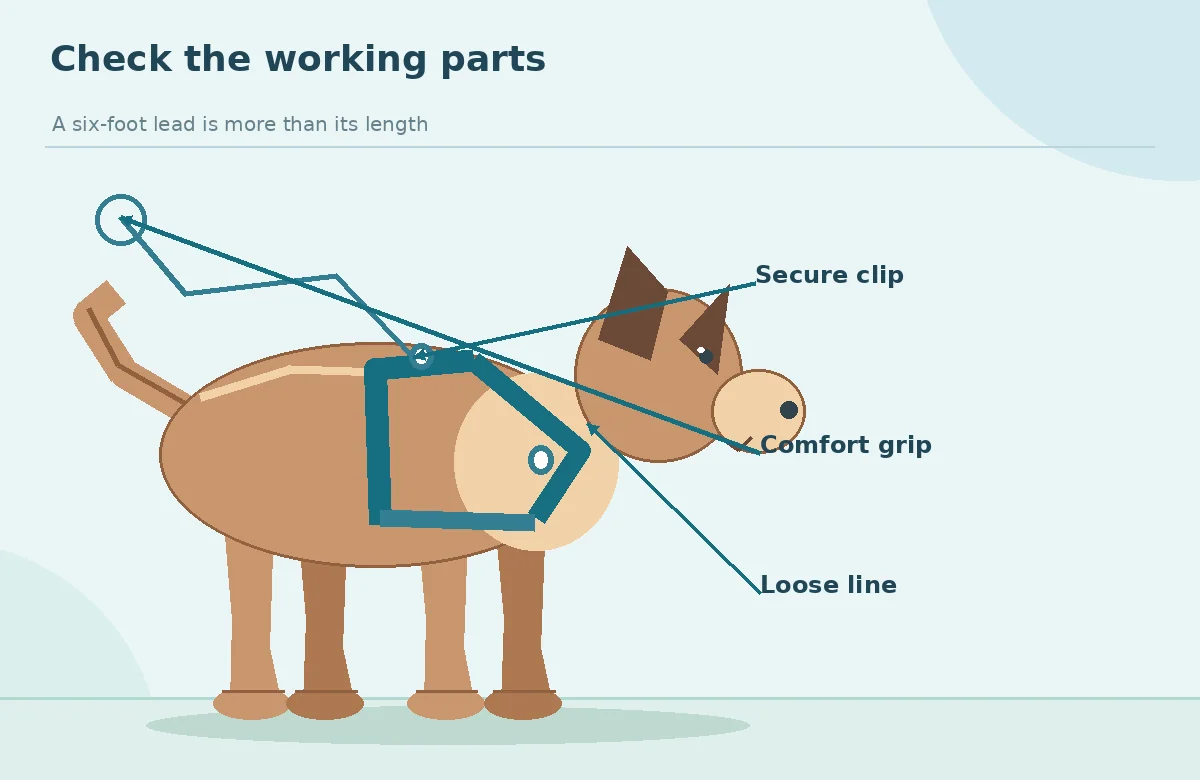
For an active dog, a comfortable hand loop and a grippy surface are often more valuable than decorative accessories. Reflective stitching improves visibility but does not make a dog visible from every angle; use suitable lights when needed. A traffic handle may help at crossings. Never use it to yank a dog or restrain the dog tightly for an entire walk. Use calm, planned changes in distance, frequent rewards for a loose line and enough room for normal movement. For a training sequence, see the existing loose-leash training guide.
A simple pre-walk equipment check
- Lay out the whole leash; look for frayed webbing, torn seams, worn coating or a damaged handle.
- Open and release the clasp several times; confirm that the spring closes and the swivel turns freely.
- Check the attached harness or flat collar for fit and escape risk; a leash cannot correct badly fitting gear.
- Clip to the intended D-ring, tug gently by hand to confirm engagement, and keep the line free of legs and wheels.
- Begin in a quiet place; reward moments of relaxed line and shorten your working distance before a tight passage.

Try your own grip before heading into a busy area. Can you gather the leash and offer a reward without wrapping the strap around your fingers? If not, change your grip. Practice in a driveway or empty path. Start, stop, collect slack smoothly, reward attention and release some length again. The San Francisco SPCA describes six-foot-leash loose-leash training as a reinforcement exercise rather than a correction routine. For a dog already dragging the handler, first lower the level of distraction and consider a comfortable no-tightening body harness.
Match the leash to the walking environment
| What you see | Better adjustment | What to avoid |
|---|---|---|
| Dog pulls hard near a road | Use safe distance, a manageable fixed line and reward-based practice | Letting a 20–50 ft line run into traffic |
| Small dog struggles under heavy hardware | Choose lighter, secure materials | Oversized clips that swing into the dog |
| Dog needs recall practice in a field | Switch to a long line on a secure back-clip harness | Long line on a neck collar or head halter |
| Leash rubs the handler’s hand | Change grip/texture; gather slack safely | Wrapping line around hand or wrist |

Check local leash-length requirements before changing from everyday walking to long-line practice. One public area may limit leads to six feet. A longer training line is not automatically legal in another place. In crowded locations, find safe side areas for sniffing. The lead need not stay taut to keep the dog nearby. If pulling remains an ongoing problem, this pulling-on-leash resource covers the training problem rather than pretending that an expensive leash fixes it.
When six feet is not the right answer
Six feet may be too long beside vehicles, scooters or crowded doorways. Reduce the working span before entering those spaces. It may feel restrictive during deliberate recall practice, where a fixed long line on a harness is more useful. A leash cannot prevent escape from an ill-fitting harness. It also cannot replace a secure yard barrier. Avoid clipping a long line to any device that redirects the head. A dog that suddenly refuses walks or coughs under leash tension needs a fit check. Seek veterinary advice for pain.
How We Research
We compared leash-length guidance from the AKC and San Francisco SPCA. We separated everyday handling from the goals of open-field recall training. These are decision rules, not product endorsements. Actual leash laws, clasp designs, dog size and handler ability change the answer. We favor rewards for walking on a soft line and avoid force-based corrections. For the general editing standards behind our content, read How We Research at HubPet. Shopping-category links in this article are navigation routes, not statements of sponsorship or partner approval.
Sources
AKC: Choosing the Right Dog Leash; San Francisco SPCA: Collars and Leashes; San Francisco SPCA: Loose-Leash Walking; AVSAB: Humane Dog Training Position. We use these references for practical fit, handling, and humane-training precautions; their advice does not substitute for an in-person fitting.
Not necessarily. It is a common everyday length, but you should manage the usable slack well before traffic, narrow entrances and crowds.
A fixed leash gives a predictable maximum span and is generally easier for early loose-leash work; retractable lines add specific control and entanglement risks.
A long line is for suitable open areas with careful handling, not a default for crowded sidewalks, crossings or busy paths.
No. Match width, clip strength, grip and weight to your dog and your handling ability; inspect wear and follow the maker’s guidance.
Use the intended secure ring on a properly fitted harness or suitable flat collar; for recall long-line work, prefer a back-clip body harness.