
This guide is general information, not individualized veterinary advice. If your pet shows pain, distress, illness, or a sudden behavior change, speak with a veterinarian. Read HubPet’s veterinary disclaimer.
Dog bowls to slow eating down use raised ridges, grooves or compartments so a dog takes smaller mouthfuls instead of gulping a whole meal at once. A slow-feed bowl can be helpful, but the right design depends on muzzle width, food texture, portion size and how your dog reacts. A dense maze may be a fun challenge for one dog and a source of frustration for another. This guide compares shallow ridges, deeper puzzles and simple spread-out feeding surfaces, with a start-small test and a cleaning checklist. Slowing meals is not proof of GDV prevention or a treatment for vomiting; recurring symptoms and high-risk large breeds need individual veterinary advice.
Match ridge depth to muzzle and meal type
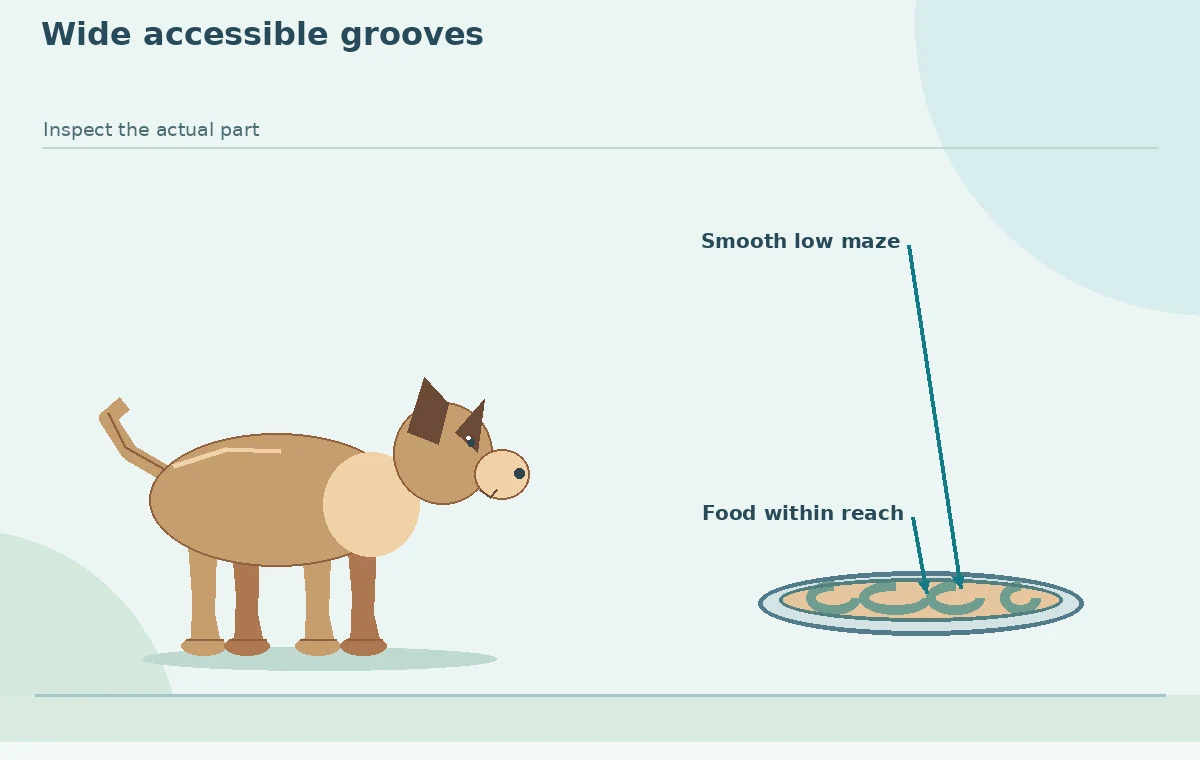
For small dogs with narrow muzzles, intricate deep channels can block access and create frantic pawing. Broad-muzzled dogs may need wider grooves with no sharp interior edges. For kibble, moderate ridges can divide the meal into small reachable areas. Wet food may stick in narrow corners and need a smooth shallow pattern that comes completely clean. Choose food-contact materials intended for dogs, inspect for rough plastic or easily chewed fragments and follow the maker’s dishwasher instructions. AKC describes slow-feed dishes and puzzle feeders as ways to encourage smaller mouthfuls; the veterinary-reviewed Chewy guide cautions that some seniors and heavy chewers need simpler designs. A slow bowl should contain the full normal meal without requiring overfilling or pushing food into inaccessible channels. Test access with the bowl on the floor before relying on it for daily feeding.
| Dog or meal | Try first | Avoid |
|---|---|---|
| Small dog with narrow muzzle | Open shallow rounded channels | Deep tight pockets |
| Broad muzzle or large dog | Wide spaced ridges and stable base | Narrow maze with inaccessible food |
| Wet or fresh food | Smooth simple maze, washable inserts | Crevices trapping residue |
| Dry kibble | Moderate ridges or a spread-out tray | Overfilling that defeats the dividers |
| Senior or easily frustrated dog | Low-complexity feeder | Hard puzzles that stop eating |
| Strong chewer | Durable supervised food-safe design | Pieces that can break off |
Introduce a slow-feeding bowl without stress
Serve a small portion of the dog’s normal meal in a simple feeder while you supervise. Let the dog investigate voluntarily; reward calm interest, but do not push its muzzle into the channels. Observe whether the dog reaches food with comfortable tongue and jaw movement. A mild increase in time is enough; this is not a contest to make the meal last as long as possible. If the dog paws hard, flips the dish, bites its ridges, growls at nearby dogs or leaves food because it cannot reach it, choose a simpler layout or return to a regular dish. Move dogs apart if competition makes them rush. Divide the daily ration into the usual veterinarian-advised meals rather than adding extra calories to fill the maze. For positive routines around mealtime, use our wait-for-food training guide.
- Choose a broad, stable and shallow first pattern that fits the dog’s muzzle.
- Start with part of the normal meal and let the dog explore without forcing.
- Observe licking, chewing and breathing; stop if coughing, gagging or marked frustration appears.
- Only increase difficulty when your dog consistently reaches all food calmly.
- Wash and fully dry the bowl after use and re-check for cracks or loose pieces.

Compare slow bowl, lick mat, puzzle feeder and flat tray
The slow bowl keeps food in a stationary dish while ridges separate mouthfuls. By comparison, a lick mat can spread soft food thinly, but it differs from a dry-kibble maze. Supervise dogs that might chew silicone. Puzzle feeders introduce movable parts and may be more demanding to clean; check for small removable components. Alternatively, a flat tray or muffin pan can distribute ordinary kibble in separate small portions without a specialized product, provided it is stable and safe to use. Each method changes the mechanics of access, not the nutritional content of the meal. The best choice is the one the dog can use without distress and that the owner can clean completely. For a dog that persistently gulps food or regurgitates, discuss the pattern with a vet instead of buying increasingly complicated equipment.
| Method | Good starting situation | Watch for |
|---|---|---|
| Shallow slow-feed bowl | First attempt with kibble | Accessible grooves and easy cleaning |
| Wide-ridge bowl | Broad muzzle and larger ration | No sharp tall ridges |
| Lick mat | Appropriate soft food | Chewing mat edges or poor cleaning |
| Puzzle feeder | Dog enjoys simple food problems | Frustration or detachable small pieces |
| Tray or muffin pan | Low-cost distributed kibble | Sharp edges and sliding |

Use the feeder as one part of a calmer meal
Dogs may eat faster when other animals crowd them or compete for food. Feed in separate areas, preserve a predictable schedule and avoid snatching dishes away. VCA notes that speeding up or freezing around a bowl can be early signs of guarding, not misbehavior to punish. A calm feeding environment may matter more than adding a more intricate maze. The CDC advises washing wet-food bowls after each use and dry-food and water bowls daily. Grooves need extra attention to remove retained food. Replace bowls with scratches, chew damage or crevices that no longer wash clean.
For large, deep-chested dogs, a slower pace may be worth discussing with the veterinarian, but no dish guarantees protection from GDV. Cornell lists fast eating and raised food bowls among several GDV risk factors. Avoid combining a slow feeder with an elevated platform without veterinary guidance. Our reward-based mealtime boundaries and food change guide can support a consistent routine without using a feeder as a shortcut for behavioral or medical care.
When to Call Your Vet
Seek emergency veterinary care for a suddenly swollen abdomen, unproductive retching, marked distress, weakness or collapse. Contact your veterinarian for repeated coughing while eating, regurgitation, vomiting, weight loss or a sudden change in feeding behavior. Do not assume a slow bowl treats an underlying condition.
How We Research
We compared AKC slow-feeding methods with a veterinary-reviewed bowl design guide, Cornell’s GDV risk discussion, CDC hygiene requirements and VCA behavior recommendations. We do not make product rankings or promise disease prevention. Reviewed November 2026. For site editorial information, read about HubPet.
Sources
American Kennel Club — How to Help Your Dog Eat More Slowly. Chewy Veterinary Review — Slow-Feeder Dog Bowl Selection. Cornell University College of Veterinary Medicine — Gastric Dilatation-Volvulus. CDC — Cleaning and Disinfecting Pet Supplies. VCA Animal Hospitals — Recognizing Food Bowl Guarding.
Many designs divide food into smaller reachable portions and may slow gulping, but effectiveness depends on the dog, food and ridge pattern.
Start with a shallow stable design that allows the muzzle and tongue to reach every part comfortably; do not choose by a size label alone.
Yes if the maker permits it and the bowl can be thoroughly cleaned. Select smooth accessible channels instead of deep corners that hold residue.
No single bowl has established evidence of preventing GDV. GDV has multiple risk factors, and large or deep-chested dogs need individualized veterinary guidance.
Stop using that layout, offer a simpler supervised alternative and check for damaged pieces. Do not punish the dog for frustration.