
A dog stroller can look roomy in a product photo but feel cramped once a dog settles inside. A useful size check starts with the inside floor, standing headroom, turning room, and the manufacturer’s stated payload limit. These are four different tests, not interchangeable promises. The aim is a supported, ventilated space in which the dog can change position without pressing against the canopy or sides. Measure your actual dog, then check the real stroller rather than relying on small, medium, or large labels. This is equipment guidance rather than a medical diagnosis or treatment plan; consult your veterinarian about new discomfort or distress and see the veterinary disclaimer.
Measure your dog in a natural position
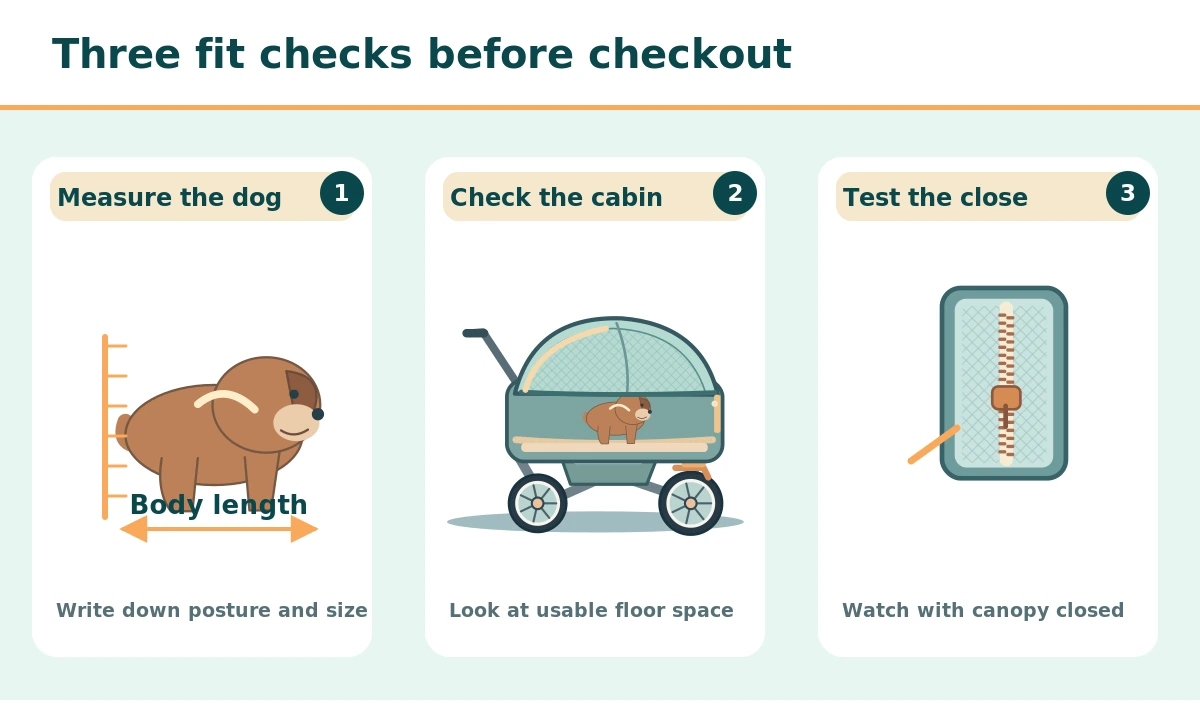
On a non-slip floor, measure the dog from the front of the chest to the base of the tail while standing naturally, then record shoulder-to-floor height and the widest comfortable body width. For a dog that curls to sleep, observe the size of the curl as well, but do not assume a curled shape is the only posture needed. Add space for repositioning rather than forcing a dog to remain curled. If your dog resists standing or has pain, ask your veterinarian how to assess mobility without forcing a posture.
Request the inside dimensions, not the outer frame
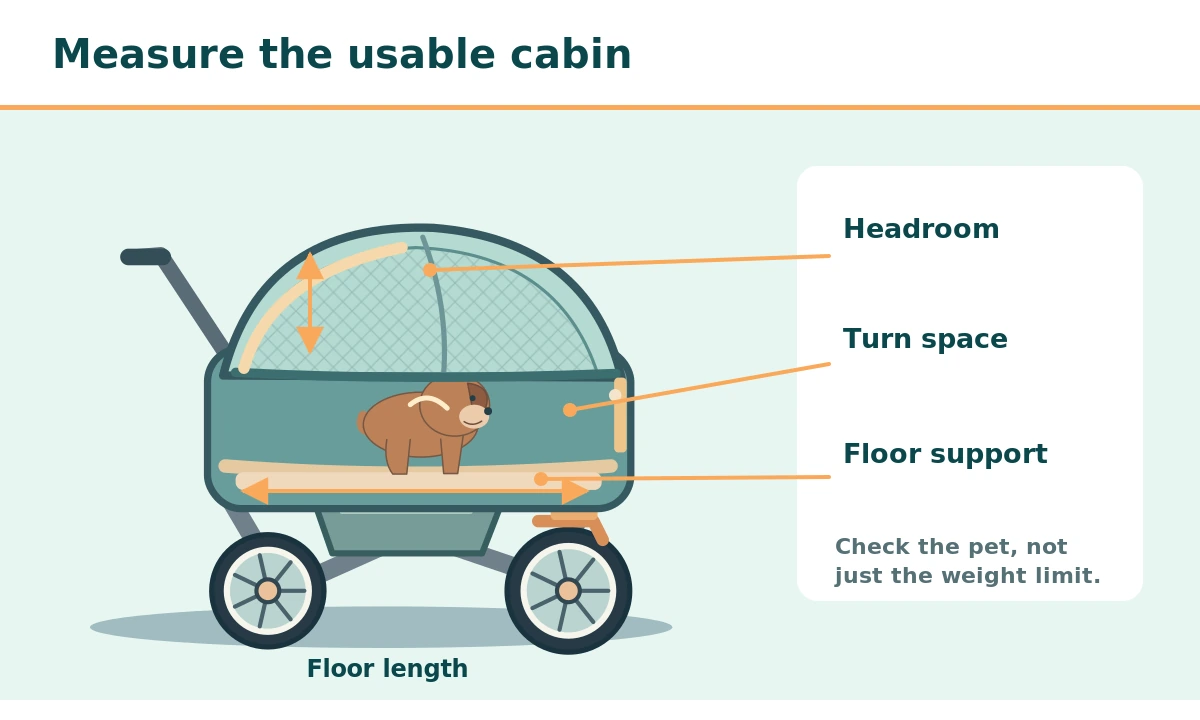
Product listings often emphasize overall length, handle height, and weight capacity. Those do not describe the usable floor. Find the interior cabin length and width at floor level, the height beneath the closed canopy, and the width of the entry opening. Ask whether a thick pad reduces standing clearance or whether a sloped front panel steals usable length. Check the narrowest point, including side braces and wheel wells. When a manufacturer provides no interior dimensions, compare an assembled model in person or request measurements before ordering.
Check headroom and turning with the canopy shut
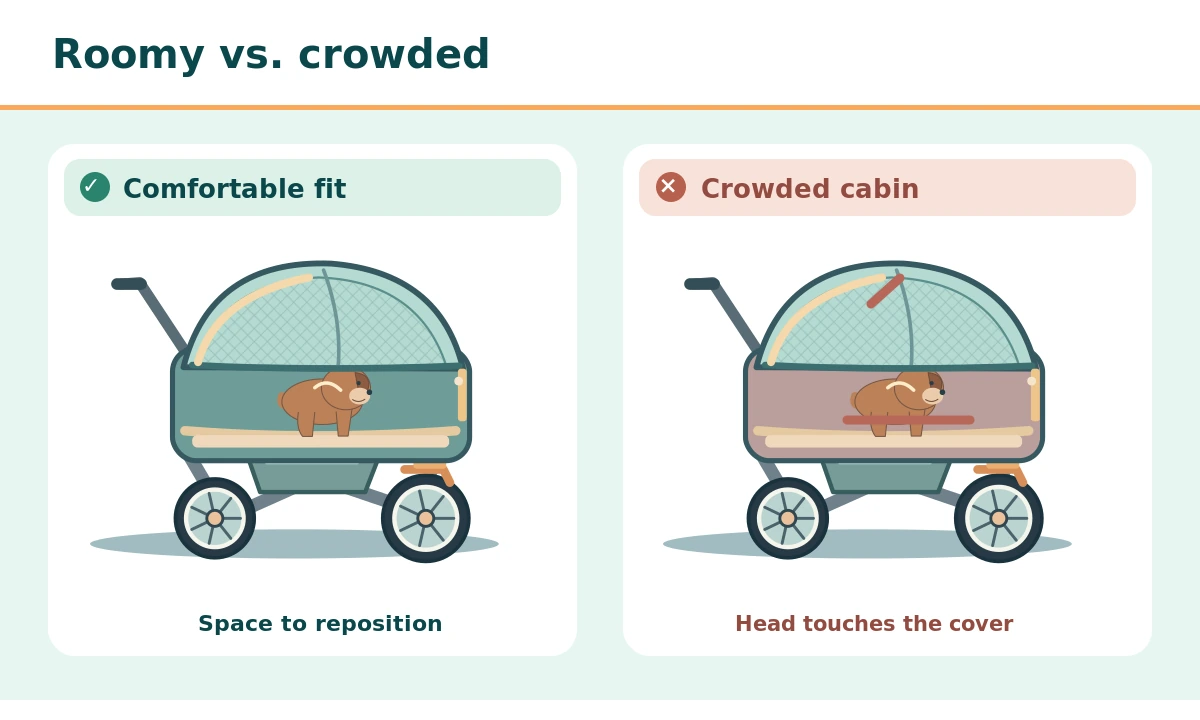
A dog should be able to lie in its natural resting position, change sides, and sit or stand comfortably within the intended cabin design. Test these movements with the mesh door and canopy fully closed, because an open canopy can make a too-small stroller appear adequate. The dog’s ears or back should not need to press against the cover. Ask a helper to hold the stroller stationary with its brake set during a calm fit test. If the dog looks crowded or distressed, stop rather than interpreting a still posture as comfort.
Treat the rated load as a limit, not a fit guarantee
A weight rating is a structural specification issued for that specific product, not evidence that every dog under the number fits. Weigh the dog using a reliable scale and consider the manufacturer’s instructions about whether bedding, treats, or gear count toward the payload. Never assume a larger number on a shopping page replaces the actual manual. Check frame and wheel ratings if a removable cabin mounts on a different chassis. If an animal is near the limit, choose a model with adequate verified capacity and generous physical room; avoid improvised modifications.
Account for the floor pad and posture
A slippery, sagging, or heavily quilted floor can make even a large cabin uncomfortable. Inspect whether the base is rigid, supported across its width, and free of hard protrusions. A thin washable non-slip liner may improve grip, but follow the product’s guidance and ensure any added pad does not block closures or ventilation. Observe your dog’s preferred posture at home. A dog that stretches its front legs forward will need more usable length than a tightly curled measurement implies. Avoid thick pillows that crowd a small cabin.
Measure the entry, not just the sitting space
A comfortable interior is only useful if the dog can enter without scraping a shoulder, twisting, or risking a rough placement. Measure the clear opening with the door open to its intended limit. Check whether the floor is low enough for voluntary step-in, whether you need a stable platform, and how a person will support a dog who cannot climb. Keep the stroller brake engaged during entry. Never lift a heavy or painful dog by the front legs, collar, or harness attachment points; seek appropriate help or veterinary advice.
Verify the inside harness anchor and closures
Look for a sturdy manufacturer-provided attachment point and check its instructions before using an internal restraint. A short connector may help prevent an impulsive jump, but it should attach to a well-fitted body harness, not to a neck collar, and should not tangle around legs. It is not a crash-tested car restraint. Check that zippers or latches close without catching fur or pinching skin. Close the canopy while stationary and inspect for gaps the dog could squeeze through. A secure closure and a roomy cabin are equally important.
Compare doorway, elevator, and storage dimensions
The stroller must also fit the spaces in your home. Measure your doorways, elevator opening, hallway turns, vehicle trunk, and storage space. Compare overall width including wheel hubs, not just the cabin width. Check the folded dimensions with the wheels installed, as well as any parts the owner must remove before folding. A stroller that cannot maneuver through a narrow doorway will encourage awkward lifting. Test the fold with the pet elsewhere and never fold or carry the chassis with an animal inside.
Recheck capacity if two small pets share the cabin
Two animals can meet a combined weight rating and still have too little floor space or dislike sharing close quarters. Each needs room to rest without one pet crowding the other. Sharing also introduces resource competition, tether tangles, and escape risk during entry. Do not assume bonded pets will remain relaxed in close quarters outdoors. If the manufacturer does not explicitly support two occupants, do not improvise. Separate, secure accommodations are often a clearer choice, especially when pets have different activity levels or stress responses.
Do a real-world stationary fit rehearsal
Set the brake, place the stroller on level ground, and invite the dog to investigate without pressure. Reward voluntary approach and let the dog leave. If the dog chooses to enter, briefly close the mesh and reopen it while observing breathing, balance, and body language. Check the dog’s nose clearance, foot placement, turning room, and ability to lie down. Then push only a few feet on smooth ground if the dog remains relaxed. Fit is not just a tape-measure result: the animal’s response matters.
Know when another transport option is better
Strollers can be inconvenient on stairs, crowded public transit, rough trails, or doorways with no clear path. Depending on the pet, a properly sized handheld carrier, a well-fitted walking setup, or a safe home rest period may work better. Seek veterinary guidance before outings if your dog develops unexpected weakness, breathing difficulty, pain, or severe anxiety. Do not use a stroller as an automatic substitute for gentle activity when walking is appropriate. The goal is participation and welfare, not forcing every dog into the same travel gear.
Keep a measurement record before ordering
Write down the dog’s standing length, shoulder height, width, and current weight beside the product’s actual internal dimensions and rated load. Add the opening width, wheel-to-wheel outside width, folded size, and the return policy. Photograph the product label and retain the manual for future checks. If you change the liner or your dog grows or gains weight, repeat the fit check. This short record prevents confusion between advertised exterior dimensions and the space your dog can actually use.
How We Research
We reviewed current guidance from veterinary and animal welfare organizations alongside the practical features identified in stroller design and use. Recommendations distinguish manufacturer-specific load and hardware instructions from general animal comfort principles. We prioritize secure containment, owner control, gradual introduction, and observable pet welfare over marketing promises. Specifications vary by model; confirm all measurements, permitted activities, and replacement parts with the maker. Read more about HubPet and our editorial approach.
Sources
American Kennel Club — Strollers for Dogs: Everything You Need to Know.
AVMA — Traveling with your dog or cat.
AVMA — Warm weather pet safety.
No. The load rating covers a different question from cabin length, floor width, headroom, and safe entry. Check both measurements and your dog’s movements.
There is no universal inch allowance. Confirm that your individual dog can sit, lie naturally, and reposition with the canopy fully closed and without pressure against the sides.
Yes. Any liner or pad changes usable height and sometimes length. Check the actual setup your dog will ride in, with the brake applied.
Only when the product permits the occupancy and both dogs have adequate room and remain relaxed. Consider tether tangles, escapes, and different needs.
Do not force entry or interpret freezing as acceptance. Restart with calm indoor introductions and rewards, or choose a different transport arrangement.