
A fixed mesh dog gate can provide a light, see-through divider in an ordinary doorway. Unlike a retractable roll-up gate, a fixed fabric panel stays stretched between its edge supports. That difference matters when checking attachment points, tension, seams, and access for humans. Mesh can be convenient for a calm dog, yet fabric may tear or bow when a dog chews, claws, or runs at it. This guide is about fixed mesh panels, not retractable mechanisms, and explains when to choose a stronger alternative.
Identify the exact mesh construction
Check whether the frame holds the fabric inside a rigid frame, tensioned between posts, or fastened with hooks or straps. Each design behaves differently when a dog presses the middle. A mesh sheet loosely hooked onto a doorway may sag even if its advertised width appears correct. Read the maker’s permitted mounting surfaces and height range before setting it up. Identify whether someone can remove the entire assembly easily in an emergency. Do not treat a decorative insect screen, magnetic curtain, or improvised net as a pet safety gate.
Measure the opening and usable fabric span
Measure the clear width at the top, middle, and bottom of the doorway. Then check the finished panel area after installing the designated mounting hardware. Some products list an overall frame width that includes posts and straps, leaving less usable barrier than expected. Measure low gaps near baseboards where a small dog could crawl underneath. Avoid stretching material beyond the approved range. If the panel does not fully cover the opening without loose folds, select a product designed for that width rather than adding random ties.
Inspect binding tape, seams, and stitched corners
Most fabric failures begin at a seam, corner, or attachment point rather than the center of an intact panel. Look for fraying, broken threads, skipped stitches, loose hem tape, and any small plastic end caps that might detach. Pull lightly on the empty panel as permitted by its instructions; do not tug hard enough to simulate a dog collision. A seam that opens or a grommet that loosens calls for replacement. Do not glue torn mesh over a stressed joint and assume its original strength has returned.
Keep tension even without creating pinch points
A properly tensioned fixed mesh panel should remain reasonably smooth and keep its edges seated in the intended supports. Uneven tension can make the bottom sag or bow the side posts. Adjust only the manufacturer’s provided tensioning mechanism. Keep excess cord or strap ends inaccessible to the pet, and do not tie long loops near the floor. Check that mounting tabs cannot rotate into the opening. A panel that springs backward after a pull may startle or strike a dog, so test the empty assembly carefully before any supervised pet introduction.

Know what mesh can and cannot contain
A calm dog may respect a visible fabric boundary, while a dog that jumps, scratches, or chews can damage it quickly. Fabric is not an appropriate barrier for controlling stair falls or hazardous machinery access. It may not stop a frightened dog from trying to push through or climb. For a chewing dog, inspect after every brief session and stop use at the first hole. The goal is to set a realistic boundary, not to prove the fabric can withstand repeated impact. Choose a fixed rigid gate when the situation requires dependable closure.
Watch how visibility affects your dog
Mesh lets the dog see movement on the opposite side. That can reduce surprise in some households but may increase excitement when visitors or another pet appear. Try a short session with the dog at a comfortable distance, rewarding moments of calm attention and disengagement. Do not let dogs meet nose-to-nose across a stretched sheet if either appears tense. During new-pet introductions, Guelph Humane Society recommends controlled visual sessions with secure barriers and room to retreat. A simple mesh panel may not provide that level of security for every pairing.
Inspect mounting points without improvising
Check the fastening system: brackets, tension poles, hook-and-loop straps, or manufacturer-approved wall fixtures. Install these parts only on the types of surfaces specified in the instructions. Do not attach a mesh barrier to a loose curtain rod, weak adhesive tab, or rolling furniture. If a frame needs screws, verify the wall structure first. Never drill into unknown services or required door assemblies. A light fabric panel still fails when its supports detach. Confirm that people can open the passage without pulling on the mesh itself.
Keep the human walkway free of loose fabric
Loose mesh flapping at ankle height creates a trip hazard, especially in dark hallways. Mark the path used by people carrying laundry or children, and make sure people can clear the gate without climbing over it. Avoid long drawstrings and handles that catch clothing. If the barrier requires repeatedly unhooking a corner, check whether people will reattach it properly every time. A rigid walk-through gate may be more usable in a busy opening. Convenience is part of safety because ignored closures offer no protection.

Clean mesh without weakening the fibers
Hair, dust, and food residue can collect in fine netting and along its bottom seam. Vacuum gently with an appropriate brush or wipe according to the manufacturer’s cleaning directions. Harsh cleaners, hot dryers, or abrasion may damage coatings and stitching. Dry the panel fully before retensioning. Examine seams afterward for stretched holes or unraveling edges. A pet that mouths detergent residue may be at risk, so keep pets away during cleaning and let the surface dry. Replace fabric when wear changes its shape or strength.
Compare fixed mesh with retractable designs
A fixed panel maintains one installed shape; a retractable gate rolls or slides fabric into a housing when not in use. Retractable designs introduce additional spool, latch, and tension parts. Fixed mesh still needs reliable posts and edge bindings, and assume neither style suits the top of stairs. Choose based on the opening, installation permissions, dog behavior, and how people will move through the room. Avoid forcing a model into a new use just because another mesh design worked elsewhere.
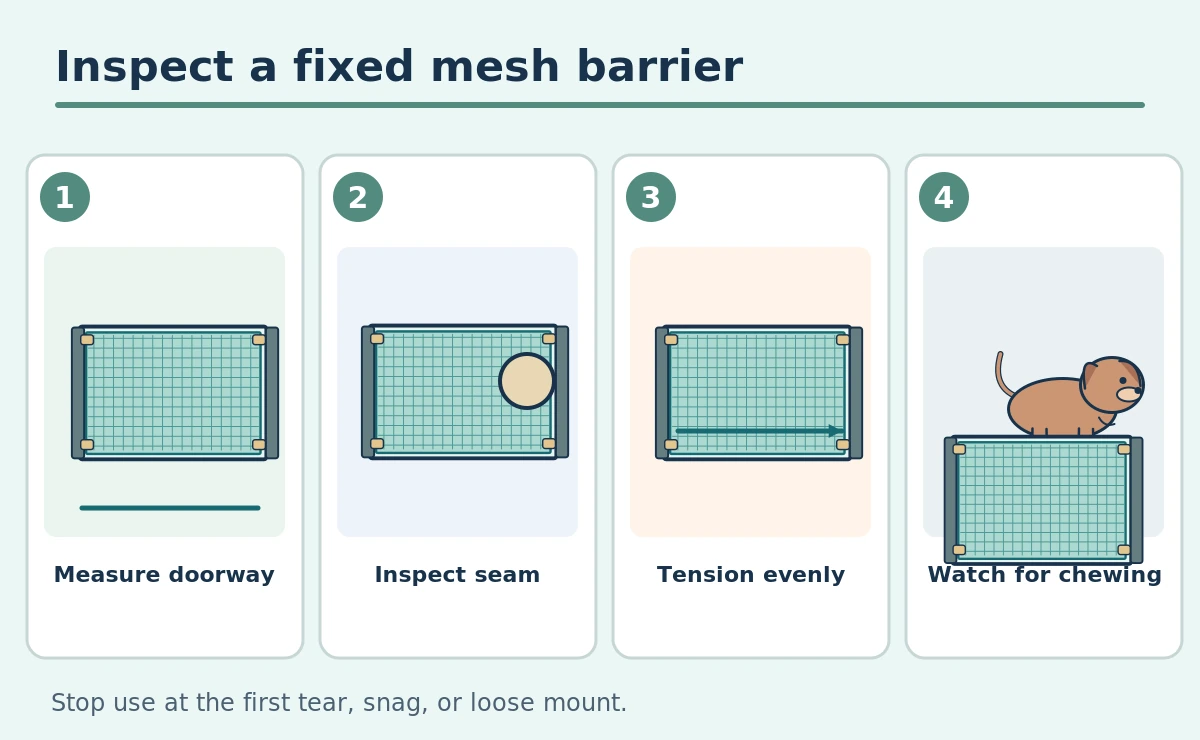
Use a four-step daily inspection
First check that every wall attachment or post sits securely. Second, look for even fabric tension and a closed bottom edge. Third, scan seams and bindings for loose threads or holes. Fourth, observe the dog while the barrier is in use; pawing, biting, or pushing are reasons to stop. Keep the dog on the safe side before opening or removing the panel. If the setup has become a frequent source of stress or escapes, replace it with a more appropriate physical arrangement and get humane training support when needed.
How We Research
We follow the HubPet editorial approach and use verifiable animal-welfare and product-safety guidance, rather than treating marketing phrases as certifications. For this article we compared the sources below, then organized the most practical inspection points for a real household. The drawings are original explanatory illustrations, not tests of a particular brand. Gate design and installation vary by model, so follow the manufacturer’s exact limits, approved hardware and cleaning directions. No household barrier guarantees containment, and signs of serious distress or destructive escape attempts warrant humane professional help. This is general safety guidance, not veterinary diagnosis. See our veterinary disclaimer.
Sources
Guelph Humane Society: Introducing a New Pet — background on gate construction, setup, containment limits, or animal welfare, as applicable.
CPSC: Gates and Enclosures Business Guidance — background on gate construction, setup, containment limits, or animal welfare, as applicable.
ASPCA: Separation Anxiety — background on gate construction, setup, containment limits, or animal welfare, as applicable.
No. Fixed mesh stays stretched between supports, while retractable designs include moving spool or housing parts.
Do not assume a fabric pet barrier is safe at stair tops. Use an appropriate hardware-mounted safety gate designed for that location.
Remove the gate from use and inspect for loose fibers or parts. Choose a more chew-resistant supervised setup and address the chewing behavior.
Look for sagging, shifting supports, exposed bottom gaps, and uneven edges. Adjust only within the manufacturer’s instructions.
Not automatically. Introductions may need sturdier or double barriers and a retreat route. Follow humane staged introduction guidance for the animals involved.