
Freestanding dog gates appeal to renters and households that need to move a divider between rooms. They often fold, stand on support feet and require no wall drilling. That convenience comes with an important limitation: a dog can move, tip or push an unsecured panel. This guide helps you decide whether a freestanding gate fits a level-floor setting, compare stabilizing features and run a realistic household test. It does not promise containment for dogs that jump or panic. For persistent distress around barriers, seek qualified behavioral advice and review HubPet’s veterinary disclaimer.
Use portable panels only in low-consequence spaces
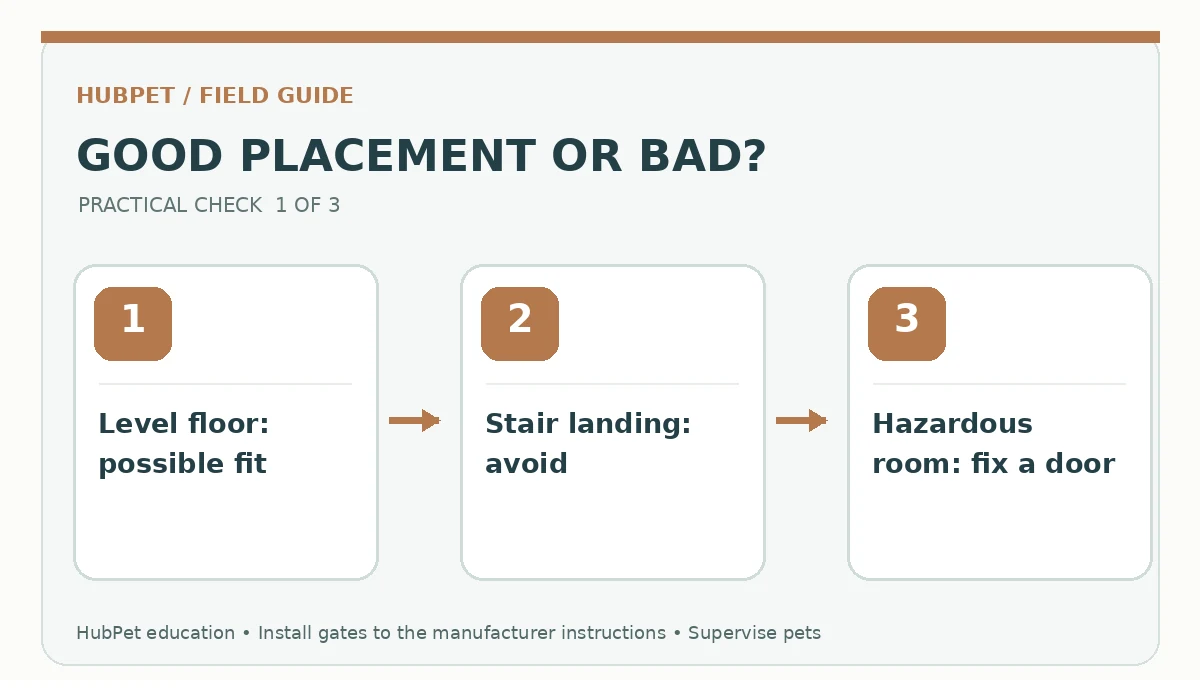
A level hallway, quiet doorway or broad room may suit a movable divider when a calm dog respects boundaries. The same gate should never be trusted at the top of stairs, near an open balcony or beside a hot stove. Ask what happens if the panel moves several inches: can the dog reach medications, children, electrical cords or an exterior door? If the answer involves a serious hazard, select a fixed and appropriate barrier or close a solid door. Freestanding panels manage access; they are not structural fall guards. This single distinction should guide your buying decision before appearance or price.
Choose a footprint that resists tipping
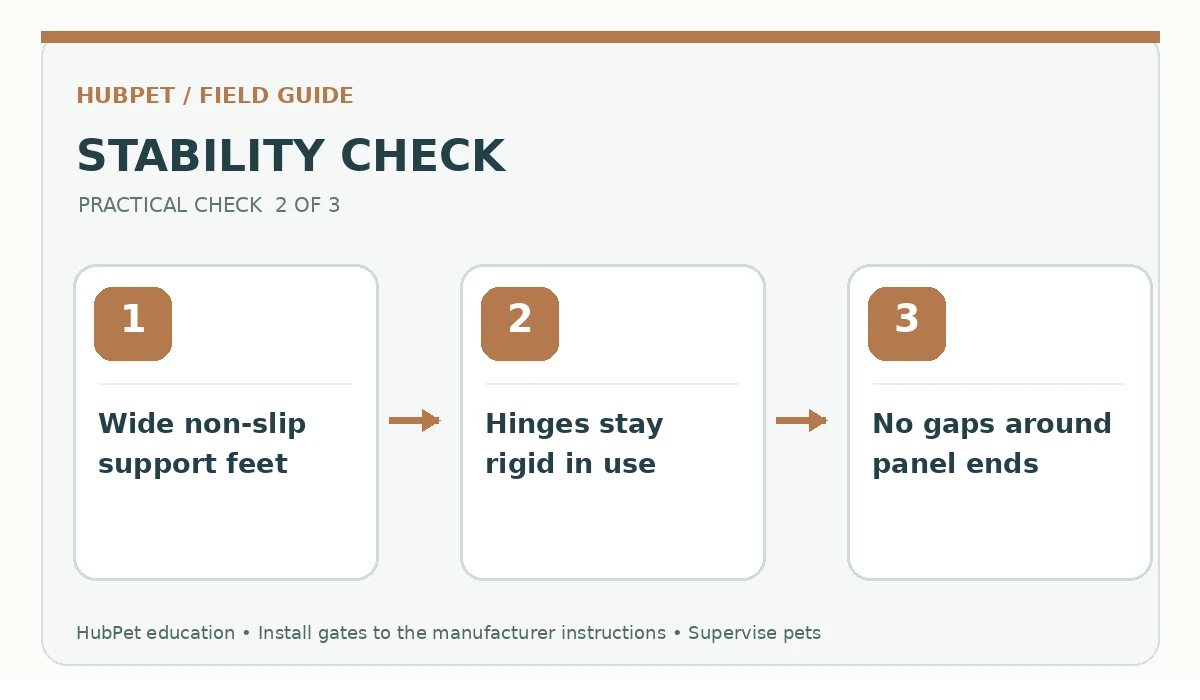
Look at the feet from above and from the side. A narrow base under a tall lightweight panel creates leverage when a dog leans on the top edge. Wider stabilizers, hinged zigzag panels and grippy pads can improve balance, but they cannot replace a wall connection. Compare the direction in which your dog normally approaches the barrier and whether the design can rock on slick floors. Do not attach makeshift weights, which can fall onto paws or create choking hazards if pieces loosen. If the assembled panel rocks under ordinary gentle hand contact, reject that placement.
Measure the real gap, not just the nominal width
Write down the doorway or span and consider baseboards, radiator pipes and protruding trim. Some freestanding gates overlap walls without sealing the edges; a small dog can slip around the last panel. Others require a zigzag shape to stand securely, which reduces their effective straight-line reach. Check the stated width for the actual configuration you will use. Measure the bottom clearance and openings between rails against the smallest pet in the home. Position the gate so a dog cannot climb from a sofa or chair. A good-looking product photo cannot replace measuring the assembled layout.
Compare hinged panels, feet and finish quality
Multiple hinged sections adapt to unusual spaces, but each hinge introduces a point that should remain secure during repeated folding. Inspect for pinching gaps, sharp welds, peeling finishes and rubber pads that can be chewed off. Wood may suit a gentle adult dog yet be a poor fit for an animal that gnaws barriers. Metal can resist chewing better but may be heavy or leave sharp edges if damaged. Smooth exposed edges and reliable hinges matter more than matching the living-room furniture. Choose a panel you can move without dragging it against paws or scratching the floor.
Plan where people walk through the space
A portable divider that blocks the normal walking route can encourage people to step over it. Stepping over while holding a dog, food or laundry raises the chance of a fall. A hinged access opening is useful only if it closes easily and does not make the structure wobble. Mark a regular route that visitors and children can understand. Never set a loose barrier across a required exit. If the divider must be repositioned several times every day, check whether it has a stable repeatable placement rather than gradually creeping into a hazardous area.
Try an introduction before leaving the dog alone
Place the panel in the room with the dog present and reward calm investigation. At first, keep it open or off to one side so the dog does not experience a sudden loss of access. Practice a brief supervised separation while offering a mat, water and an appropriate activity behind it. Note whether the dog simply settles or begins pushing, barking, chewing or pacing. Training progress matters more than a stated product weight rating. If the dog displays escape attempts or significant distress, stop using the portable panel as a containment method and choose a safer environment.
Account for puppies and mixed-size households
Young puppies can fit through openings an adult dog cannot, and many explore gates with their mouths. Inspect hinges and finish for loose parts after chewing. In homes with both a large dog and a small pet, select clearances for the smallest animal while checking stability against the largest. Do not rely on a tall gate to prevent a determined cat from jumping over it. A movable panel may also shift when pets chase one another through a room. Supervised use and a fallback door are prudent during playful or tense periods.
Keep the arrangement maintainable
Inspect the feet every time you reposition the panel, particularly after cleaning floors or moving rugs. Dust can reduce traction and uneven rug piles can make one end stand higher than the other. Hinges may loosen over months of folding. Follow any manufacturer torque or replacement guidance instead of overtightening bolts until the frame bends. Check that the floor material tolerates the pads and that a dog cannot pull the base into a narrow corridor. Store unused panels flat and secure so they cannot tip onto a child or pet.
Decide when a permanent gate is worth it
Choose hardware-mounted or otherwise appropriately secured gates when the dog is strong, repeatedly tests boundaries or the blocked area contains danger. Freestanding designs make sense when access changes often, the floor is level, the dog is calm and failure would not cause injury. Compare total effort over a week: if you must reset the feet repeatedly or chase escaping pets, the portable design is not convenient in practice. A secure door can be the simplest option. No freestanding gate replaces supervision, enrichment and training for a dog that finds separation difficult.

How We Research
Our editorial review compared animal-welfare recommendations with consumer safety guidance for gate placement, mounting, household hazards, cat introductions, and supervision. Each source supports the specific safety context named above; child-safety gate standards are not interchangeable with pet-gate claims. We did not test gate models, certify installation strength, or receive manufacturer endorsements. Always follow the current instructions for a specific gate and seek qualified installation advice if a mounting surface is uncertain. We reviewed these sources on October 27, 2026. Read about our editorial standards on the About HubPet page.
Sources
American Kennel Club: How to choose a dog gate for the home. Accessed October 27, 2026.
ASPCA: Dogs and babies: creating safe access boundaries. Accessed October 27, 2026.
U.S. Consumer Product Safety Commission: Childproofing your home: safety gates. Accessed October 27, 2026.
No. Do not use an unsecured portable panel as a barrier beside a stair drop. Choose a product and mounting system intended for that hazard.
Not reliably. A strong dog may push or tip them; a securely mounted design is more appropriate when containment matters.
Flat, even floors allow more stable positioning. Check the manufacturer’s approved surfaces and verify that grippy feet remain intact.
Possibly. Compare the widest opening and bottom gap with the puppy’s head and body, including as the puppy grows.
Start with a short calm introduction, reward settling and practice supervised separations without forcing a distressed dog to remain behind it.