
This guide offers general training information, not veterinary advice. If your dog suddenly changes behavior, seems painful, or shows severe distress, consult your veterinarian. Read our veterinary disclaimer.
Positive-reinforcement dog training changes behavior by making a useful action worth repeating. A dog sits, checks in, or steps onto a mat; the handler immediately marks that choice and delivers something the dog values. This guide focuses on the mechanics: timing, criteria, reinforcement, and how to recognize when a training plan needs to become easier. For a broader orientation, see our introduction to positive reinforcement.
This is not the same as showing food until a dog complies. A clear reward plan teaches the animal what worked, and it can coexist with sensible boundaries, rest, and management. The American Veterinary Society of Animal Behavior supports reward-based training and discourages methods that rely on fear or pain. You can test the following approach with a low-stakes cue before applying it around distractions.
Start With an Observable Behavior
Pick an action you can describe without guessing the dog’s motives. “Four paws stay on the floor when I approach” is easier to teach than “be respectful.” Choose a quiet place, a reward your dog actually wants, and a very small first criterion. If the dog cannot meet it twice, make the requirement easier rather than saying the cue more loudly.
Create an environment where the desired response can happen. For a sit, wait for a natural weight shift instead of pressing the dog into position. For loose-leash practice, start far from other dogs or traffic. Settle a puppy’s energy with a break before asking for focus. This is management plus teaching, not an expectation of perfect self-control.
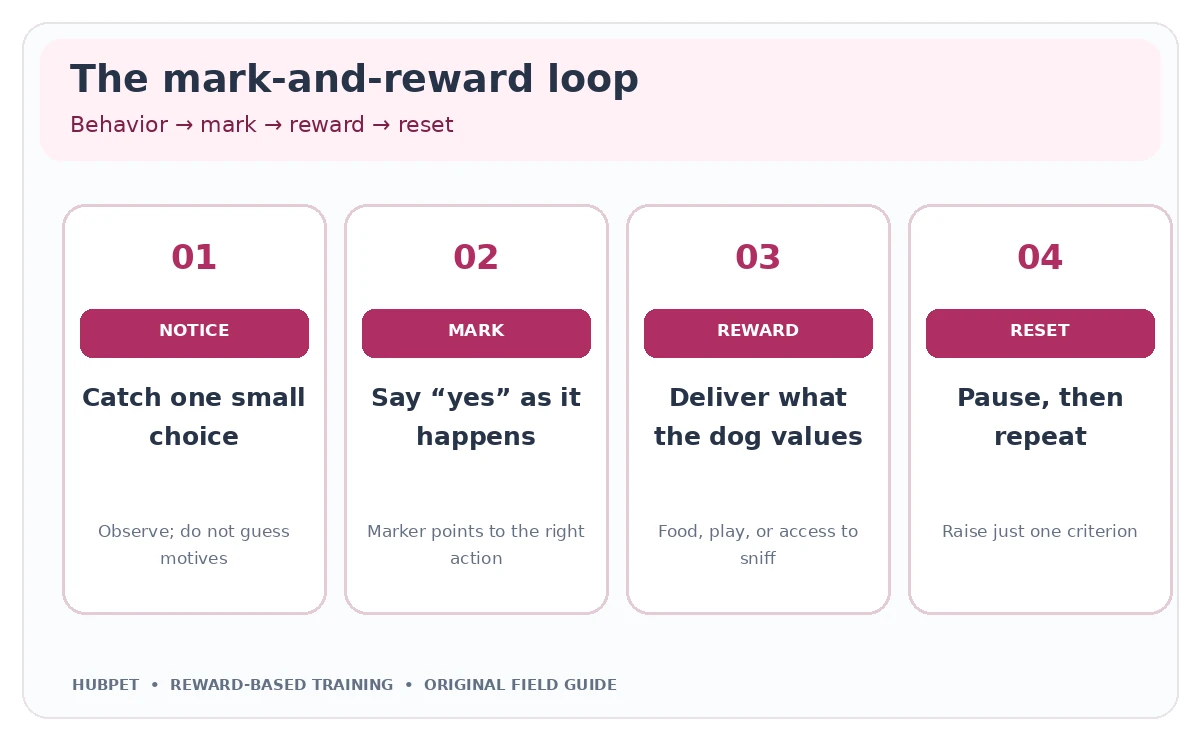
Mark the Moment, Then Pay the Dog
Choose a short marker such as “yes,” or a clicker if the sound is comfortable for your dog. First pair the sound with a small reward so it predicts something good. Then say the marker at the instant the target action happens and follow it with the reward. Keep your treat hand still until after the marker; otherwise movement toward your pocket can become the accidental cue.
When your dog looks back during an easy walk, mark that glance and reward near your leg. Then let the dog sniff or move again. Food is useful, but the reward can also be a toy, a brief game, or permission to explore if that opportunity matters to this dog. Observe the next repetition: if the behavior becomes more likely, the consequence is working as reinforcement.
A Repeatable Four-Step Practice Loop
First, arrange the scene so success is likely. Second, notice one small behavior. Third, mark and promptly reward it. Fourth, pause and repeat, changing only one variable at a time. Three clean repetitions at a simple level teach more than a long string of confused attempts. Our short-session guide explains how to end while the dog still wants to participate.
For a new “go to mat” skill, reward one paw near the mat, then any step onto it, then four paws, and finally a relaxed pause. This is shaping: a sequence of reachable approximations. You can also capture behavior the dog already offers. Neither method requires physically placing the animal in position. If several attempts fail, return to the previous step.
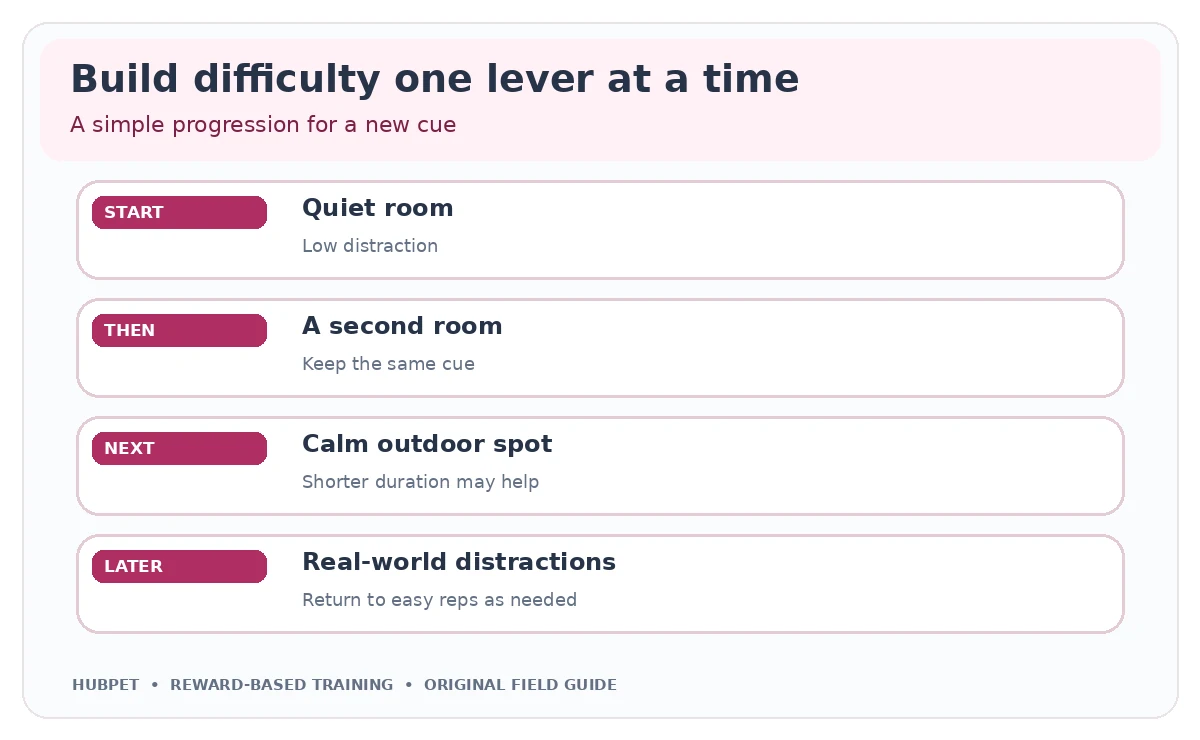
Add a Cue Only When the Action Is Predictable
A cue labels a behavior; it should not become background noise. Wait until the action reliably occurs, say the cue just before it is likely, then mark and reward the response. Do not repeat “sit, sit, sit” when the dog is confused. Move closer, reduce distractions, or return to an easier version instead.
Practice in different rooms before asking for the skill outdoors. Dogs do not automatically transfer learning from a quiet kitchen to a park. Increase distance, duration, or distraction separately. Record the setting and the response, not just whether the dog did the behavior once. That small change makes progress visible without turning every walk into a test.
Troubleshoot Without Punishment
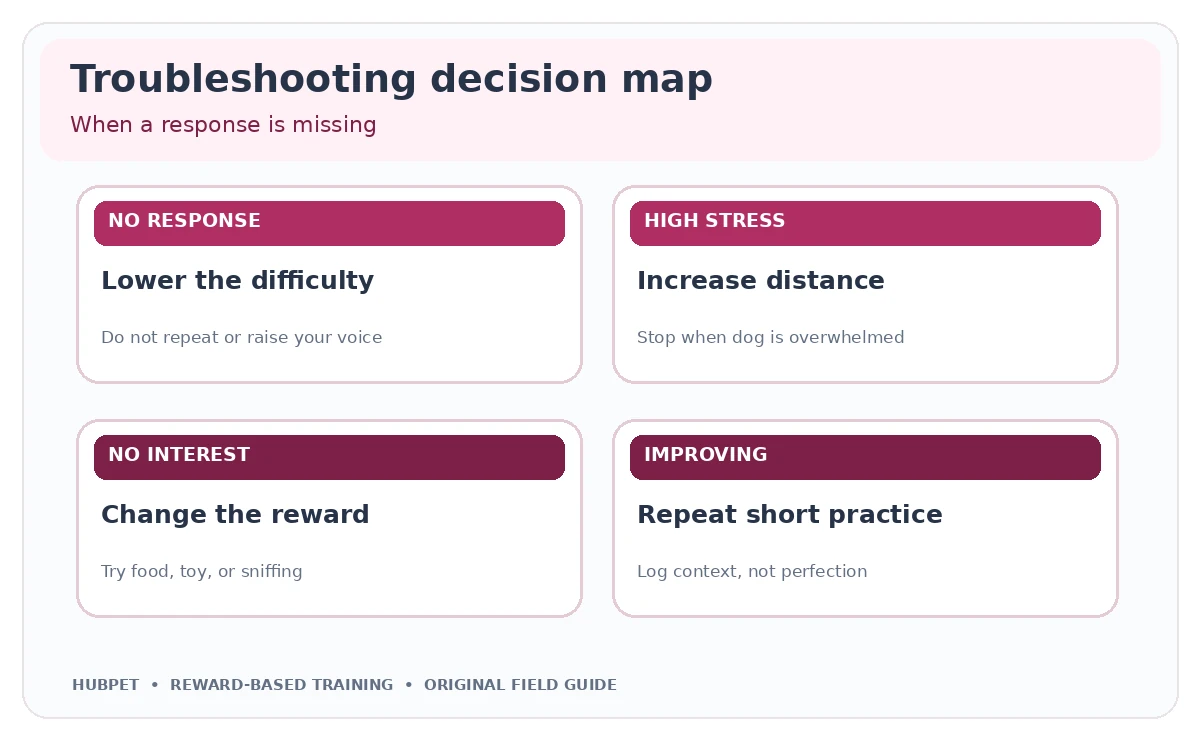
If treats seem ineffective, check whether the dog is hungry, frightened, overstimulated, tired, or more interested in the environment. Use a different reward or change location. If your dog jumps during greetings, arrange enough distance to practice calm approaches, then pay for grounded paws. If a dog growls or freezes, prioritize safety and consult a qualified reward-based professional rather than pushing the exercise.
Avoid trying to overpower a dog or using equipment meant to startle or hurt. A management step such as closing a gate can stop rehearsal of an unwanted behavior while a new skill develops. The common training mistakes guide gives more examples of missed timing and inconsistent criteria. Expect uneven progress; learning is not a straight line.
Check Progress and Decide What Comes Next
Track one week of brief sessions. Write the skill, location, distraction level, reward and approximate success rate. If your dog offers the behavior readily, strengthen it in another familiar setting. If success drops, reduce the difficulty and rebuild. The goal is usable everyday communication, not a dog that performs continuously for food.
You can gradually vary rewards after a response becomes reliable, while still acknowledging difficult choices and new environments. Keep safety-critical responses well practiced and generously reinforced. For fearful or aggressive behavior, a veterinary assessment and an appropriately credentialed behavior professional can provide an individualized plan. Reward-based teaching should make the dog feel safe enough to learn.
How We Research
We reviewed the linked guidance below on October 26, 2026, paying particular attention to humane methods, realistic expectations, and when owners should stop training and seek professional help. We cross-checked practical steps against the HubPet editorial approach. The diagrams are original teaching aids, not records of a clinical trial. Individual dogs vary, and this guide is educational rather than a veterinary diagnosis or a promise of results.
Sources
AVSAB: AVSAB humane dog training position and its 2025 clarification. Reviewed October 26, 2026.
AVSAB: Overview of reward-based training methods. Reviewed October 26, 2026.
FOUR PAWS: Marker signal timing and reward delivery. Reviewed October 26, 2026.
No. A bribe appears before the action to persuade the dog; reinforcement follows the desired behavior and makes it worth repeating. You can use a visible treat at first, then move it out of sight as the cue becomes reliable.
No. A consistent short marker word can work well. A clicker helps some handlers mark a precise instant, but the important pieces are timing, an understandable criterion, and a reward your dog values.
Reduce the difficulty before repeating the cue. Try a quieter location, shorten the distance or duration, and reward a smaller success. Sudden behavioral change or distress deserves veterinary guidance.
Food often helps teach a new skill. With practice, you can use other valued consequences and vary rewards for established behaviors, while generously reinforcing harder situations and safety cues.
They can form part of a behavior plan, but safety and distance come first. Do not force exposure or punish warning signs. Ask a veterinarian or qualified reward-based behavior professional for an individualized approach.