
This article is general information, not veterinary advice. If your pet seems unwell, is in pain or may have eaten something harmful, contact your vet or an animal poison control line right away. Read our vet disclaimer.
Apartment living with pets checklist planning starts with needs, not square footage alone. A workable apartment gives pets predictable access to rest, toileting, movement, enrichment, and safe ways to avoid household traffic. The Merck Veterinary Manual husbandry overview, accessed 2026 describes enrichment and housing as core welfare considerations.
Cats also need species-specific resources in a small floor plan. The FelineVMA 2025 indoor-cat position statement emphasizes safe resting places, play, foraging opportunities, toileting resources, and vertical space. Therefore, an apartment living with pets checklist should organize the home around access and choice rather than trying to keep every activity in one room.
Apartment Living with Pets Checklist: Short Answer
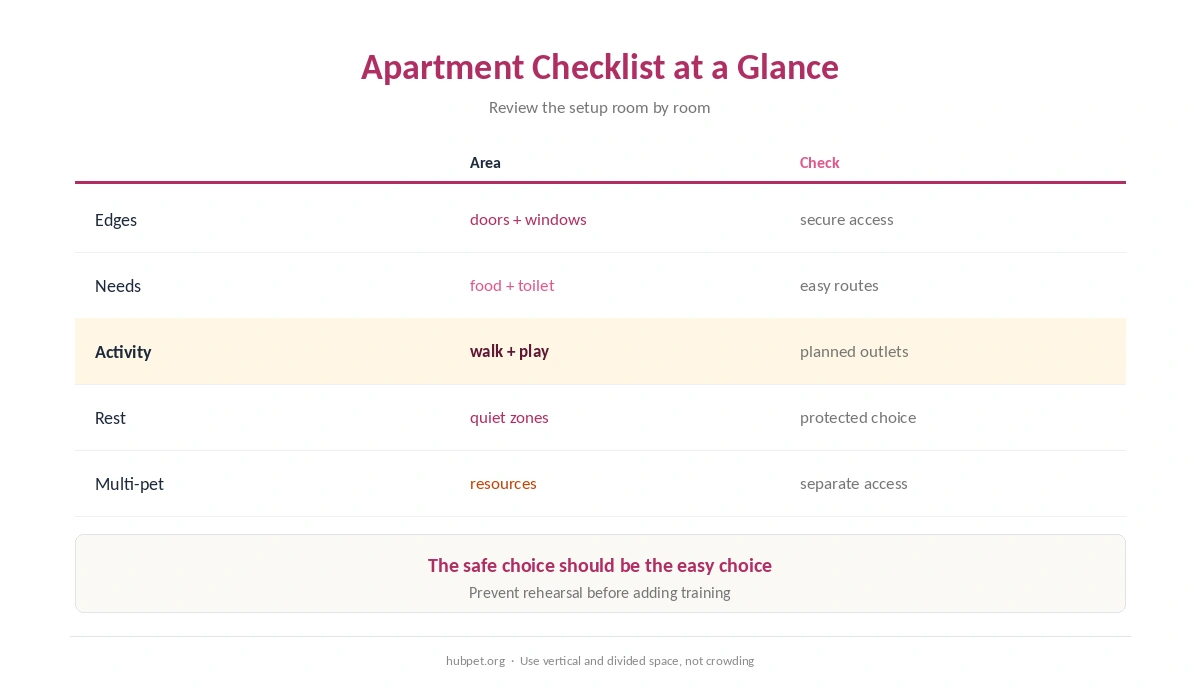
An apartment living with pets checklist should cover five areas: safe boundaries, easy resource access, suitable exercise, enrichment, and a low-conflict rest plan. Start by using the same principles as managing pets in an apartment, then turn them into repeatable checks you can review room by room.
Next, decide where the pet can retreat when the building gets noisy. The calm-space guide and predictable-routine guide can help make an apartment feel more controllable without making the day rigid.
- Check windows, balcony doors, screens, and exterior doors for escape risks before giving unsupervised access.
- Place food, water, toileting areas, and beds where another pet or busy walkway cannot block them.
- Plan daily movement that fits the individual animal instead of relying on indoor pacing for exercise.
- Provide scratching, chewing, sniffing, climbing, foraging, or play outlets that fit the species and pet.
- Protect at least one quiet resting place from visitors, children, and other pets.
- Use mats, storage, gates, or closed doors to reduce clutter and access to unsafe household items.
- Schedule short enrichment choices across the week rather than creating nonstop stimulation.
- Review noise, elevator, hallway, and door routines before a predictable busy period.
- For multi-pet homes, duplicate key resources and protect routes so one animal cannot control access.
- Recheck the setup after a move, schedule change, new pet, or noticeable change in mobility.
Apartment Living with Pets Checklist for Space and Safety
First, secure the edges of the home. Review pet-proofing basics and the more specific balcony and window safety guide before leaving a pet near an open window or exterior door. For cats, safe balcony planning adds another layer when outdoor access is controlled.
Next, use vertical and divided space instead of assuming the answer is a larger room. Cats may benefit from stable climbing and resting options described in safe climbing spaces for cats. Dogs may use a bed, mat, pen, or quiet room as a predictable low-traffic area. The goal is not confinement. Instead, give the pet a place to rest without repeated interruption.
| Apartment need | Useful setup | Watch for |
|---|---|---|
| Rest | More than one undisturbed option | Blocking or repeated interruption |
| Activity | Planned walks, play, or training | Restlessness after needs are met |
| Cat territory | Stable vertical and hiding choices | Crowding around one perch |
| Door safety | Barrier or routine at arrivals | Dashing into hallways |
| Multi-pet access | Separated core resources | One pet guarding routes |
For indoor cats, pair territory with activity. The guides to keeping indoor cats stimulated and creating an enrichment corner give low-space options that can rotate without taking over the room.
Build an Apartment Routine That Pets Can Predict
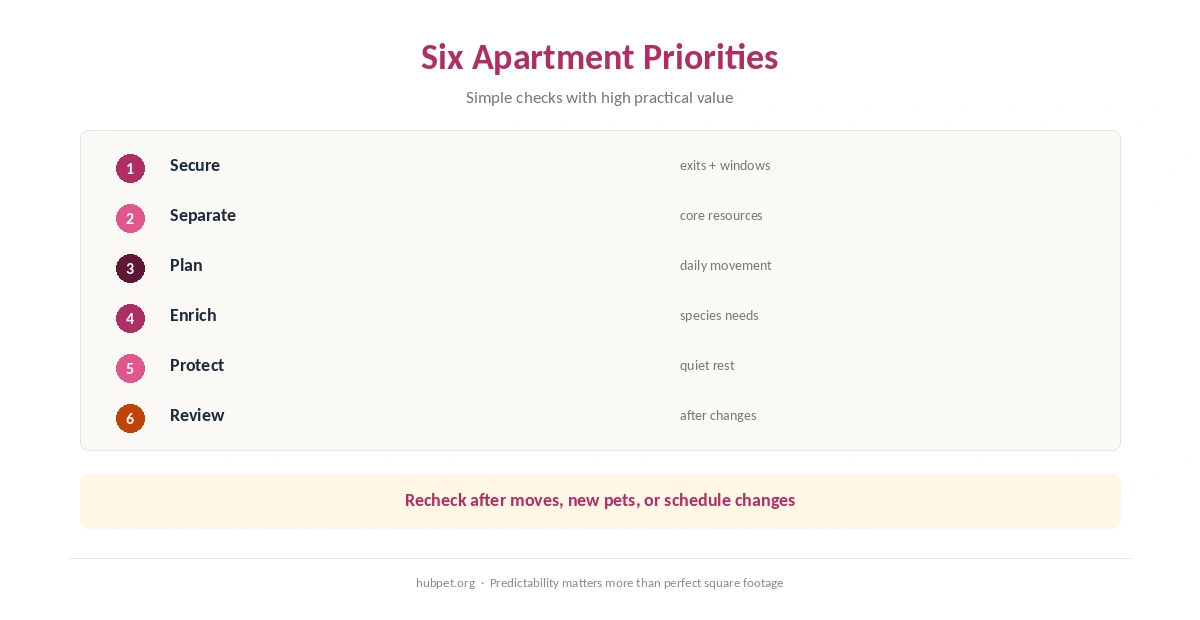
Apartment life includes shared walls, hallway traffic, elevators, and visitors. A pet that repeatedly practices rushing the door or barking at every sound may find the pattern harder to change later. Use doorbell training for dogs, and preserve a retreat for cats that prefer distance.
If you work long hours, front-load only what is practical and leave safe independent options. The long-work-hours guide and weekly enrichment checklist can help distribute activity across the day and week without promising that a single toy will replace social contact or exercise.
For pets that share the apartment, separate important resources before conflict appears. The multi-pet household checklist and multi-pet attention guide both support predictable access and optional group time rather than competition.
When the Apartment Setup Needs More Support
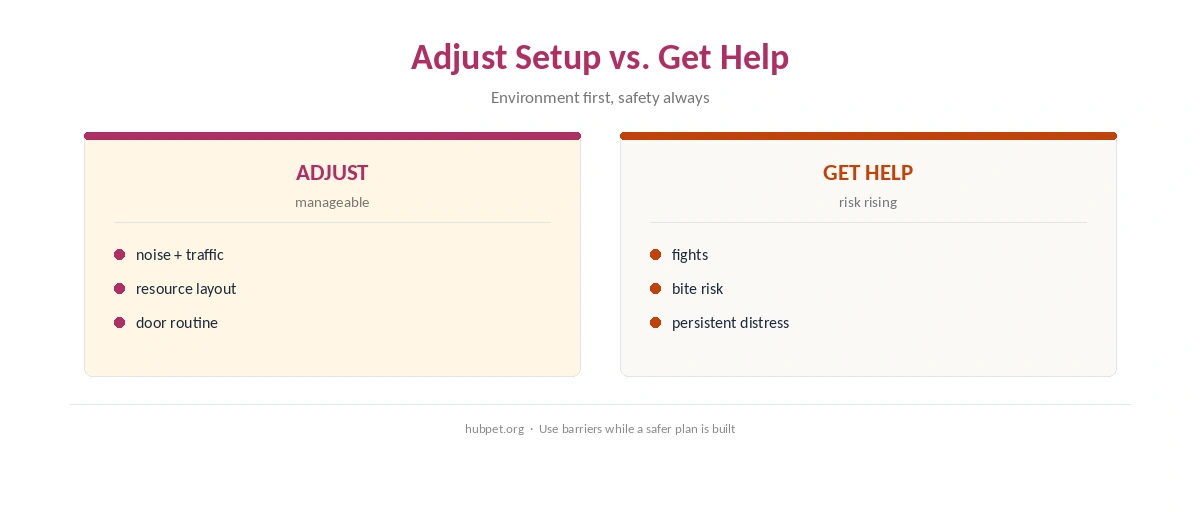
If a dog struggles with building noises, visitors, or outdoor triggers, reduce exposure while teaching an easier response. The distraction-training guide uses reward-based practice and distance instead of correction.
If the household stays tense despite better resources and routines, stop forcing shared space. Revisit introductions, use barriers, and seek qualified help when aggression or bite risk is present. Apartment living with pets checklist work is successful when the environment reduces preventable pressure rather than demanding perfect behavior.
How We Research
HubPet reviewed these sources on October 11, 2026: the FelineVMA 2025 indoor-cat position statement and the Merck Veterinary Manual husbandry overview. Read more about our research process.
Yes, when the home provides safe access to species-appropriate resources, activity, enrichment, rest, and toileting needs.
Not necessarily. Useful enrichment matches the animal and is offered in a way that preserves interest and choice.
Use barriers or distance first, then teach a predictable alternative response with rewards.
Safe places, separated resources, play and foraging opportunities, scratching options, and stable vertical territory all matter.
Separate high-value resources, create multiple routes and rest areas, and use barriers before conflict escalates.
The Bottom Line on an Apartment Living with Pets Checklist
An apartment living with pets checklist works best when it turns limited space into predictable access. Secure exits, separate key resources, plan suitable activity, add species-specific enrichment, and protect rest. Recheck the setup whenever the household or the pet changes.