
This article offers general humane dog-training guidance, not veterinary diagnosis or a guarantee of safety. Use secure, comfortable equipment and follow local leash and traffic rules. If your dog shows pain, sudden behavior change, intense fear, or aggressive responses, consult a veterinarian and an appropriate qualified reward-based behavior professional. Read our veterinary disclaimer.
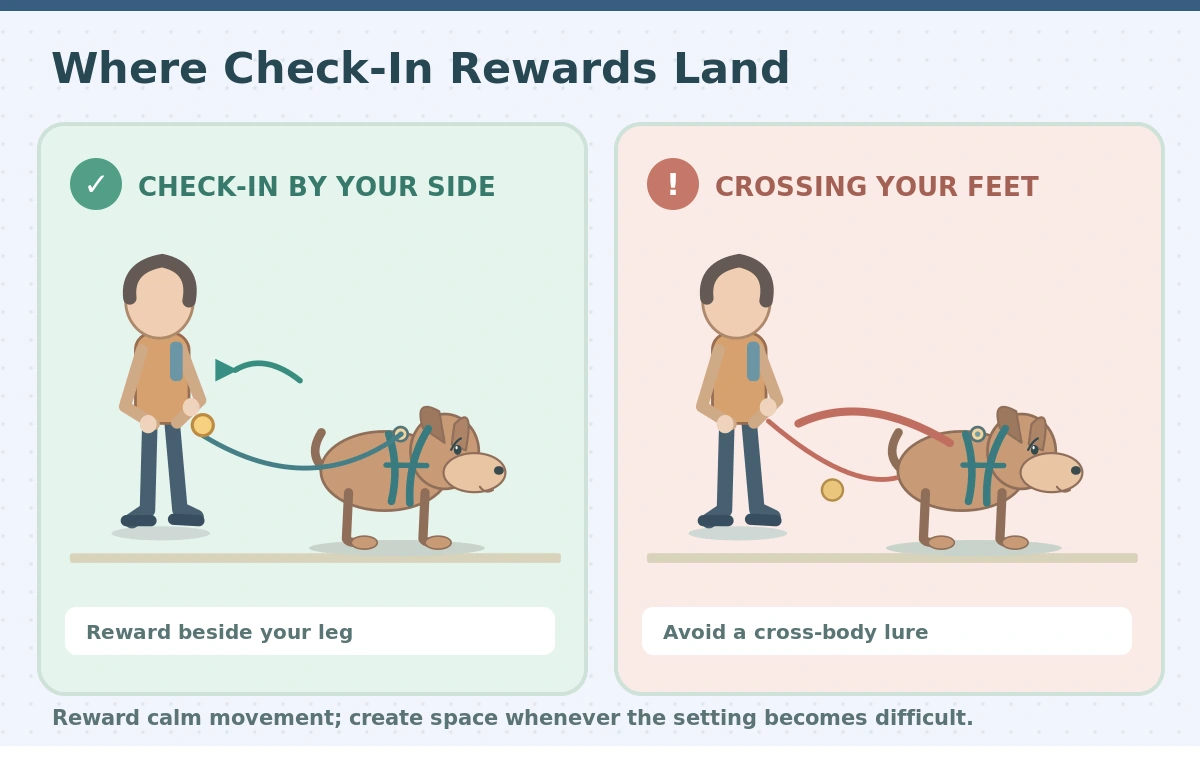
A relaxed walk does not require eye contact every second. Dogs learn about their surroundings by sniffing and scanning, and those natural activities can fit alongside short moments of attention to a person. A check-in is a voluntary glance or turn toward you, often followed by a return to exploring on a loose leash. When you reward those moments clearly, the dog has a reason to stay connected without constant name-calling. The placement of the reward matters because a treat delivered across your body can accidentally teach dangerous weaving.
Define a realistic check-in
Look for a small observable action: the dog briefly turns its head toward you, softens pace to match yours, or glances up after investigating a scent. You are not asking for a formal heel with constant eye contact. Reward the behavior you can actually recognize. If your dog rarely looks up on a busy street, practice first indoors, in a driveway away from traffic, or on a quiet path. Avoid pulling its head toward you or repeating its name. For a fearful dog, an alert glance may signal concern rather than readiness to approach anything new; respect the context.
Choose the walking side and reward zone
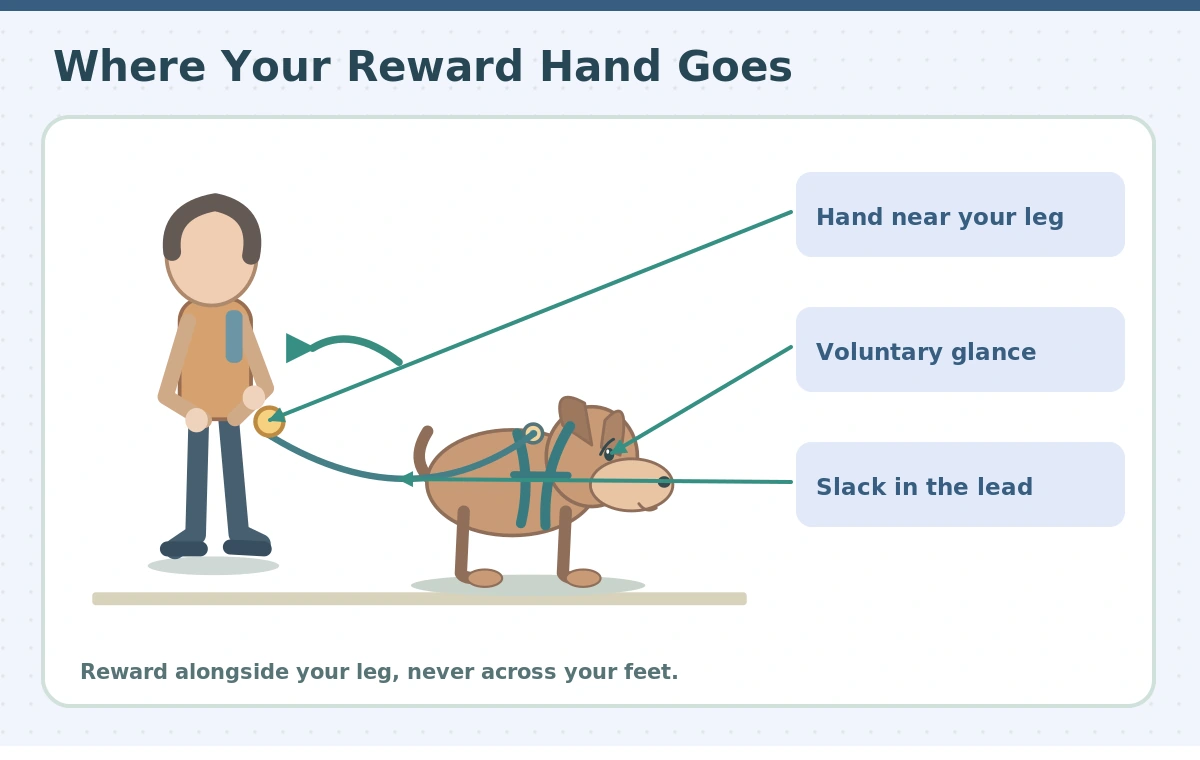
Pick a side where you can safely deliver tiny treats without leaning over the dog. Hold the leash with enough slack for a comfortable body position, then keep the reward near your outer pant seam at the dog’s head height. Do not deliver treats in front of your shoes: the dog may dart across your path. Small treats reduce time spent chewing and leave attention available for walking. For dogs who do not want food outside, begin in a less stimulating place and consider access to sniffing as an additional reward.
Mark the glance before reaching for food
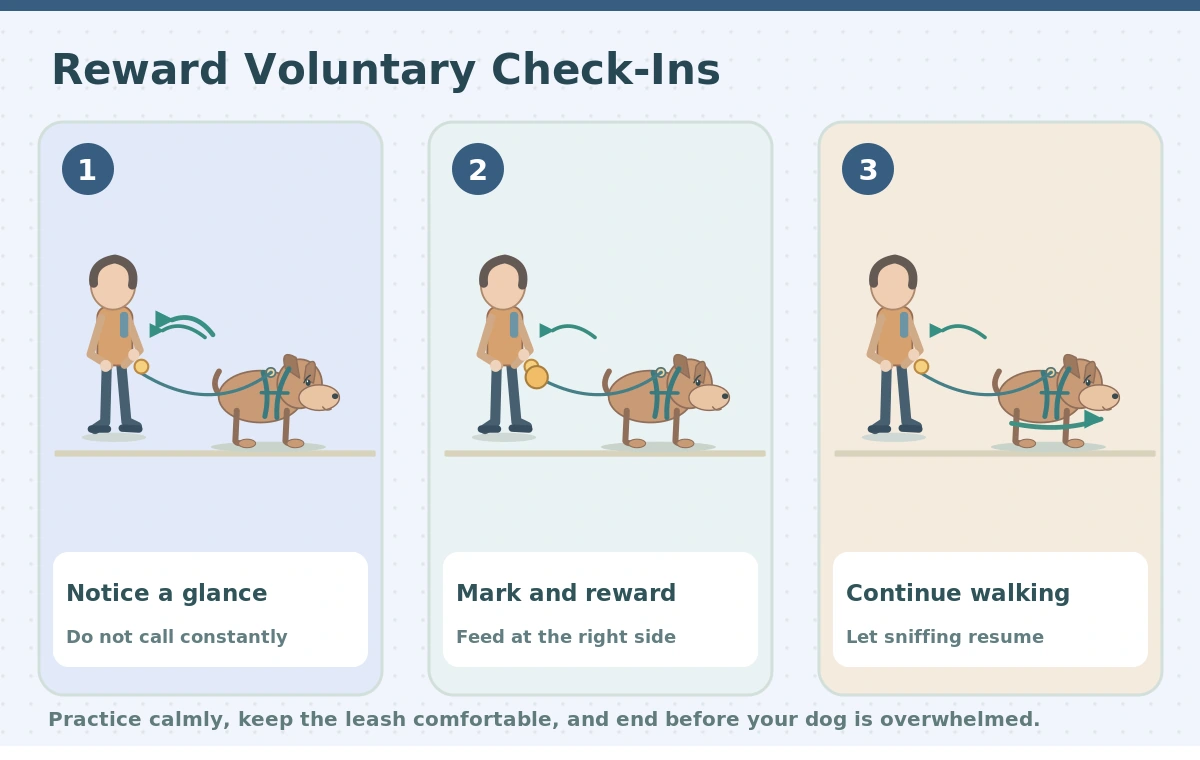
Wait for an unprompted glance. Say a consistent marker such as “Yes” when it happens, then take a treat from the pouch. If your hand goes into the pouch first, the dog may learn to watch that movement rather than offer attention independently. Let it return to normal exploration after receiving the reward. Timing matters more than how loudly you praise. VCA describes promptly reinforcing the behavior you want during leash-walking practice. Begin with frequent rewards, then adjust as the dog understands the pattern.
Keep your hands from teaching zigzags
A dog can learn to cut across your knees when treats always appear on the opposite side. Practice with a short straight path and deliberately deliver each reward beside the leg nearest the dog. Keep the leash free of loops around fingers, wrists, or legs. Walk a few steps at a pace your dog can follow before pausing for another voluntary glance. If the dog switches sides, stop somewhere safe and quietly reset your position. Do not pull it back across your feet while moving.
Use quiet sniff breaks as useful reinforcers
After several calm check-ins, allow the dog to investigate a safe patch of grass or a familiar tree. A brief release cue can make the transition understandable. Your dog does not need to stare at you to earn a whole walk, and exploration supports a more enjoyable outing. If the dog becomes fixated on a hazardous object, move away without using the scent as a lure. Battersea recommends planned sniff breaks alongside relaxed loose-lead practice. Rewarded attention and environmental choice can complement rather than compete with each other.
Add easy motion before adding crowds
Walk a few steps past an uninteresting landmark. Reward one check-in, then continue. Next, make a gentle turn or change pace. Only after this feels comfortable should you try a moderately more interesting route. Keep enough distance from other dogs and people to let your pet respond without barking or lunging. It is not a failure to move to a quieter street. RSPCA guidance emphasizes short, regular loose-lead sessions with praise and rewards; a brief successful walk often teaches more than a long frustrating drill.
Notice when the dog is not able to learn
A dog that stops eating, freezes, pants unusually, hides behind you, or repeatedly lunges may be under stress or discomfort. Do not demand eye contact while its body communicates distress. Create distance from the trigger and give it a chance to settle. Sudden behavioral change may also have a medical explanation, so speak with a veterinarian when appropriate. Reward-based professionals can help develop a plan for fear or reactivity; an article about routine attention is not a treatment for severe distress.
Avoid turning rewards into constant bribery
If you show a treat before every glance, the dog may follow the visible food rather than understand its own choice. Gradually keep your hand neutral until the behavior occurs, then mark and reward. Continue offering enjoyable rewards often enough that the interaction is worth repeating. Change one element per session, such as a few extra steps between rewards. Do not abruptly stop rewarding when the dog has just learned in a quiet environment; new places require more support, not less.
Track the quality of the walk, not a perfect score
Notice whether check-ins become easier, whether the leash remains comfortable, and whether your dog returns to sniffing with a relaxed body. Counting glances can be useful for your own notes but should not become a demand for constant attention. Ask anyone else who walks the dog to use the same reward placement and marker. Practice on manageable routes and stop before fatigue or frustration builds. If your dog enjoys exploring and occasionally reconnects with you, that can be an excellent practical outcome.
How We Research
HubPet reviewed published reward-based leash-walking guidance from Battersea Dogs & Cats Home, RSPCA, Dogs Trust, and VCA Animal Hospitals, then applied it to the specific skill and illustrated setups in this guide. Additional sources are noted below when relevant. We did not observe these dogs, conduct controlled product trials, certify walking equipment, or replace individual veterinary or behavior assessments. Different dogs, environments, and local traffic rules may require a different plan. See About HubPet for our editorial approach. Prioritize relaxed body language, safe distances, and the dog’s voluntary participation.
Sources
Battersea — Teaching a dog to walk on a lead
RSPCA — Teach your dog to walk without pulling
Dogs Trust — Positive reinforcement with rewards
No. A check-in is a short voluntary moment of attention. A relaxed loose-leash walk can include sniffing, scanning, and comfortable movement.
Not necessary. Start by reinforcing spontaneous glances so the dog learns to offer attention without repeated prompting.
Beside the leg on your dog’s walking side, away from your feet. This reduces weaving and crossing in front of the handler.
Try a quieter area, more appealing suitable rewards, or a planned sniff break. Do not force attention near overwhelming distractions.
Reduce how often you reward gradually, but keep reinforcing the behavior, especially on unfamiliar routes with more distractions.