
An anti-hair-wrap vacuum aims to reduce hair winding around its rotating brushroll. It does not make every hair disappear, and it is not automatically the best machine for every shedding pet. Loose fur can collect at the roller ends, around a bearing, in the hose, or inside an upholstery tool even when the central roll looks clean. Start your comparison by inspecting the floor head rather than choosing the largest claim printed on the package. A useful vacuum lifts fur from your surfaces, keeps the air path clear, and makes the parts that still collect hair accessible. Ask what the design prevents, where debris travels, and how you will check it.
Understand the three common approaches
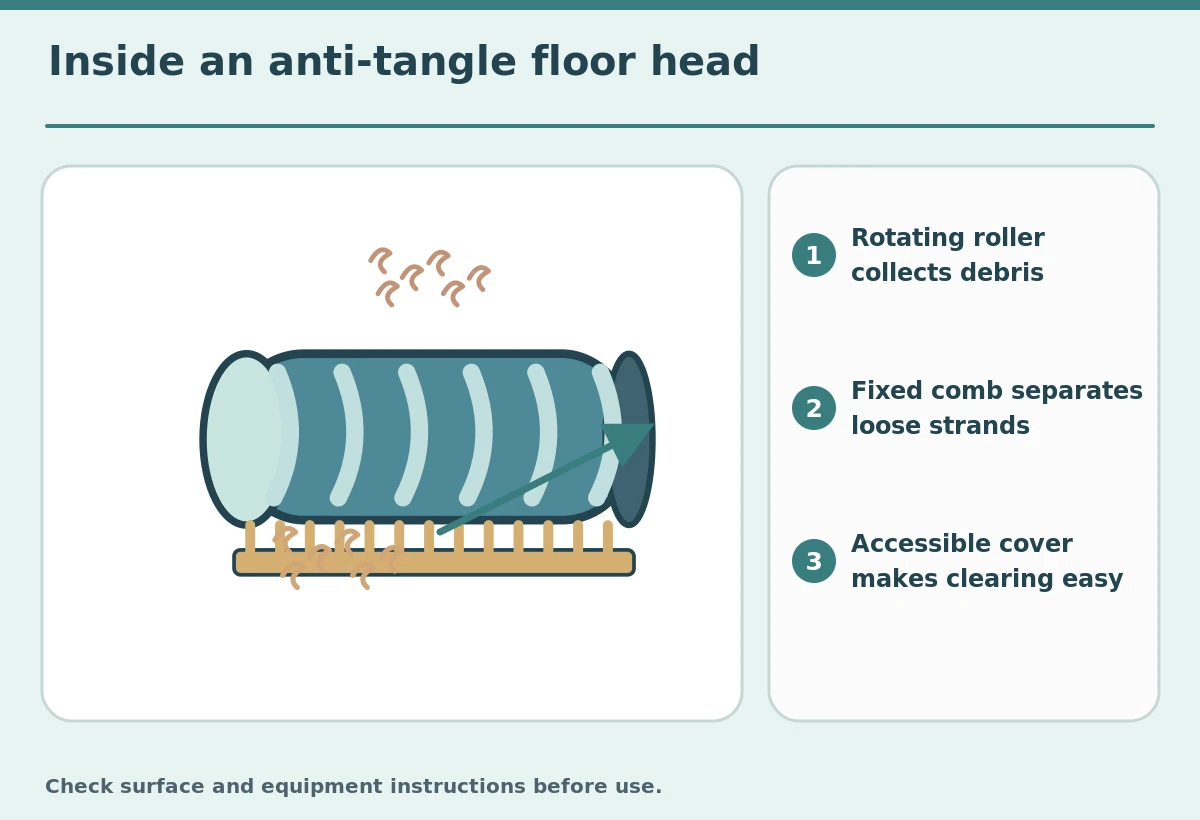
Traditional bristle rolls agitate carpeting effectively, but long strands may wind between bristle rows. Some newer designs use flexible rubber fins or ribs that present fewer snag points; others pair a roller with a fixed comb or scraping edge intended to redirect strands toward suction. A self-cleaning mechanism may reduce winding on the central barrel without eliminating the problem at the sides. Calling a design tangle-free does not earn it a universal guarantee. Look closely at the roller end caps, removable cover, and route into the suction channel. If the seller will not show those components, treat the claim as incomplete.
Match the head to your actual floor surfaces
A thick carpet needs appropriate agitation to release embedded fur, while a sealed wood floor needs a hard-floor setting that will not abrade the finish. Compare a machine on your most difficult rug and your most-used hard surface instead of relying on a single overall rating. Check whether you can turn off a carpet beater or fit a bare-floor tool. Brushroll anti-tangle claims do not excuse running a stiff rotating brush against delicate flooring. For fringed rugs, lifted threads and tassels can wrap even around clever rollers; use a suitable nonrotating attachment near fragile edges.
Inspect the roller ends and access doors
The center of a brushroll is easy to show in advertising. Hair often collects near narrow side gaps and spindle ends instead. Check whether the manufacturer allows you to remove the roller, whether the end caps are serviceable, and whether an ordinary user can open the housing without disturbing wiring. A tool-free release is convenient but should fasten securely during use. Read the instructions before removing any cover and unplug a corded vacuum or disconnect a removable battery first. Do not cut toward soft seals, wires, or the roller surface. Never bypass guards just to make a tangled machine run again.
Separate suction from hair handling
A roller that stays clear may still push pet fur into an undersized dust cup, clogged prefilter, narrow hose, or full bag. Look for a straightforward emptying procedure and accessible washable or replaceable filters as specified by the maker. The EPA recommends routine cleaning of upholstered furniture and carpets and notes that HEPA filtration can help keep some collected dust from escaping a vacuum. That guidance does not mean every product described as HEPA has an equally well-sealed system. Consider leakage paths, filter replacement cost, and whether emptying the bin exposes you to a large dust cloud.
Evaluate upholstery and stair attachments separately
The full-size anti-tangle head rarely fits the corners of a sofa or narrow stair tread. A compact motorized upholstery attachment may use a different roller design entirely. Inspect its end caps and cleaning instructions independently. For delicate woven furniture, a smooth upholstery nozzle may be safer than aggressive bristles. Test a hidden patch and follow the fabric-care guidance, especially around loops or loose piping. When a tool grabs a seam, stop immediately rather than pulling it free under power. A machine that handles hall carpeting beautifully can still be a poor fit for a velvet chair.

Use a simple demonstration before buying
If an in-store demonstration or verified independent test is available, watch how the cleaner picks up real fur rather than a few paper scraps. Review different hair lengths, carpet pile, and whether the test inspects the roller after cleaning. Consumer Reports separates pet-hair removal performance from other cleaning tasks, an important reminder that anti-tangle technology is only one factor. Check the maneuvering effort, replacement part availability, noise level, and how quickly you can clean the head. Online ratings of a floor cleaner may report battery life or shipping satisfaction, not the specific hair-wrap performance you need.
Create a maintenance routine that prevents a surprise clog
At the end of a heavy shedding cleanup, power the vacuum off and look at the exposed edges of the floor head. Empty the dust cup before it reaches the recommended fill limit, clear the inlet if the manufacturer allows it, and check the filters on the schedule provided in the manual. Do not wash an electrical motor head unless the instructions explicitly permit it. Allow approved washable filters to dry completely before reinstalling. If the roller stops spinning, disconnect power, inspect safely, and consult the manual instead of repeatedly restarting a jammed motor.
Know when anti-tangle features are not worth a premium
For a mostly hardwood home with a short-coated dog, a gentle bare-floor head and frequent dry collection may matter more than a specialized motorized carpet brush. For a home with several long-haired animals and thick carpeting, serviceable roller ends and strong carpet pickup may justify spending more. A small handheld tool might be more helpful than replacing a sound primary vacuum solely to clean furniture. Put your most common surface, hair length, cleaning frequency, and maintenance tolerance into a brief list. The right choice is the one that makes those repeat tasks easier without damaging the home.

Make the final choice on evidence and upkeep
Compare the exact attachments included in the box, not an impressive accessory shown in a different configuration. Confirm replacement rollers and filters remain obtainable; note warranty conditions for tangled or damaged heads. Read one independent hair-pickup test, one maintenance manual, and several detailed owner reports. Be wary of promises that the brushroll never needs cleaning. Keep pets clear of moving suction and electrical cords during operation, and secure unplugged cleaning tools between sessions. Anti-hair-wrap is a maintenance aid, not a substitute for regular grooming or responsible floor care.
How We Research
We compared mechanisms that redirect strands with independent pet-hair pickup criteria, and separated roller maintenance from filtration, floor compatibility, and marketing claims. No individual vacuum was laboratory-tested for this guide. HubPet does not replace veterinary evaluation, professional flooring advice, or the manufacturer’s care instructions. See our editorial information.
Sources
Consumer Reports — Best Vacuums for Pet Hair, Tested and Reviewed: Read the source. Accessed October 27, 2026.
US Environmental Protection Agency — Sources of Indoor Particulate Matter: Read the source. Accessed October 27, 2026.
National Wood Flooring Association — Wood Floor Maintenance: Read the source. Accessed October 27, 2026.
Safety note: Follow manufacturer instructions for electrical appliances, chargers, fabric care and floor finishes. When a pet has sudden hair loss, unusual itching, irritated skin, or pain during grooming, consult a veterinarian instead of using stronger equipment. See our veterinary disclaimer.
No. It may reduce winding around the central roller, while hair still collects at end caps, bearings, and accessory heads.
Not on every surface. Compare real pickup on your carpet pile or bare floor along with hair-wrap maintenance.
No. Disconnect power first and follow the manufacturer’s removal procedure; never cut toward seals or wires.
No. Filter quality, fit, seals, and how dust is emptied all affect containment.
Use the flooring and vacuum makers’ approved bare-floor settings or tools; avoid an active beater bar where the finish could be harmed.